


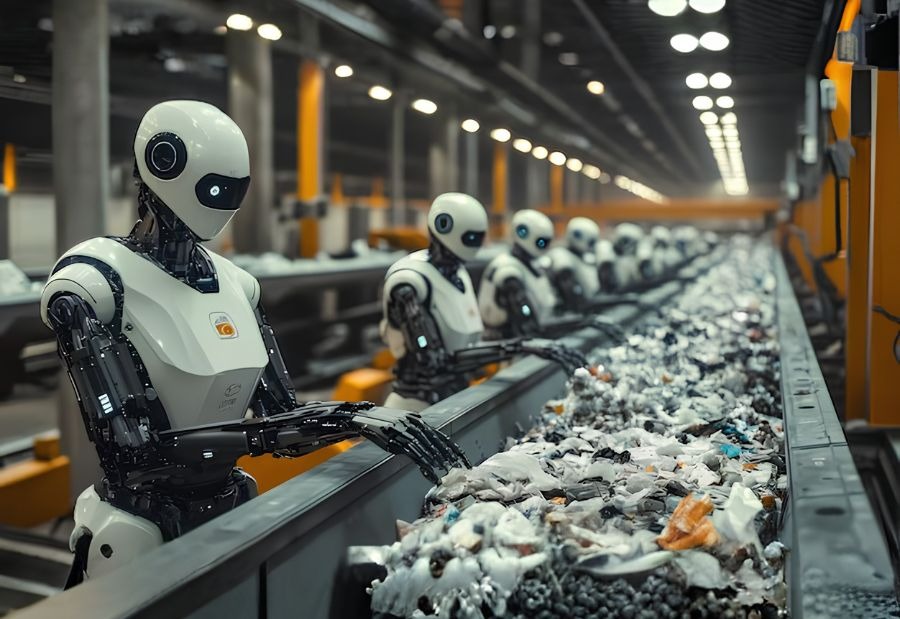
Facing rising labour shortages and difficult working conditions, waste management firms are increasingly turning to robotics to transform operations. At a busy recycling facility in Rainham, East London, owned by Sharp Group, the shift is already underway.
The plant processes up to 280,000 tonnes of mixed recycling annually, with 24 agency workers handling fast-moving conveyor belts. The work environment is demanding, with high noise levels, dust, and safety risks. Industry data shows work-related injury and ill-health rates are 45% higher than other sectors, while staff turnover at the facility stands at 40%.
“The belt is moving all the time, you’re constantly picking. I go through a lot of pickers because they just aren’t up to the job,” said line supervisor Ken Dordoy.
To address these challenges, the company is testing a humanoid robot named Alpha (Automated Litter Processing Humanoid Assistant), developed by RealMan Robotics and adapted by TeknTrash Robotics. The robot is being trained to sort waste using AI and motion tracking.
Unlike traditional automation, Alpha mimics human movement, allowing it to work within existing plant setups. Training involves identifying materials on conveyor belts and learning how to pick them. Workers assist by wearing VR headsets to demonstrate sorting actions, generating large volumes of training data.
TeknTrash CEO Al Costa noted, “The market thinks these robots are prêt-à-porter, that all you need to do is to plug them to the mains and they will work flawlessly. But they need extensive data in order to be effectively useful.”
Other companies are also advancing automation. AMP uses AI-powered systems and air jets to sort materials, with CEO Tim Stuart stating their robots operate 8 to 10 times faster than humans. Meanwhile, Glacier applies AI-driven robotic arms to improve sorting accuracy across facilities.
According to Rebecca Hu-Thrams, handling unpredictable waste remains a challenge, with items ranging from leaking cans to hazardous materials entering the system.
Experts believe automation is becoming essential. Marian Chertow said, “Robotics coupled with AI-driven vision systems offers the greatest potential for improving material recovery, worker experience, and economic competitiveness in the recycling sector.”
While concerns remain about job displacement, companies say roles will evolve. Workers may shift to supervising and maintaining robotic systems, reducing exposure to hazardous conditions.
Also read: Viksit Workforce for a Viksit Bharat
Do Follow: The Mainstream LinkedIn | The Mainstream Facebook | The Mainstream Youtube | The Mainstream Twitter
About us:
The Mainstream is a premier platform delivering the latest updates and informed perspectives across the technology business and cyber landscape. Built on research-driven, thought leadership and original intellectual property, The Mainstream also curates summits & conferences that convene decision makers to explore how technology reshapes industries and leadership. With a growing presence in India and globally across the Middle East, Africa, ASEAN, the USA, the UK and Australia, The Mainstream carries a vision to bring the latest happenings and insights to 8.2 billion people and to place technology at the centre of conversation for leaders navigating the future.