


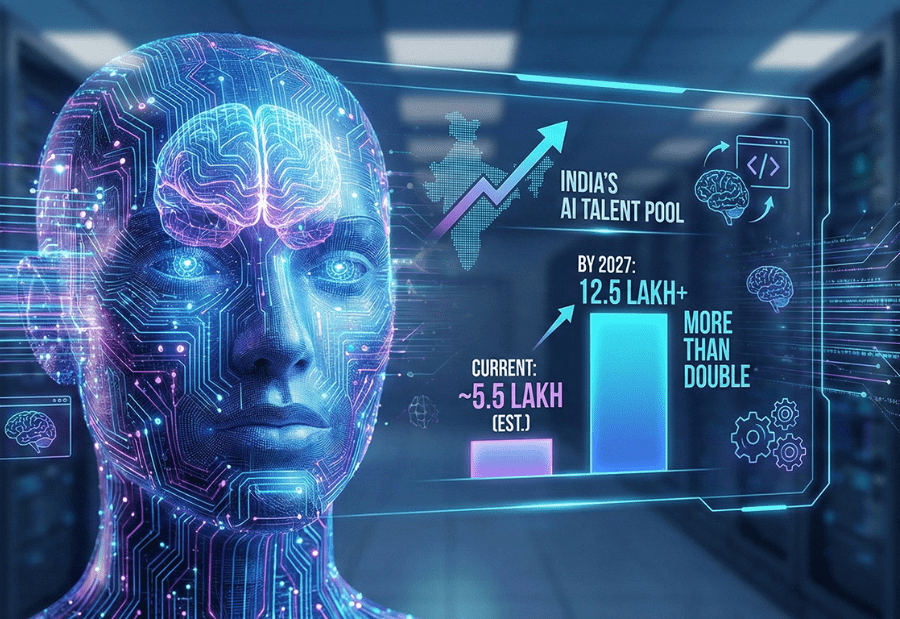
A new study by Stanford University has highlighted India’s strong position in global artificial intelligence research while also revealing a significant challenge in retaining AI talent.
According to the AI Index 2026 report released on April 13 by the Stanford Institute for Human-Centered Artificial Intelligence (HAI), the United States led with 220,520 identified AI authors and inventors in 2025, followed by India at 50,460 and Germany at 48,520. This places India as the second-largest contributor to top AI talent globally.
However, the report also shows a sharp imbalance in talent mobility. The number of AI scholars relocating to the United States has dropped 89% since 2017 and declined 80% in the last year alone. India, meanwhile, recorded the highest net outflow of AI research talent at -16.9 in 2025, reflecting more experts leaving the country than entering it.
The study notes that the United States remains the primary destination for Indian AI professionals, reinforcing a long-standing migration trend. It also highlights that countries like India and Brazil show a more diverse educational mix among AI researchers, with fewer PhD holders compared to developed economies.
A persistent gender gap was observed across all countries, with men dominating AI authorship and invention, although the scale varies by region.
On adoption trends, India continues to show strong AI integration in business environments. Enterprise adoption reached 88% in 2025, up from 77% in 2024. Globally, 58% of employees reported regular AI use at work, while in India and several other countries including China, Nigeria, the UAE, and Saudi Arabia, the figure exceeded 80%.
India also recorded the highest AI skill penetration rate at 3.0, compared to 2.0 in the United States and 1.8 in Germany. However, men in it were found to list AI skills at more than 1.5 times the rate of women, highlighting a continued gender divide.
Despite strong adoption and skills growth, They saw the sharpest rise in AI-related concern, with nervousness increasing by 14 percentage points between 2024 and 2025. Excitement rose only modestly by 2 points.
In terms of investment, It attracted $4.09 billion in private AI funding in 2025, behind the United States ($285 billion), China ($12.41 billion), the United Kingdom ($5.90 billion), France ($4.36 billion), and Canada ($4.28 billion). It also added 108 newly funded AI startups, while the US led with 1,953.
Globally, over 90% of leading AI models were developed by tech companies, though open-source contributions expanded rapidly to 5.6 million projects since 2023. It accounted for 5.2% of GitHub AI projects with at least 10 stars.
Other findings show global AI compute capacity rising 3.3 times annually since 2022, and AI data centres heavily concentrated in the United States with 5,427 facilities.
Also read: Viksit Workforce for a Viksit Bharat
Do Follow: The Mainstream LinkedIn | The Mainstream Facebook | The Mainstream Youtube | The Mainstream Twitter
About us:
The Mainstream is a premier platform delivering the latest updates and informed perspectives across the technology business and cyber landscape. Built on research-driven, thought leadership and original intellectual property, The Mainstream also curates summits & conferences that convene decision makers to explore how technology reshapes industries and leadership. With a growing presence in India and globally across the Middle East, Africa, ASEAN, the USA, the UK and Australia, The Mainstream carries a vision to bring the latest happenings and insights to 8.2 billion people and to place technology at the centre of conversation for leaders navigating the future.