


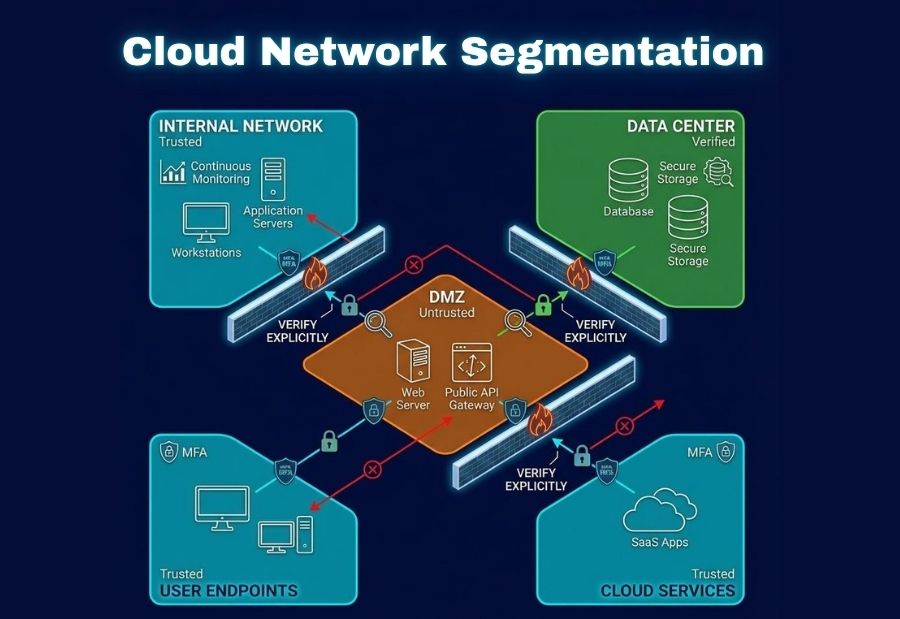
Cloud environments often host applications, databases, development systems and business services that communicate across shared infrastructure. If these resources have unrestricted network access, a compromised workload may create opportunities for attackers to reach other systems. Cloud network segmentation helps reduce this exposure by dividing cloud environments into controlled network zones and restricting communication between them.
For organisations using public, private or hybrid cloud infrastructure, segmentation is an important part of designing a secure network architecture.
What is Cloud Network Segmentation?
Cloud network segmentation is the practice of dividing a cloud network into separate logical sections based on workload, application, security requirements or business function.
Each segment has defined communication rules that determine which systems can exchange traffic. These rules may be implemented through virtual networks, subnets, security groups, network access control lists, firewalls or other cloud-native security services.
For example, a business may separate its public-facing web application, application services and database systems into different network zones. The web layer may communicate with the application layer, while database access is restricted to approved application services.
This reduces unnecessary connectivity and helps limit the potential impact of a compromised resource.
How does Cloud Network Segmentation Work?
1. Divide workloads into logical zones
Identify systems that need different levels of access or protection. Common segments include production, development, testing, management and database environments.
Segmentation can also be based on application boundaries, data sensitivity or regulatory requirements.
2. Define communication policies
Establish which workloads need to communicate and which connections should be blocked.
For example, a database may accept connections only from approved application services rather than from every system in the cloud network.
Policies should specify relevant sources, destinations, protocols and ports.
3. Enforce access controls
Use cloud-native security groups, network firewalls, routing policies and access control lists to enforce the segmentation design.
Where supported, apply workload-level controls to restrict communication even between systems within the same network segment.
4. Monitor network activity
Review network flow logs, firewall events and traffic patterns to identify unexpected communication.
Monitoring helps security teams detect policy violations, unusual connections and potential attempts to move between segments.
Types of Cloud Network Segmentation
| Type | How it works | Common use |
| Network-based segmentation | Separates resources into virtual networks or subnets | Isolating environments and applications |
| Security group-based segmentation | Controls traffic to and from cloud resources | Restricting workload access |
| Microsegmentation | Applies more granular controls between workloads | Protecting critical applications |
| Environment-based segmentation | Separates development, testing and production | Reducing cross-environment exposure |
| Application-based segmentation | Defines access boundaries around application components | Limiting unnecessary service communication |
How Cloud Network Segmentation Limits Security Risks
Reduces lateral movement
If an attacker compromises one workload, segmentation can prevent unrestricted access to other systems. This makes it harder to move across an environment and reach sensitive resources.
Limits unauthorized access
Network policies can restrict connections to approved services and workloads. This reduces the number of systems exposed to unnecessary network traffic.
Protects sensitive data
Databases and systems that process confidential information can be placed behind stricter access boundaries. Only authorised applications and users should be able to reach them.
Supports zero trust security
Segmentation supports zero trust principles by limiting implicit trust based on network location. Access can be restricted according to identity, workload, context and policy.
Improves incident containment
When a workload is compromised, security teams can isolate the affected segment and restrict communication while investigating the incident. This can help limit the spread of an attack.
Best practices for implementing Cloud Network Segmentation
Start by mapping applications, workloads, data flows and communication dependencies. Avoid creating network boundaries without understanding which services need to interact.
Use least-privilege rules and permit only necessary traffic. Review overly broad rules, temporary exceptions and unused network access policies regularly.
Automate policy deployment where possible, but test changes before applying them to production. Incorrect segmentation can interrupt legitimate application communication.
Organisations should also maintain network documentation and monitor policy changes. As workloads move, scale or adopt new services, segmentation rules must be reviewed and updated.
Common Challenges to Consider
Complex cloud environments can make it difficult to identify every workload dependency. Excessively restrictive rules may disrupt applications, while broad policies can weaken the value of segmentation.
Hybrid and multi-cloud environments may also use different security controls, making consistent policy enforcement more challenging.
A phased approach helps. Begin with critical workloads, establish clear ownership and expand segmentation after validating application dependencies and operational impact.
Final Thought
Cloud network segmentation helps organisations reduce unnecessary connectivity, protect sensitive workloads and limit the potential spread of security incidents. Its effectiveness depends on well-defined policies, accurate network visibility and continuous review.
The Mainstream covers cloud infrastructure and cybersecurity practices that help organisations strengthen technology resilience. When combined with identity controls, monitoring and zero trust principles, network segmentation can provide an important layer of cloud security.