


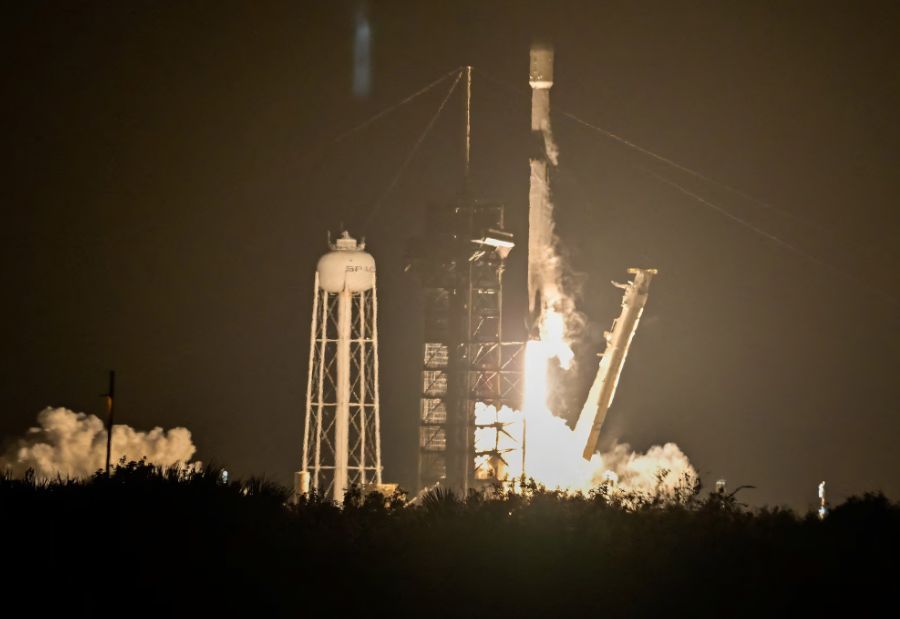
A SpaceX Falcon 9 rocket stage left drifting in space since January 2025 is expected to crash into the Moon in the early hours of Wednesday, creating a high-speed impact that will send lunar dust into space.
The school bus-sized rocket body, which weighs around 4,000 kg, was used to launch Firefly Aerospace’s lunar lander. It is expected to strike the Moon at around 2:35 a.m. ET (0635 GMT) at a speed of nearly 8,690 km/h.
According to SpaceX, the impact is unintentional. The rocket stage is expected to hit Einstein Crater on the Moon’s western limb, an area that is often difficult to observe from Earth. The collision will create a plume of lunar dust that may be illuminated by sunlight but is unlikely to be visible to the naked eye.
Unlike most missions, where the rocket’s second stage re-enters Earth’s atmosphere and burns up or falls into the ocean, this mission required additional thrust to send the payload toward the Moon. As a result, the rocket stage remained in space after exhausting its fuel and could no longer be controlled.
Astronomers only confirmed earlier this year that the rocket stage was on a collision course with the Moon.
“What has happened is essentially a mixture of solar activity and gravity forces have put it on a path toward the moon,” said Julianna Scheiman, SpaceX’s Director of NASA Science and Dragon Programs.
Astronomy software developer Bill Gray said the impact could offer some scientific value but also raises concerns about space debris management.
“This may be of some — probably minor— scientific interest, and we may learn some things from it,” he said.
“It doesn’t present any danger to anyone, though it does highlight a certain carelessness about how leftover space hardware (space junk) is disposed of.”
Moon impacts involving space debris are uncommon. A Chinese rocket stage crashed into the Moon in March 2022, while NASA intentionally crashed a Saturn V rocket stage into the lunar surface during the 1970s to study seismic effects. In 2009, NASA also deliberately crashed a rocket stage to analyse the dust plume created by the impact.
Several lunar landing missions have also ended in crashes, including India’s Chandrayaan-2 and Israel’s Beresheet in 2019, and Russia’s Luna-25 mission in 2023.
NASA and SpaceX are now discussing ways to prevent similar accidental lunar impacts in the future, particularly as NASA prepares for regular astronaut missions and a planned lunar base under its Artemis programme later this decade.
Also read: Viksit Workforce for a Viksit Bharat
Do Follow: The Mainstream LinkedIn | The Mainstream Facebook | The Mainstream Youtube | The Mainstream Twitter
About us:
The Mainstream is a premier platform delivering the latest updates and informed perspectives across the technology business and cyber landscape. Built on research-driven, thought leadership and original intellectual property, The Mainstream also curates summits & conferences that convene decision makers to explore how technology reshapes industries and leadership. With a growing presence in India and globally across the Middle East, Africa, ASEAN, the USA, the UK and Australia, The Mainstream carries a vision to bring the latest happenings and insights to 8.2 billion people and to place technology at the centre of conversation for leaders navigating the future.