


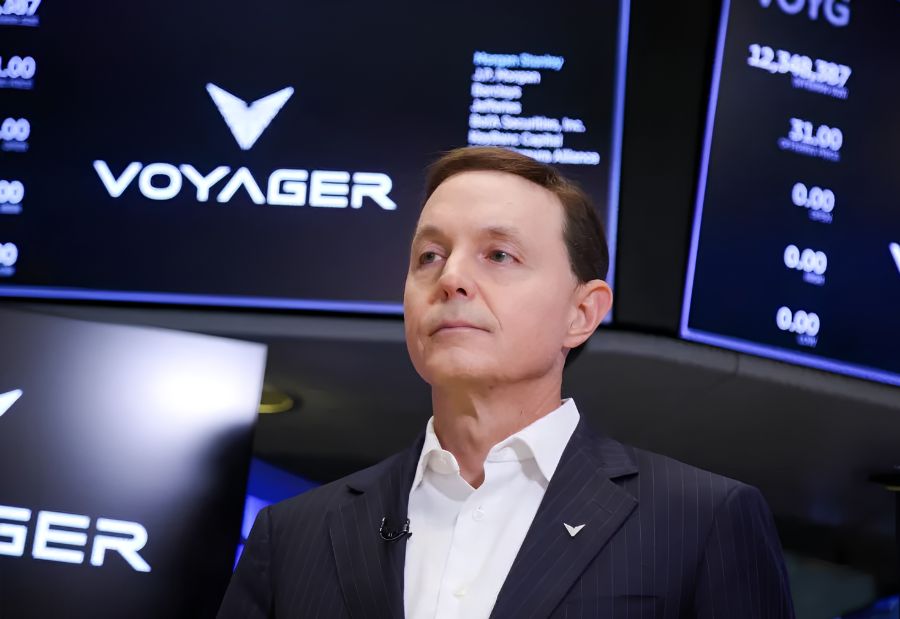
The idea of humans living and working in space, beyond Earth is moving closer to reality, according to Voyager Technologies founder and CEO Dylan Taylor. He believes people could be living and working on the moon in the early 2030s, with some eventually commuting there.
“Humans will definitely be living and working in space,” Taylor said. “The next step would be the Moon. That’ll happen in the 2030s—probably early 2030s. We’ll have a moon base, people living and working on the moon. You’ll be able to look up at the moon and see lights on the moon.”
A small number of people already work in space. The International Space Station has had humans continuously aboard for 26 years. Taylor said the industry is now working to expand space-based work beyond trained astronauts and make it accessible to a wider population.
Future jobs could include resource mining, orbital data centers and power grid construction. Taylor believes humans will still be needed for such work despite advances in humanoid robots. “You’re not going to be able to program Optimus to do everything on the moon. You’re going to have to have humans to figure it out.”
Taylor began investing in space in 2007 as an angel investor in Space Adventures. He later invested in Relativity Space with Mark Cuban. In 2017, he founded Space for Humanity, a nonprofit that aims to purchase seats on commercial space flights for people without typical access. In 2019, he founded Voyager. The company went public on the NYSE last year, reached a $3.8 billion valuation and made Taylor a billionaire at 53. His financial records were reviewed by a media report.
Voyager is building the replacement for the International Space Station and holds multiple NASA contracts. Taylor also flew to space on a 2021 Blue Origin flight, becoming the 606th human to do so.
Mars, however, remains a much bigger challenge because of its distance and radiation. Taylor said the moon does not provide enough diversification from Earth, while Mars could offer that option in the event of a major catastrophe.
He believes a small Mars colony could eventually emerge, driven by people with an appetite for exploration. However, creating a complete civilization or terraforming Mars would take a very long time.
Elon Musk has predicted humans could reach Mars as early as 2028, although his earlier 2016 target of sending humans there by 2024 was not achieved.
Jeff Bezos has predicted that millions of people could live in space by 2045, with robots commuting to the moon for work.
OpenAI CEO Sam Altman has also said that within less than 10 years, college graduates could be working in “some completely new, exciting, super well-paid” jobs in space. He has said he is jealous of young people because early-career jobs from his generation will seem “boring” and “old” by comparison.
Also read: Viksit Workforce for a Viksit Bharat
Do Follow: The Mainstream LinkedIn | The Mainstream Facebook | The Mainstream Youtube | The Mainstream Twitter
About us:
The Mainstream is a premier platform delivering the latest updates and informed perspectives across the technology business and cyber landscape. Built on research-driven, thought leadership and original intellectual property, The Mainstream also curates summits & conferences that convene decision makers to explore how technology reshapes industries and leadership. With a growing presence in India and globally across the Middle East, Africa, ASEAN, the USA, the UK and Australia, The Mainstream carries a vision to bring the latest happenings and insights to 8.2 billion people and to place technology at the centre of conversation for leaders navigating the future.