


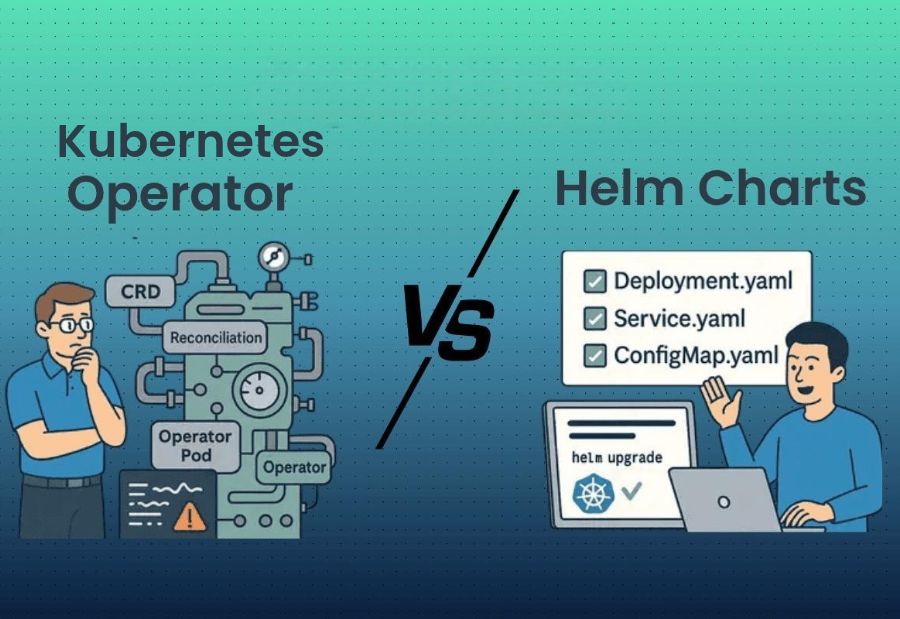
Managing applications in Kubernetes involves more than deploying containers. Teams must configure resources, manage dependencies, handle upgrades and maintain application health. Kubernetes Operators and Helm Charts are two popular tools that simplify these activities, but they work in different ways. Understanding Kubernetes Operators vs Helm Charts helps technology teams choose the right approach for deploying and managing cloud-native applications.
Helm focuses on packaging and installing Kubernetes applications, while Operators use application-specific logic to automate operational tasks throughout an application’s lifecycle. Both can also work together.
What are Kubernetes Operators?
Kubernetes Operators are software extensions that use the Kubernetes API to automate the management of specific applications or services.
An Operator typically includes a custom resource definition (CRD) and a controller. The CRD introduces application-specific resource types, while the controller continuously observes the desired state and takes action to make the actual environment match it.
For example, a database Operator may automate database deployment, configuration, backup scheduling, failover and version upgrades. Instead of requiring administrators to perform every operation manually, the Operator applies predefined operational knowledge.
Key capabilities include:
- Automating application deployment and configuration.
- Managing application upgrades and version changes.
- Monitoring application health and responding to failures.
- Supporting backup, recovery and scaling operations.
- Maintaining the desired application state through reconciliation.
Operators are particularly useful for stateful and complex applications that require ongoing operational management.
What are Helm Charts?
Helm is a package manager for Kubernetes. It uses Helm Charts to define, configure and distribute Kubernetes resources required by an application.
A chart contains templates and configuration values that generate Kubernetes manifests. Teams can install a chart, customise its values and manage releases using Helm commands.
For example, a team deploying a web application can use a Helm Chart to configure its Deployment, Service, Ingress and other required resources without writing each manifest from scratch.
Key capabilities include:
- Packaging Kubernetes resources into reusable charts.
- Managing application installation and upgrades.
- Supporting configurable deployment values.
- Tracking releases and enabling rollback to previous revisions.
- Sharing standardised deployment configurations across environments.
Helm is useful when teams need a consistent and repeatable way to deploy applications across development, testing and production environments.
Kubernetes Operators vs Helm Charts: Key Differences
| Comparison | Kubernetes Operators | Helm Charts |
| Primary purpose | Automates application operations | Packages and deploys Kubernetes resources |
| Main components | CRDs and controllers | Charts, templates and values |
| Automation | Can continuously reconcile application state | Primarily manages installation and release operations |
| Application knowledge | Can include application-specific operational logic | Defines resource configuration |
| Upgrades | Can automate application-aware upgrades | Manages chart and release upgrades |
| Complexity | Higher development and maintenance effort | Generally simpler to create and use |
| Best suited for | Complex applications requiring ongoing management | Repeatable application deployment |
When should teams use Kubernetes Operators?
Operators are suitable when applications require specialised operational tasks beyond basic deployment.
For example, databases, message brokers and distributed platforms may need automated failover, recovery, cluster membership management or application-aware upgrades. An Operator can encode these procedures and execute them through a controller.
However, Operators require maintenance. Teams must review controller behaviour, permissions, supported versions and failure-handling logic.
When should teams use Helm Charts?
Helm Charts are a good choice when the primary requirement is packaging and deploying Kubernetes resources consistently.
They work well for stateless applications, standard services and workloads that do not need complex application-specific automation. Helm also helps teams maintain reusable configurations across multiple environments.
However, Helm does not automatically provide continuous application lifecycle intelligence. A chart can define resources, but it does not inherently understand how to perform specialised database recovery or application-level failover.
Can Kubernetes Operators and Helm charts work together?
Yes. They are complementary tools rather than direct replacements.
A Helm Chart can install an Operator and its required configuration. The Operator can then manage the application resources and lifecycle after installation.
For example, a platform team may use Helm to deploy a database Operator and create the required custom resources. The Operator then manages database clusters, monitors their state and performs supported operational tasks.
This approach combines Helm’s packaging capabilities with the Operator’s ongoing automation.
How to choose the right approach
Start by evaluating application complexity, operational requirements and the level of automation needed.
Choose Helm when repeatable deployment and configuration management are the main priorities. Consider an Operator when an application requires continuous reconciliation and specialised lifecycle operations.
Also assess team expertise, support requirements, security permissions and maintenance costs. The goal should be to reduce operational effort without introducing unnecessary components.
Final Thought
Kubernetes Operators and Helm Charts address different parts of application management. Helm simplifies packaging and deployment, while Operators automate application-specific operations over time. Choosing between them depends on the complexity of the workload and the level of lifecycle management required.
The Mainstream covers cloud-native technologies and infrastructure practices that influence modern IT operations. For many organisations, combining Helm and Operators can provide a practical foundation for consistent deployments and more automated Kubernetes management.