


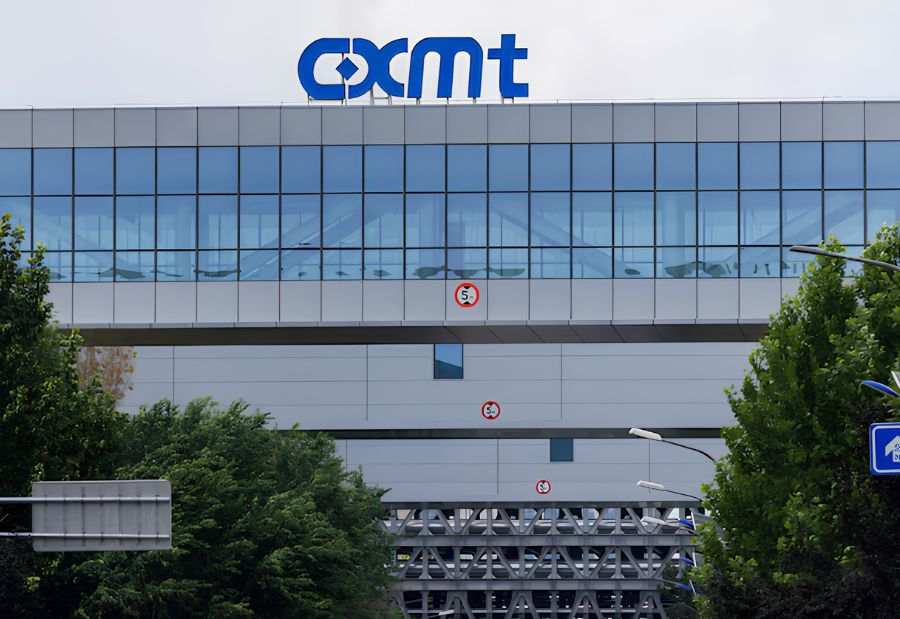
China’s memory-chip maker CXMT has announced that its 5th-generation technology platform has entered mass production, marking a major step in its efforts to strengthen its position in the global DRAM market.
DRAM, or dynamic random-access memory, provides the short-term working memory used by smartphones, computers and other electronic devices to run applications and programs.
CXMT said the new platform is designed to produce higher-performance memory chips while reducing manufacturing costs and power consumption. It also gives electronics manufacturers another source of supply for memory chips used in smartphones and other devices.
The Hefei-based company said the platform places the tiny data-storage structures closer together, allowing more memory to fit onto each chip and increasing the number of chips that can be produced from a single silicon wafer.
CXMT said it has reduced the spacing of key features in the data-storage area to 11.95 nanometres, or about 12 billionths of a metre. The company achieved this using “quadruple patterning”, a manufacturing process that repeats multiple steps to create finer circuit patterns.
“Our process capability is now on par with the most advanced mass-produced nodes out there in the industry,” Luo Xiaodong, CXMT’s vice president and head of its marketing centre, said at the 2026 World Manufacturing Convention in Hefei.
The company also introduced 2 new 24-gigabit LPDDR5X products based on the platform. LPDDR5X is a low-power form of DRAM commonly used in smartphones and portable electronics.
CXMT said the new products can hold 50% more data than its previous equivalent products and are already in mass production. They are available in 2 package formats for different device designs.
The new platform can also produce at least 50% more gross chip dies per wafer than CXMT’s 4th-generation platform, based on an 8-gigabit-chip baseline.
CXMT said the technology was developed using computer simulations and collaboration with Chinese chip-equipment manufacturers on critical production processes.
The development comes as China seeks to reduce dependence on foreign semiconductor technology, while US export controls introduced since 2022 have restricted access to certain advanced chipmaking equipment and related software.
Also read: Viksit Workforce for a Viksit Bharat
Do Follow: The Mainstream LinkedIn | The Mainstream Facebook | The Mainstream Youtube | The Mainstream Twitter
About us:
The Mainstream is a premier platform delivering the latest updates and informed perspectives across the technology business and cyber landscape. Built on research-driven, thought leadership and original intellectual property, The Mainstream also curates summits & conferences that convene decision makers to explore how technology reshapes industries and leadership. With a growing presence in India and globally across the Middle East, Africa, ASEAN, the USA, the UK and Australia, The Mainstream carries a vision to bring the latest happenings and insights to 8.2 billion people and to place technology at the centre of conversation for leaders navigating the future.