


Astronomers have detected radio signals directly coming from an exoplanet for the first time, providing new insights into the magnetic environment of a world beyond our solar system.
The signals were detected from Beta Pictoris b, a massive gas giant located about 64 light-years from Earth. The planet has a mass roughly 10 times that of Jupiter and orbits the star Beta Pictoris.
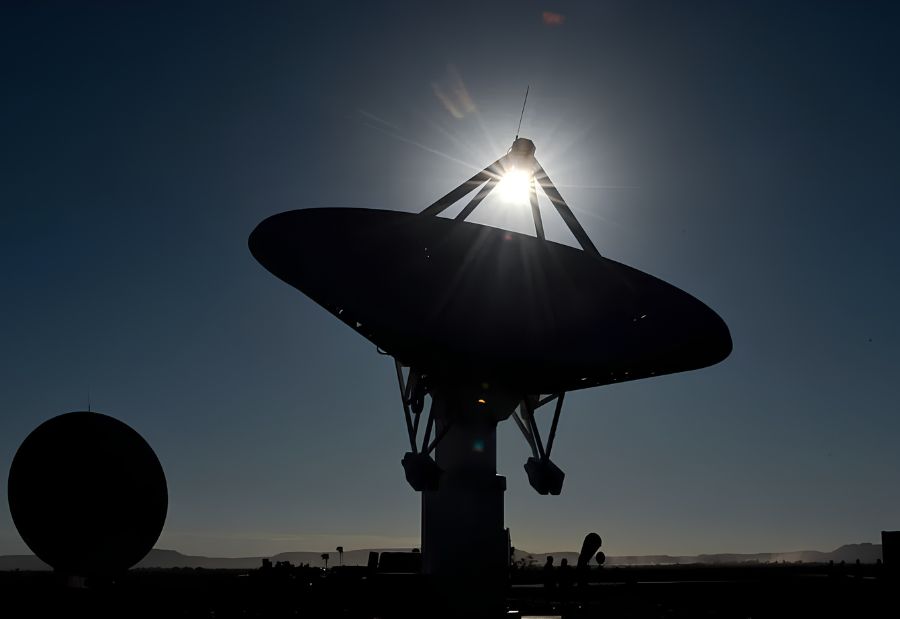
A research team led by Kevin Ortiz Ceballos, a graduate student at the Harvard and Smithsonian Center for Astrophysics, used the MeerKAT radio telescope array in South Africa to observe the planet. The team detected rapid, repeating bursts of radio emission.
Initially, researchers could not determine whether the signals came from Beta Pictoris b or its host star. By comparing radio images of both objects with the positions of distant quasars, which provide fixed reference points, they were able to establish that the emission was coming from the planet.
The study, which has not yet been peer-reviewed, describes the finding as the first unambiguous radio detection localized to an exoplanet rather than its host star.
The signals are not considered evidence of extraterrestrial life. Researchers believe they are most likely produced by auroras, which occur when energetic charged particles from a star interact with a planet’s upper atmosphere. Another natural process that can produce radio emissions is magnetic reconnection between a planet and its host star.
The observations also allowed researchers to estimate Beta Pictoris b’s magnetic-field strength at about 1,250 gauss. That is considerably stronger than Jupiter’s roughly 4.3-gauss field and Earth’s approximately 0.5-gauss field.
Measuring exoplanet magnetic fields could help scientists understand how planetary magnetospheres form and how strong they can become. Strong magnetic fields can also protect planetary atmospheres from charged particles and high-energy radiation from their host stars.
Beta Pictoris b is not expected to support life because of its size and thick atmosphere. However, researchers say similar observations of smaller planets could eventually help scientists assess how magnetic fields influence atmospheric retention and potential habitability.
MeerKAT is also serving as a pathfinder for the Square Kilometre Array, a much larger radio observatory expected to become operational in the coming years. Its greater sensitivity could allow astronomers to study radio emissions from many more planetary systems.
Also read: Viksit Workforce for a Viksit Bharat
Do Follow: The Mainstream LinkedIn | The Mainstream Facebook | The Mainstream Youtube | The Mainstream Twitter
About us:
The Mainstream is a premier platform delivering the latest updates and informed perspectives across the technology business and cyber landscape. Built on research-driven, thought leadership and original intellectual property, The Mainstream also curates summits & conferences that convene decision makers to explore how technology reshapes industries and leadership. With a growing presence in India and globally across the Middle East, Africa, ASEAN, the USA, the UK and Australia, The Mainstream carries a vision to bring the latest happenings and insights to 8.2 billion people and to place technology at the centre of conversation for leaders navigating the future.