


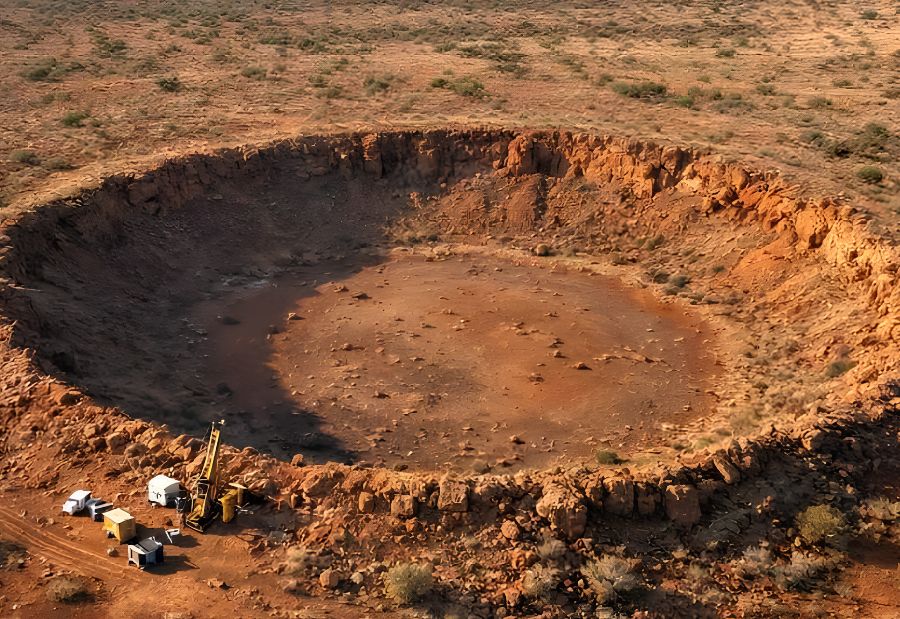
A routine satellite image search in 2007 led to the discovery of a previously unidentified impact structure in Western Australia. Geologist Arthur Hickman of the Geological Survey of Western Australia noticed a near-perfect circle while examining Google Earth images of the outback.
The structure, located in the Pilbara region, measures around 260 metres (850 feet) across and has since been informally named Hickman Crater. It has been described as the latest meteorite crater structure discovered in Australia.
The first detailed analysis was published in the Australian Journal of Earth Sciences in 2008. Researchers Glikson, Hickman and Vickers reported a mean crater diameter of 260 metres and concluded that the structure was more consistent with a meteorite impact than an explosive volcanic event.
They estimated that a projectile around 10 metres wide created a crater roughly 80 metres deep. The structure was initially dated to the Late Pleistocene period, with an estimated age of between 10,000 and 100,000 years.
Further evidence came from a 2012 drilling project conducted by the Geological Survey of Western Australia with Atlas Iron, which was already operating in the area. The findings were detailed in a study titled Collaborative scientific drilling at Hickman Crater by P. W. Haines.
The crater has a circular rim about 260 metres wide that rises approximately 30 metres above its flat floor. The drilling reached a depth of 64.7 metres. The upper 48.4 metres consisted of sediment deposited inside the crater after its formation, while highly fractured rhyolite was found between 55.1 and 64.7 metres, representing the original bedrock.
The key evidence came from the chemistry of the crater material. Ratios of platinum group elements in the breccia were closer to those found in meteorites than in average continental crust, indicating significant meteoritic material. A high concentration of nickel further pointed to an iron meteorite.
According to Haines, iron projectiles are common sources of small, simple craters of this type. Stony meteorites are more common among meteorite falls overall, but objects of this size can break apart in the atmosphere before reaching the ground.
The crater shows relatively little shock damage. Haines suggested that the approximately 10-metre-wide object may have slowed considerably while passing through Earth’s atmosphere. This could have reduced the impact pressure below the level needed to produce diagnostic planar deformation features while still leaving enough energy to excavate the crater.
The drilling project is notable because it appears to be the first scientific drill hole in Australia through a simple crater less than 1 kilometre in diameter, and potentially one of the first examples of its kind elsewhere.
Also read: Viksit Workforce for a Viksit Bharat
Do Follow: The Mainstream LinkedIn | The Mainstream Facebook | The Mainstream Youtube | The Mainstream Twitter
About us:
The Mainstream is a premier platform delivering the latest updates and informed perspectives across the technology business and cyber landscape. Built on research-driven, thought leadership and original intellectual property, The Mainstream also curates summits & conferences that convene decision makers to explore how technology reshapes industries and leadership. With a growing presence in India and globally across the Middle East, Africa, ASEAN, the USA, the UK and Australia, The Mainstream carries a vision to bring the latest happenings and insights to 8.2 billion people and to place technology at the centre of conversation for leaders navigating the future.