


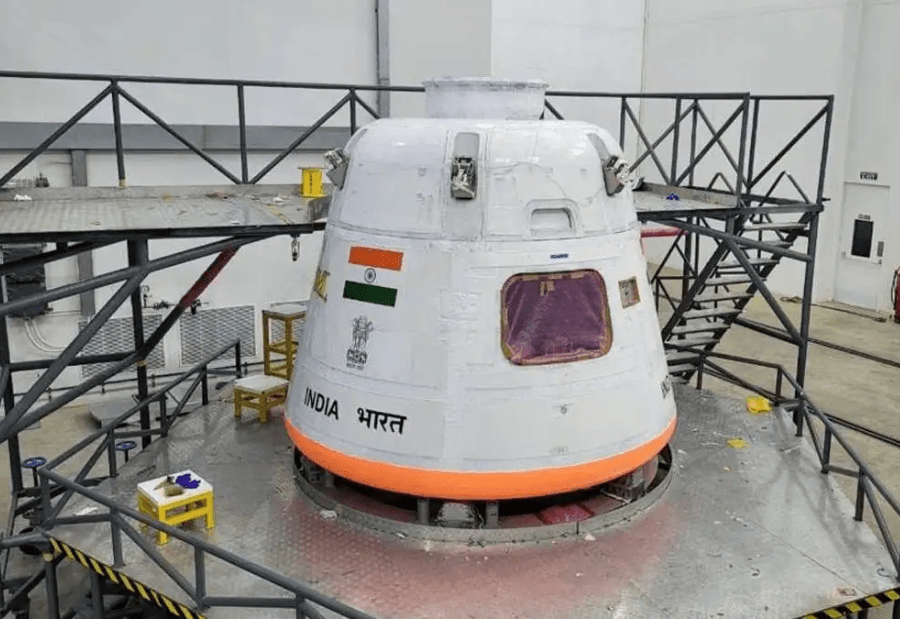
As global momentum builds around human spaceflight, India’s flagship programme, Gaganyaan, is facing growing uncertainty over its 2027 crewed launch target. While Indian Space Research Organisation (ISRO) remains optimistic, current progress suggests significant challenges ahead.
The core issue lies in the absence of 2 critical uncrewed test missions, which are essential before any human flight. These missions are meant to validate crew safety systems, life support, avionics, and overall mission readiness. As of April 2026, neither test has been conducted, tightening an already ambitious timeline.
The situation is further complicated by a slowdown in launches at Sriharikota. ISRO had planned 18 launches for 2026 but has completed only 1 so far, and that mission failed. Two recent failures involving the Polar Satellite Launch Vehicle (PSLV) have triggered investigations, leading to a cautious pause in launch operations.
This delay impacts Gaganyaan directly, as human spaceflight requires near-perfect reliability. Ongoing reviews, system audits, and safety checks have slowed progress but are considered necessary.
Internally, development has also been slower than expected. Key systems such as environmental control, crew safety protocols, and mission integration are still under refinement. The programme, initially impacted by the COVID-19 pandemic in 2020, has made progress, but not at the pace needed for a 2027 launch.
Human infrastructure remains another concern. ISRO is yet to fully establish ground teams, mission control units, and astronaut support systems. A simulation exercise, Mission Mitra, conducted in Ladakh in April 2026, marked an early step in building these capabilities, but it remains preliminary.
India currently has a pool of 4 astronauts, with 3 expected to be selected for the mission. However, long-term plans such as the Bharatiya Antariksh Station by 2035 and a Moon mission by 2040 will require a larger and continuously trained astronaut base.
On the hardware front, the crew module has seen improvements, including inputs from astronauts trained on international missions like the SpaceX Dragon. However, it still requires rigorous testing, including abort scenarios and long-duration simulations. Recent parachute tests are a step forward, but real validation depends on uncrewed missions.
Another growing concern is reduced transparency. Unlike earlier phases, updates from ISRO have become limited, raising questions about timelines and readiness.
In contrast, missions like Artemis II by NASA have demonstrated the value of open communication, sharing both progress and setbacks.
Taken together, the lack of completed test missions, launch delays, slow system readiness, incomplete infrastructure, and limited communication point to a widening gap between ambition and execution.
While India’s human spaceflight goals remain strong, a delay beyond 2027 may be the more realistic and safer path. Human space missions demand precision, patience, and rigorous validation—leaving little room for shortcuts.
Also read: Viksit Workforce for a Viksit Bharat
Do Follow: The Mainstream LinkedIn | The Mainstream Facebook | The Mainstream Youtube | The Mainstream Twitter
About us:
The Mainstream is a premier platform delivering the latest updates and informed perspectives across the technology business and cyber landscape. Built on research-driven, thought leadership and original intellectual property, The Mainstream also curates summits & conferences that convene decision makers to explore how technology reshapes industries and leadership. With a growing presence in India and globally across the Middle East, Africa, ASEAN, the USA, the UK and Australia, The Mainstream carries a vision to bring the latest happenings and insights to 8.2 billion people and to place technology at the centre of conversation for leaders navigating the future.