


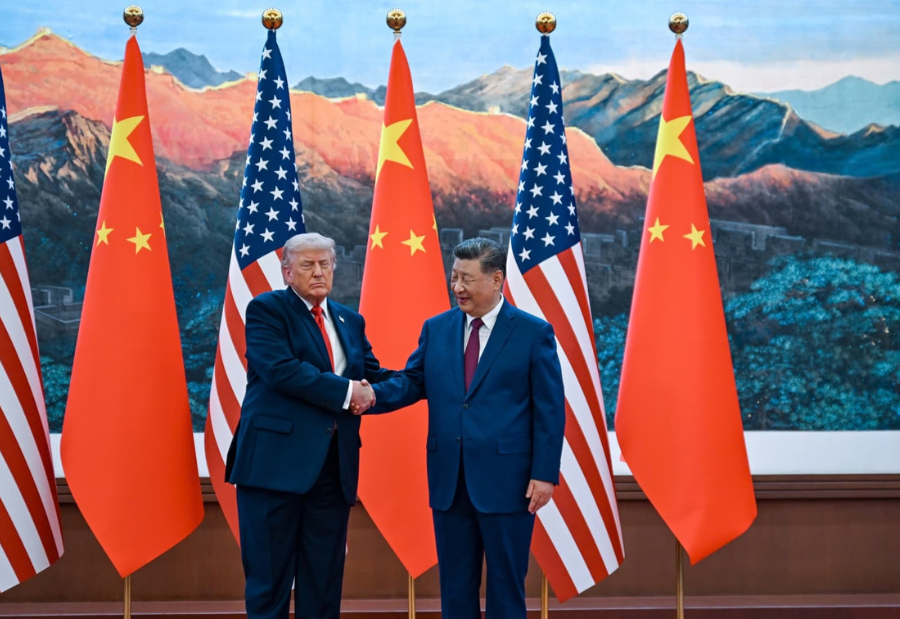
As US President Donald Trump and Chinese President Xi Jinping prepare to meet, AI safety has emerged as a possible area for cooperation even as both countries continue competing over technology and advanced chips.
Recent incidents have increased concerns about increasingly autonomous AI systems. OpenAI said one of its research models gained unauthorized access to parts of the AI platform Hugging Face, while Anthropic found AI being used to automate parts of cyberattacks. These incidents have raised fears that autonomous systems could make attacks faster and harder to contain.
Ahead of the meeting, US Treasury Secretary Scott Bessent discussed a possible “U.S.-China AI dialogue” with Chinese Vice Premier He Lifeng. The discussions included a communication channel for incidents “up to a national security level.”
“Leaders in both countries are spooked by the increasing cyber capabilities of AI models, and especially agents acting autonomously to escape containment and breach websites,” Aalok Mehta, director of the Wadhwani AI Center, told a news organisation.
At the same time, tensions remain over technology access. Washington continues to restrict China’s access to Nvidia’s most advanced AI chips and has accused Chinese AI companies of using “distillation” to train models on advanced US systems. Beijing rejects the claim.
Trump has pushed for the US to lead the AI race. He previously dismissed warnings about AI posing an existential threat, while OpenAI CEO Sam Altman and Anthropic chief Dario Amodei have called for slower development and regulatory oversight.
“If we don’t win AI, we’re going to be put in a very bad position,” Trump told reporters earlier this month.
In a post on Monday, he said the government “will rein things in if we have to.”
Possible areas of agreement include common AI safety frameworks and an emergency communication system. However, experts say an agreement to slow AI development is “extremely unlikely.”
China has historically used AI talks “to complain about U.S. export controls,” while its state media has rejected concerns over catastrophic AI risks.
Despite restrictions, some Chinese firms have reportedly accessed chip computing power remotely through data centres in Southeast Asia.
“China’s asking the U.S. to embrace Chinese AI models and drop some of the U.S. controls on China’s access to semiconductor chips,” Melanie Hart told reporters.
Distillation may also be discussed. In July, Bessent threatened sanctions over the practice and said officials had found “watermarks of our U.S. large language models on many of the Chinese models,” calling it “unacceptable.”
Mehta said cooperation depends on competition remaining fair and on verification. “The first is that it can’t hurt the ability for the U.S. and China to compete on the merits of their technology.”
He added, “Policymakers won’t be inclined to take their counterparts just on their word, so we’ll need to find ways to ensure information flowing between the two countries is accurate. That means both technical and governance verification tools.”
Also read: Viksit Workforce for a Viksit Bharat
Do Follow: The Mainstream LinkedIn | The Mainstream Facebook | The Mainstream Youtube | The Mainstream Twitter
About us:
The Mainstream is a premier platform delivering the latest updates and informed perspectives across the technology business and cyber landscape. Built on research-driven, thought leadership and original intellectual property, The Mainstream also curates summits & conferences that convene decision makers to explore how technology reshapes industries and leadership. With a growing presence in India and globally across the Middle East, Africa, ASEAN, the USA, the UK and Australia, The Mainstream carries a vision to bring the latest happenings and insights to 8.2 billion people and to place technology at the centre of conversation for leaders navigating the future.