


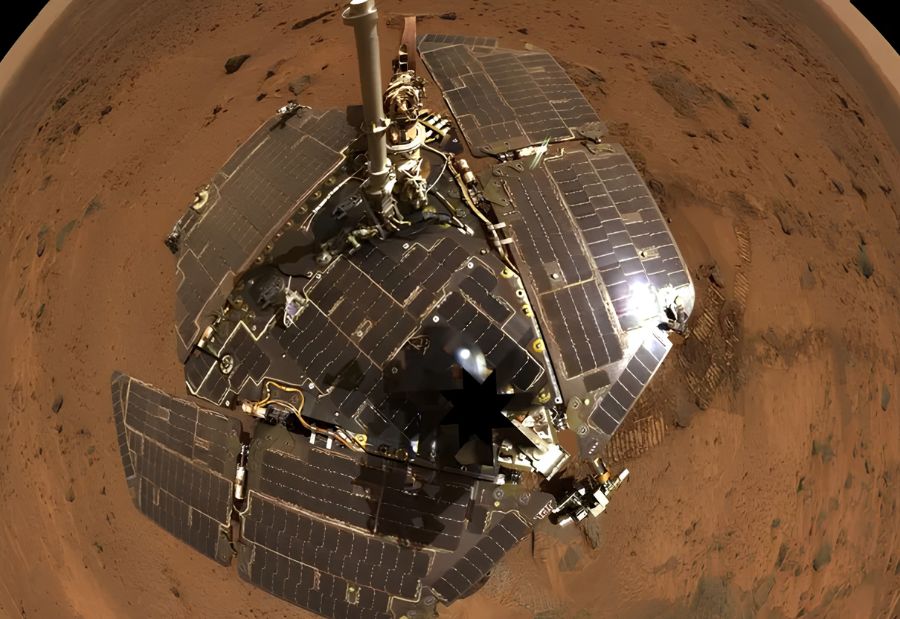
More than 20 years after NASA’s Spirit rover began exploring Mars, scientists have uncovered new evidence suggesting that large parts of the Red Planet may once have been covered by liquid water.
The discovery comes from a fresh analysis of archival rover data collected between 2004 and 2010.
Researchers re-examined Spirit’s measurements and found widespread traces of crystalline hematite and altered magnetite in ordinary Martian soil. These iron-bearing minerals are strong indicators of ancient chemical interactions between water and rock, suggesting liquid water may have been more widespread on Mars than previously believed.
The research team combined hundreds of measurements from 32 undisturbed soil sites inside Gusev Crater, where Spirit landed in January 2004, creating the most detailed iron-mineral profile ever assembled for typical Martian soil.
“One of the most important discoveries was finding crystalline hematite in ordinary Martian soil,” said Paulo de Souza, lead author of the study and a professor at Edith Cowan University (ECU). “This mineral’s widespread presence suggests not only that water was present, but that significant areas of Mars may have once been covered by water.”
Crystalline hematite has long been considered one of the strongest mineral indicators of past water on Mars. Although it can also form through volcanic or hydrothermal activity, it commonly develops when iron-rich rocks interact with liquid water.
Previous studies had concluded that crystalline hematite was largely absent from Spirit’s landing site. However, researchers found that the mineral’s signature was too weak to detect in individual rover readings. By combining thousands of spectra collected throughout the mission, they were able to identify the hidden signal.
The team also detected altered magnetite, indicating that original volcanic minerals had undergone chemical changes over time. Together, these findings strengthen evidence that water played a major role in shaping Mars’ surface and suggest similar water-related processes may have occurred across much of the planet.
The study adds to growing evidence that Mars was once far more habitable. Spirit previously discovered water-altered rocks, Curiosity found signs of ancient lakes in Gale Crater, and Perseverance continues to study an ancient river delta in Jezero Crater for signs of past microbial life.
“This work shows that important discoveries are not always made by collecting new data,” de Souza said. “Sometimes they come from looking at existing data with fresh eyes and better analytical techniques.”
The findings were published on June 26 in the journal Interactions.
Also read: Viksit Workforce for a Viksit Bharat
Do Follow: The Mainstream LinkedIn | The Mainstream Facebook | The Mainstream Youtube | The Mainstream Twitter
About us:
The Mainstream is a premier platform delivering the latest updates and informed perspectives across the technology business and cyber landscape. Built on research-driven, thought leadership and original intellectual property, The Mainstream also curates summits & conferences that convene decision makers to explore how technology reshapes industries and leadership. With a growing presence in India and globally across the Middle East, Africa, ASEAN, the USA, the UK and Australia, The Mainstream carries a vision to bring the latest happenings and insights to 8.2 billion people and to place technology at the centre of conversation for leaders navigating the future.