


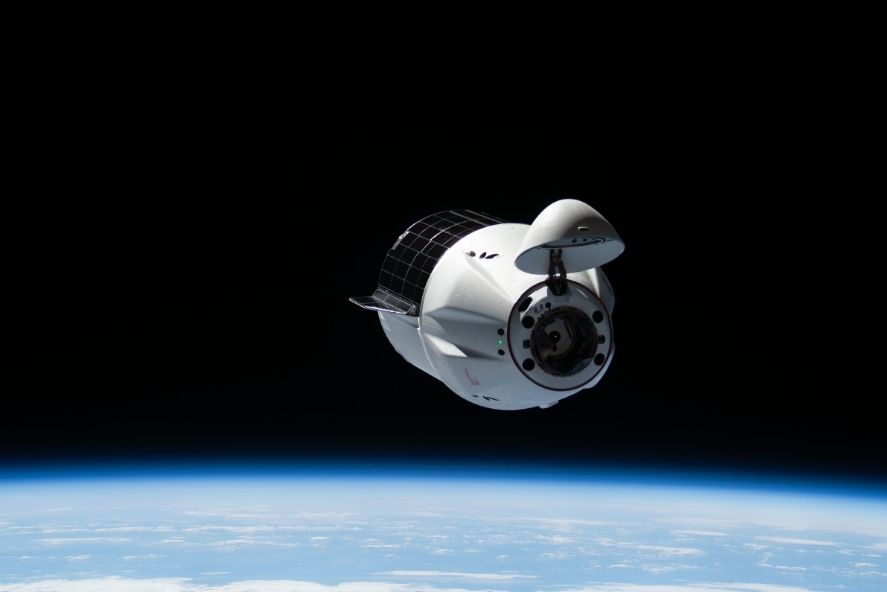
NASA and SpaceX are targeting no earlier than October 13, 2026, for the launch of the 35th Commercial Resupply Services mission to the International Space Station (ISS).
The SpaceX Dragon spacecraft will carry more than 6,300 pounds of supplies, scientific investigations and equipment. It will launch aboard a Falcon 9 rocket from Space Launch Complex 40 at Cape Canaveral Space Force Station in Florida before autonomously docking with the space-facing port of the station’s Harmony module.
The mission will deliver several experiments focused on human health, materials science and space-based manufacturing. Among them is LambdaVision-1, which will examine whether microgravity can help manufacture artificial eye retinas in thinner, more uniform layers. The research could support the development of implants for patients with retinal diseases.
The Stellar Spheroids experiment will study how microgravity affects 3D human heart tissue models and the formation of vascular networks. The findings could contribute to more realistic models for disease research and larger-scale drug testing.
ELF-Unconventional Glass 2 will examine how glass forms in microgravity by studying molten materials in space before returning samples to Earth. Researchers will assess whether the resulting materials could offer improved strength, optical performance and durability for future spacecraft and habitats.
Another investigation, MINDS, will study brain organoids to better understand inflammation associated with neurodegenerative diseases. The experiment uses “organoid villages” containing cells from multiple people to represent patient diversity and explore potential treatment targets for diseases such as Alzheimer’s, Parkinson’s and multiple sclerosis.
NASA astronauts Anil Menon and Jessica Watkins will monitor Dragon’s arrival. The spacecraft is expected to remain at the ISS for about a month before returning to Earth.
The mission will also deliver the final pair of International Space Station Roll-Out Solar Arrays, completing the station’s planned power-system upgrade. Other cargo includes a collapsible contingency urinal for Artemis III, maintenance equipment and hardware supporting the Canadarm2 robotic arm.
A large foam clamshell will return a failed Canadarm2 joint that was replaced during a June 30 spacewalk. Teams will examine the component on Earth for analysis and refurbishment.
Dragon’s return in mid-November will also bring back a spacesuit, components from the station’s urine and water processing systems, and other hardware for ground evaluation.
Also read: Viksit Workforce for a Viksit Bharat
Do Follow: The Mainstream LinkedIn | The Mainstream Facebook | The Mainstream Youtube | The Mainstream Twitter
About us:
The Mainstream is a premier platform delivering the latest updates and informed perspectives across the technology business and cyber landscape. Built on research-driven, thought leadership and original intellectual property, The Mainstream also curates summits & conferences that convene decision makers to explore how technology reshapes industries and leadership. With a growing presence in India and globally across the Middle East, Africa, ASEAN, the USA, the UK and Australia, The Mainstream carries a vision to bring the latest happenings and insights to 8.2 billion people and to place technology at the centre of conversation for leaders navigating the future.