


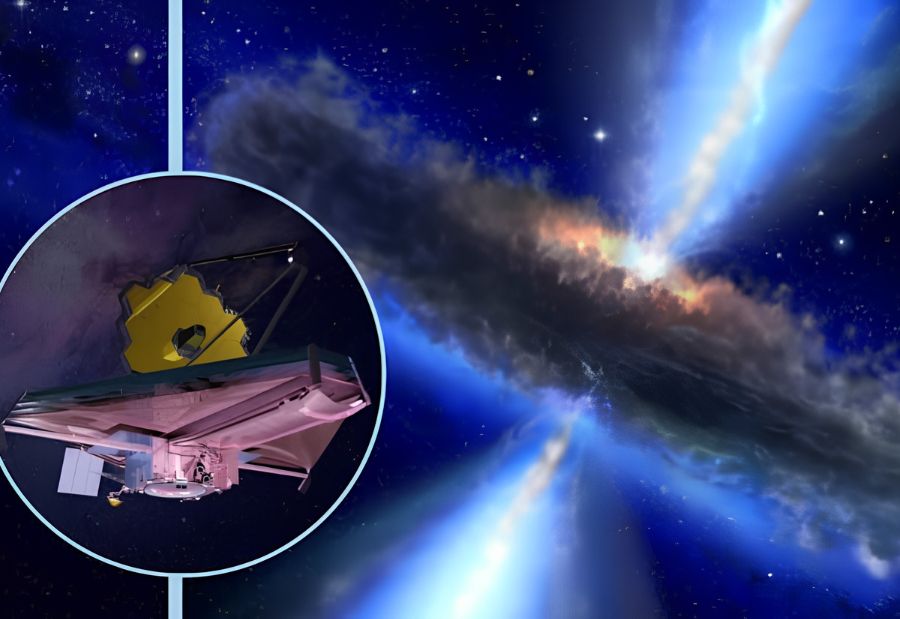
Astronomers have gained a deeper look into the distant regions of the solar system, where tiny objects appear to be preserving clues about their origins despite a history of collisions and orbital changes.
The James Webb Space Telescope (JWST) and Hubble Space Telescope have jointly identified 27 new Trans-Neptunian Objects (TNOs) beyond Neptune. Each object is smaller than 25 miles (40 kilometers) across, with the smallest measuring just 6 miles (10 kilometers) in diameter.
Some TNOs formed in the Kuiper Belt during the early solar system as planetesimals that never grew into planets. Models had suggested that repeated impacts would have altered the surfaces of these small objects, changing their composition and color. Instead, observations led by PhD candidates Anastasia Morgan of Northern Arizona University and Marielle Eduardo of the University of Victoria found that the smallest TNOs still appear remarkably pristine.
“You could imagine a scenario where getting knocked around and fragmented would change the surface composition, and then you would see a different surface color for tiny TNOs compared to their larger siblings,” said Morgan. “So it’s really fascinating to see that the smallest objects are somehow ‘remembering’ and preserving the history of how they were made.”
TNOs in near-circular, ecliptic-plane orbits are considered dynamically “cold” because they have remained close to their original locations. Others formed between Uranus and Neptune before being pushed outward by gravitational resonances. These objects now occupy highly elongated and inclined orbits in the Scattered Disk and are known as dynamically “hot” TNOs.
“These dynamically hot TNOs retain a signature of where they were born, even though they’ve been orbitally scrambled since then,” said David Trilling of Northern Arizona University.
This raises 2 possibilities: impacts may be far less common in the distant solar system than expected, or collisions occur without significantly disturbing the surfaces of small TNOs.
JWST’s infrared observations also helped Eduardo determine their sizes. Unlike visible light, infrared brightness depends mainly on an object’s size rather than its reflectivity. The data revealed fewer very small TNOs than formation models predict.
“It’s very interesting that the process of planetesimal formation ends up producing the same distribution of sizes for both cold and hot populations, despite forming in different regions of the early solar system,” said Eduardo. “The process seems to be insensitive to [planet-forming] disk conditions, producing similar planetesimal sizes whether the disk is hot or cold, and dense or fluffy.”
The objects were extremely faint, ranging from magnitudes 24.1 to 29.3, comparable to seeing a swarm of fireflies on the Moon from Earth. The study represents the deepest survey yet of the region beyond Neptune.
The research was published in The Astronomical Journal as 2 papers on Sept. 8, covering TNO color and composition and their size distribution.
Also read: Viksit Workforce for a Viksit Bharat
Do Follow: The Mainstream LinkedIn | The Mainstream Facebook | The Mainstream Youtube | The Mainstream Twitter
About us:
The Mainstream is a premier platform delivering the latest updates and informed perspectives across the technology business and cyber landscape. Built on research-driven, thought leadership and original intellectual property, The Mainstream also curates summits & conferences that convene decision makers to explore how technology reshapes industries and leadership. With a growing presence in India and globally across the Middle East, Africa, ASEAN, the USA, the UK and Australia, The Mainstream carries a vision to bring the latest happenings and insights to 8.2 billion people and to place technology at the centre of conversation for leaders navigating the future.