


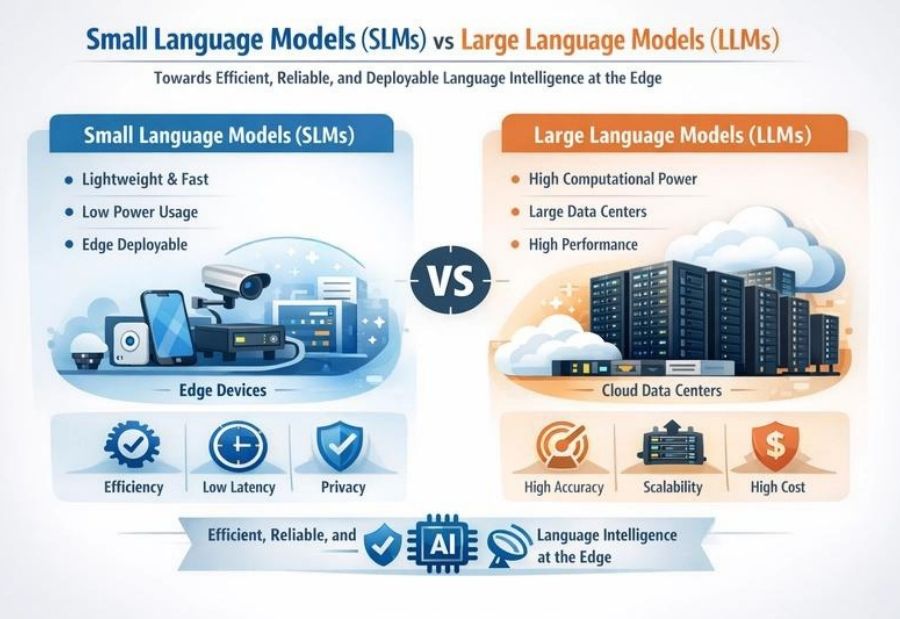
Organisations adopting generative AI must choose models that meet their requirements for quality, speed, cost and data protection. Large language models (LLMs) can handle a broad range of complex tasks, while small language models (SLMs) may offer a more efficient option for specific workloads. Understanding small language models vs large language models helps technology leaders select an appropriate model for each application.
The best choice depends on the complexity of the task, available computing resources, expected usage and the consequences of an incorrect answer.
What are Small Language Models?
Small language models are language models designed with relatively fewer parameters and more modest computing requirements than many large models. However, there is no universal parameter threshold that separates small models from large ones.
SLMs can be useful for focused tasks such as text classification, information extraction, summarisation, routing requests and generating structured responses. They may run on local servers or supported edge devices, depending on their architecture and hardware requirements.
Their smaller size can reduce inference costs and make deployment easier. However, performance still depends on training data, model design, context length and the task being performed.
What are Large Language Models?
Large language models are built to handle a broad range of language tasks, including complex reasoning, code generation, document analysis and conversational assistance.
They often provide greater general-purpose capability, particularly when a task requires handling varied instructions or interpreting complex context. Some models also support multimodal inputs, including images or audio.
However, larger models may require more memory, specialised hardware and greater inference expenditure. Their additional capability does not guarantee that every response will be accurate.
Small Language Models vs. Large Language Models: Key differences
| Factor | Small Language Models | Large Language Models |
| Computing requirements | Generally lower | Generally higher |
| Inference cost | Often lower for comparable workloads | Can be higher, depending on model and deployment |
| Response speed | Can offer lower latency | May require more processing time |
| Task coverage | Often strongest on defined tasks | Often better suited to varied, complex tasks |
| Deployment | Can suit local or edge environments | Often deployed on powerful servers or cloud infrastructure |
| Customization | Can be practical for focused use cases | Can support broad use cases and specialised adaptation |
| Data control | Local deployment may improve control | Depends on hosting and data-handling arrangements |
These are general patterns rather than specialized guarantees. A poorly optimized small model may be slower than a well-served larger model and a specialized SLM may outperform a general-purpose LLM on a narrow task.
Cost: which model is more economical?
SLMs may reduce costs because they can require less compute and memory per request. They can be attractive for high-volume, repetitive tasks such as classifying support tickets or extracting fields from standard documents.
LLMs may justify their higher operating costs when their stronger capabilities reduce the need for manual review or solve complex tasks that smaller models handle poorly.
Businesses should measure the total cost per successful task, not just the cost per token or API request. Include hosting, hardware, engineering, monitoring, evaluation and human review costs.
Speed and Latency
Smaller models can respond quickly because they may require fewer computational resources. This can be valuable for real-time applications, local processing and high-volume workloads.
Actual latency also depends on hardware, model architecture, input length, output length, batching and network conditions. A smaller model hosted on limited hardware may not outperform a larger model on an optimized accelerator.
Teams should benchmark both options using representative workloads before making deployment decisions.
Accuracy and Output Quality
Model size alone does not determine accuracy. A well-trained SLM may outperform a larger model on a narrow classification or extraction task, while a larger model may perform better when a task requires broad knowledge or complex reasoning.
Evaluation should use real examples and task-specific metrics. These may include classification precision and recall, extraction accuracy, factual correctness, instruction adherence and the rate of outputs requiring human correction.
For high-impact applications, organisations should also test edge cases and monitor performance after deployment.
How to choose the right model
Consider the following decision factors:
- Task complexity: Start with an SLM for narrow, repeatable tasks and evaluate an LLM when broader capabilities are necessary.
- Volume and cost: Estimate workload volume and calculate cost per successful result.
- Latency requirements: Benchmark response times under expected production traffic.
- Data sensitivity: Assess whether local deployment or specific hosting controls are needed.
- Quality requirements: Compare candidate models against a defined accuracy threshold.
- Operational capacity: Consider the expertise needed to deploy, update and monitor each model.
A hybrid architecture can also work well. An SLM can handle routine requests, while an LLM processes difficult cases that require more advanced reasoning. Routing should be evaluated carefully to ensure that escalation improves quality without adding excessive latency or complexity.
Final Thought
Small and large language models serve different needs. SLMs can provide an efficient option for focused, high-volume workloads, while LLMs may be better suited to complex tasks that require broader capabilities.
The Mainstream covers AI and technology decisions that influence business performance. Organisations should evaluate models using real workloads, measurable quality standards and total operating costs rather than assuming that a larger model is always the better choice.