


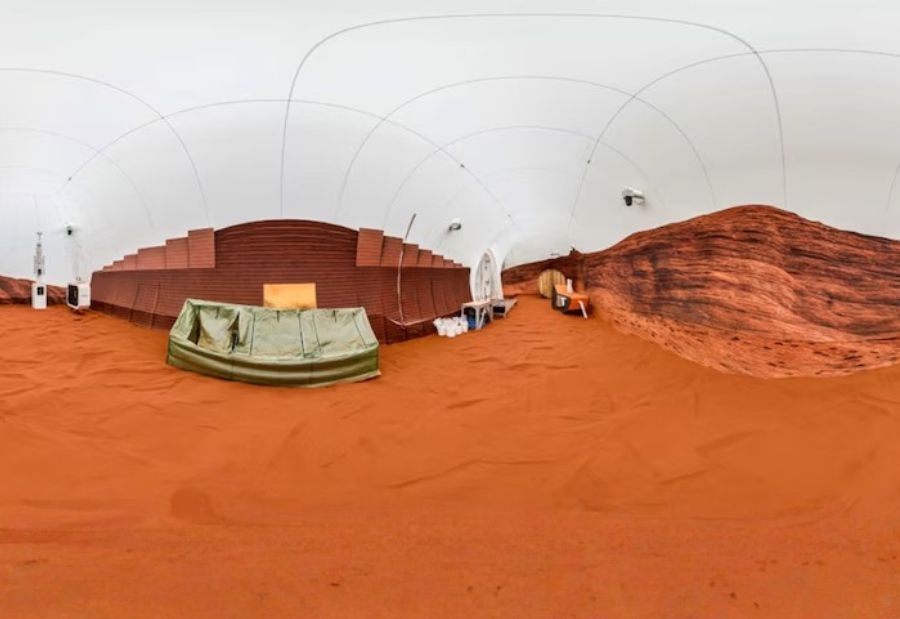
NASA’s ongoing Mars simulation mission has completed 200 days inside its isolated habitat, marking a major milestone in the agency’s long-duration space exploration research.
The 4-member CHAPEA (Crew Health and Performance Exploration Analog) mission 2 crew reached the milestone on May 7 during their 378-day simulated Mars mission. The crew is currently experiencing a simulated 2-week communications blackout designed to replicate the Mars-Earth signal loss that occurs when Mars moves behind the Sun.
During this period, the crew operates without contact with mission control, relying on preplanned procedures and available resources to complete daily activities and manage unexpected situations.
The mission crew includes commander Ross Elder, medical officer Ellen Ellis, science officer Matthew Montgomery, and flight engineer James Spicer. The team entered the 3D-printed habitat at NASA’s Johnson Space Center in Houston on Oct. 19 last year and is expected to complete the mission on Oct. 31.
“I’m proud of the crew’s accomplishments over the past 200 days — facing each challenge with fortitude and finding new ways to improve our performance and efficiency daily,” said Ellis.
Now more than halfway through the mission, the crew continues to provide NASA with important insights into how humans adapt to isolation, confinement, and limited resources during long-duration space missions.
“We approach every day committed to doing our best work, whether we’re doing a simulated spacewalk, geology, exercise, a medical activity, or anything in between,” said Spicer. “What keeps us motivated is knowing that we’re contributing directly to NASA’s deep space exploration objectives.”
Inside the 1,700-square-foot habitat, the crew has completed robotic operations, habitat maintenance, and crop-growing activities while managing delayed communications, limited supplies, and simulated equipment failures.
“Having limited resources, be it tools, equipment, software, supplies, or no internet, really bounds what you have to solve problems,” said Montgomery. “Finding creative and clever solutions has been both challenging and rewarding.”
NASA researchers are closely monitoring the crew’s cognitive and physical performance throughout the mission to better understand stress management, productivity, and human adaptation in isolated environments.
“Extended-duration missions are relatively rare in NASA’s history to date,” said Sara Whiting, project scientist and mission manager at Johnson for NASA’s Human Research Program. “The operational lessons learned, along with the detailed health and performance data this crew is providing, come at the perfect time to inform the development of a sustainable lunar presence and longer-term objectives for crewed Mars missions.”
Also read: Viksit Workforce for a Viksit Bharat
Do Follow: The Mainstream LinkedIn | The Mainstream Facebook | The Mainstream Youtube | The Mainstream Twitter
About us:
The Mainstream is a premier platform delivering the latest updates and informed perspectives across the technology business and cyber landscape. Built on research-driven, thought leadership and original intellectual property, The Mainstream also curates summits & conferences that convene decision makers to explore how technology reshapes industries and leadership. With a growing presence in India and globally across the Middle East, Africa, ASEAN, the USA, the UK and Australia, The Mainstream carries a vision to bring the latest happenings and insights to 8.2 billion people and to place technology at the centre of conversation for leaders navigating the future.