


Microsoft is expanding its AI capabilities across personal computers, introducing locally running AI models and new security technology designed to control how AI agents access data and perform tasks on Windows devices.
At an event in San Francisco, the company unveiled an AI coding model that can run directly on PCs, along with Microsoft Execution Containers, a security tool designed to prevent AI agents from accessing data or carrying out unauthorised actions on desktops and laptops.
The new technology is part of Microsoft’s broader effort to turn Windows into a platform for AI agents that can handle tasks such as writing code and working on complex business projects. The approach could also shift some AI workloads from Azure’s cloud infrastructure to high-powered computers used by businesses and consumers.
Microsoft said Anthropic, OpenAI and Nvidia will use its execution container technology. Pavan Davuluri, Executive Vice President for Windows and Devices, said the new tools will allow IT departments to establish rules for AI agents, which Windows can then enforce on individual employee machines.
Microsoft CEO Satya Nadella said, “We needed to make the desktop the most secure place for agents to execute.”
Nvidia CEO Jensen Huang, who appeared with Nadella, described the technology, known as MXC, as something that “is going to revolutionize how agents are built and deployed.”
Microsoft also introduced AI models that can now run locally on high-powered Windows PCs, including Nvidia’s open-source Nemotron model. Davuluri said a version of Chinese AI company DeepSeek’s V4 model can run on systems with at least 60 GB of memory and outperform OpenAI’s GPT-5 on some coding and reasoning tasks.
Microsoft is also extending the same approach to Copilot. Jacob Andreou, Microsoft’s Copilot chief, said the assistant will continue using the cloud for more demanding tasks while delegating some workloads to local models when privacy or cost is a priority.
The company also said Meta’s Muse personal assistant will come to Windows as a native app and use some of Microsoft’s security tools. OpenClaw, an open-source AI agent system, will also work with the technology.
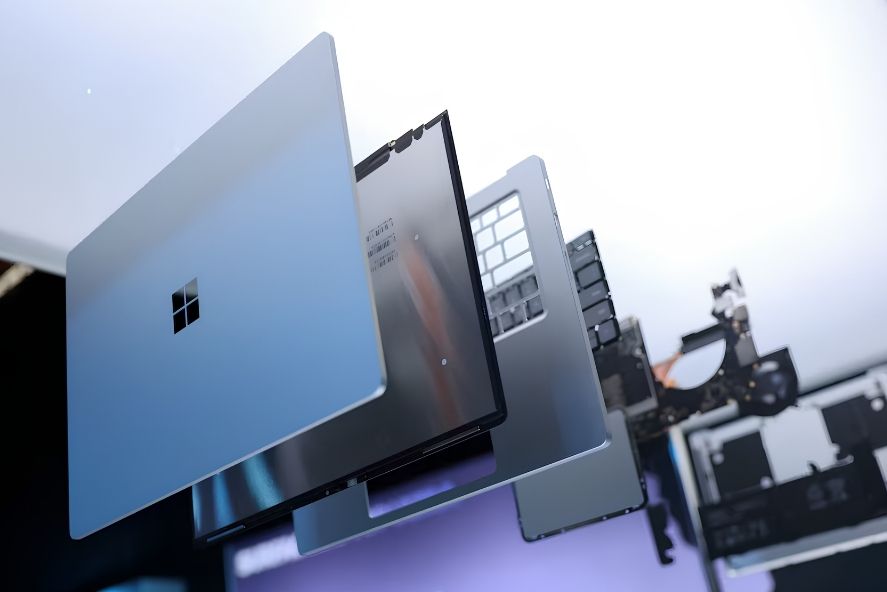
Microsoft unveiled the Surface Laptop Ultra, powered by Nvidia’s RTX Spark chips, with prices starting at $2,599 and reaching $5,899 for a configuration with a 20-core processor, 128 GB of memory and 1 TB of storage.
The pricing highlights a challenge for the local AI push. Rising memory costs have made high-performance AI hardware more expensive, potentially limiting access to on-device AI capabilities.
Analyst Anshel Sag said, “So it’s becoming this thing where only the people who have the budget can really afford to run AI locally.”
Also read: Viksit Workforce for a Viksit Bharat
Do Follow: The Mainstream LinkedIn | The Mainstream Facebook | The Mainstream Youtube | The Mainstream Twitter
About us:
The Mainstream is a premier platform delivering the latest updates and informed perspectives across the technology business and cyber landscape. Built on research-driven, thought leadership and original intellectual property, The Mainstream also curates summits & conferences that convene decision makers to explore how technology reshapes industries and leadership. With a growing presence in India and globally across the Middle East, Africa, ASEAN, the USA, the UK and Australia, The Mainstream carries a vision to bring the latest happenings and insights to 8.2 billion people and to place technology at the centre of conversation for leaders navigating the future.