


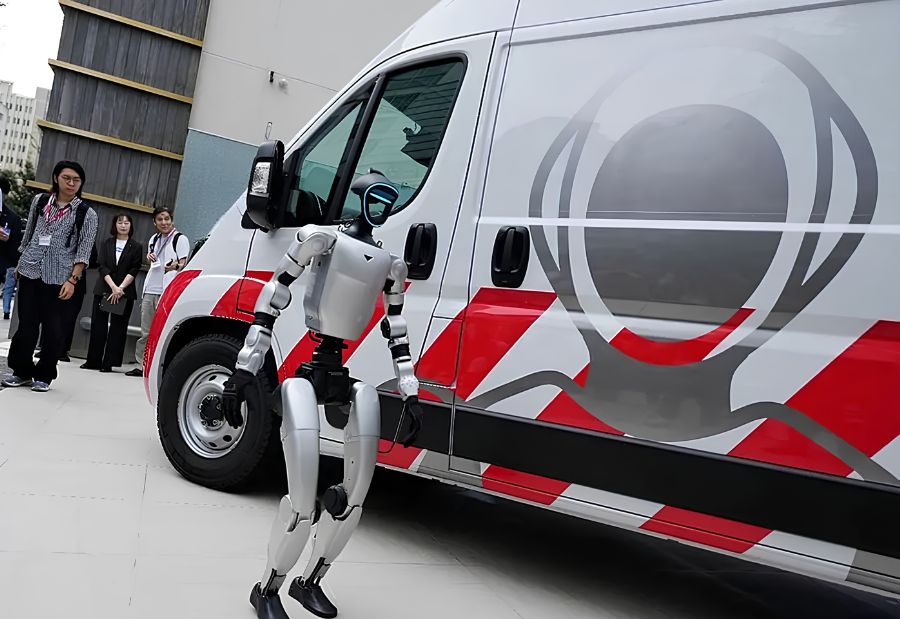
As humanoid robots begin taking on more commercial roles, Japan has introduced a new service designed to keep them operational when breakdowns occur. GMO Internet Group’s GMO Air has unveiled what it describes as Japan’s first “robot ambulance,” which is set to operate on the streets of Tokyo.
The specially equipped van is designed to transport engineers, repair equipment, replacement parts and a spare humanoid robot to locations where assistance is needed.
“The humanoid ‘ambulance’ carries the replacement humanoid to the site and replaces it with the damaged humanoid,” explained Shota Takizawa, an engineer at GMO Air.
If a robot cannot be repaired at the customer’s location, engineers can take the damaged machine back to a “repair base” while leaving the replacement robot behind as a “courtesy car” robot. The van itself is not autonomous, and the system does not involve one robot independently repairing another.
The service could prove useful in places such as hotels with humanoid cleaning staff or warehouses using humanoid workers. If a robot breaks down at the beginning of the working day, sending it back for repairs could leave the customer without its services for several days.
Under the new model, engineers travel to the customer, diagnose the issue and repair the robot on site when possible. If that is not feasible, they can take the damaged robot away and leave a replacement machine behind.
The approach reflects the type of support systems that developed around cars, industrial machinery, aircraft and IT hardware. As businesses become more dependent on humanoids for important tasks, uptime, field maintenance, spare-parts logistics and replacement machines could become increasingly important.
The concept was developed after GMO Air experienced disruptions when damaged robots had to be sent away for repairs.
“Learning from that experience, we came up with the idea of providing replacement humanoids,” said Tomohiro Uchida, CEO of GMO Air.
“When humanoids become more popular, this kind of service will be needed,” Takizawa added.
GMO Air currently has 1 robot ambulance at its Tokyo headquarters. The company plans to add more vehicles if customer demand supports expansion.
The launch comes as the US, China and Japan compete to advance humanoid robotics. Japan’s government has set a target of 10 million robots in service by 2040 across industries including healthcare and manufacturing.
Also read: Viksit Workforce for a Viksit Bharat
Do Follow: The Mainstream LinkedIn | The Mainstream Facebook | The Mainstream Youtube | The Mainstream Twitter
About us:
The Mainstream is a premier platform delivering the latest updates and informed perspectives across the technology business and cyber landscape. Built on research-driven, thought leadership and original intellectual property, The Mainstream also curates summits & conferences that convene decision makers to explore how technology reshapes industries and leadership. With a growing presence in India and globally across the Middle East, Africa, ASEAN, the USA, the UK and Australia, The Mainstream carries a vision to bring the latest happenings and insights to 8.2 billion people and to place technology at the centre of conversation for leaders navigating the future.