


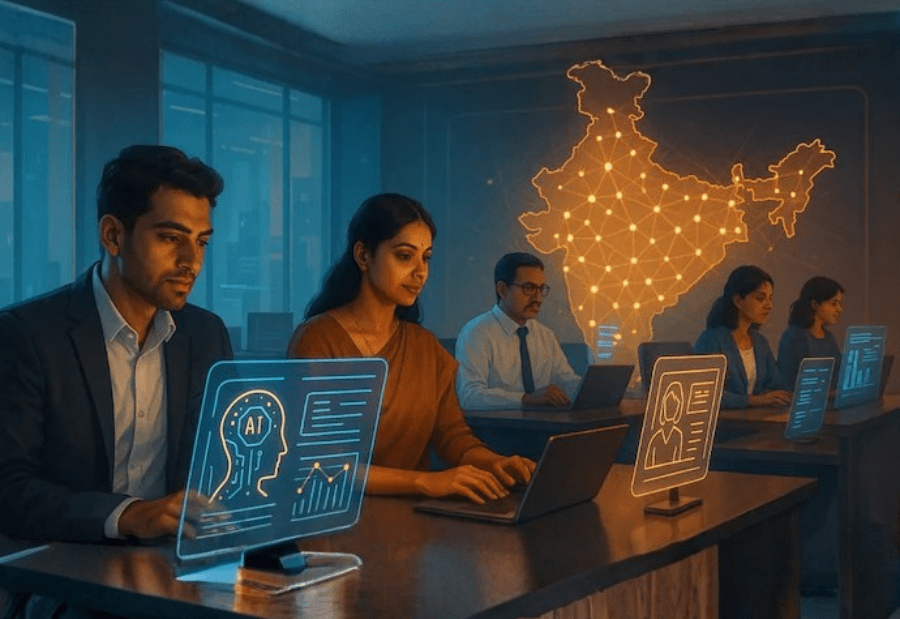
A sharp rise in enrolments for artificial intelligence (AI) and machine learning (ML) courses across India reflects more than routine upskilling. It highlights a growing urgency among professionals to stay relevant as traditional skill advantages begin to fade.
Demand for AI-led learning has surged across platforms and institutions over the past year. In 2025, AI and ML emerged as the most sought-after domains, recording a 17% year-on-year increase based on learner data from over 1 million users. However, the bigger shift lies in who is enrolling.
Professionals with over 15 years of experience now account for more than 40% of AI and generative AI course enrolments. This reverses the traditional trend where early-career learners led adoption. The shift signals that AI is not just another tool, but a force reshaping the value of experience itself.
For decades, India’s workforce operated on cumulative expertise, where experience increased value. AI is disrupting that model. Large language models and automation systems are now capable of handling tasks such as coding, debugging, analytics, and elements of decision-making, tasks that once required years of experience. As a result, many previously valued skills are losing their edge.
Upskilling is no longer about growth alone. It is increasingly about staying relevant.
The trend is also expanding beyond the technology sector. Professionals from finance, manufacturing, healthcare, and energy are actively enrolling in AI courses. A rising share of learners also comes from non-STEM backgrounds, showing that AI is becoming a core business capability rather than a niche technical skill.
At the same time, structural demand is intensifying. India is expected to require 1,000,000 AI professionals by 2026, pointing to a widening gap between enterprise needs and workforce readiness. Organisations are accelerating internal training, with a significant portion of the tech workforce already receiving AI education at work.
Despite this, a gap remains. While enrolments are increasing, industry leaders continue to highlight a shortage of professionals who can apply AI in real-world scenarios. The challenge lies not in access to learning, but in depth of application.
This is creating a divide. One group uses AI tools to improve productivity. The other understands how AI systems work, how models learn, where they fail, and how to integrate them into business workflows. The latter is increasingly valued as organisations focus on outcomes, not just output.
At scale, this surge reflects a broader transformation. India is not just adapting to AI, it is redefining how talent is built, measured, and deployed. Professionals are responding in real time, re-entering learning environments and rethinking their roles in an AI-driven economy.
The question is no longer whether to upskill. It is whether upskilling can keep pace with a rapidly changing definition of relevance.
Also read: Viksit Workforce for a Viksit Bharat
Do Follow: The Mainstream LinkedIn | The Mainstream Facebook | The Mainstream Youtube | The Mainstream Twitter
About us:
The Mainstream is a premier platform delivering the latest updates and informed perspectives across the technology business and cyber landscape. Built on research-driven, thought leadership and original intellectual property, The Mainstream also curates summits & conferences that convene decision makers to explore how technology reshapes industries and leadership. With a growing presence in India and globally across the Middle East, Africa, ASEAN, the USA, the UK and Australia, The Mainstream carries a vision to bring the latest happenings and insights to 8.2 billion people and to place technology at the centre of conversation for leaders navigating the future.