


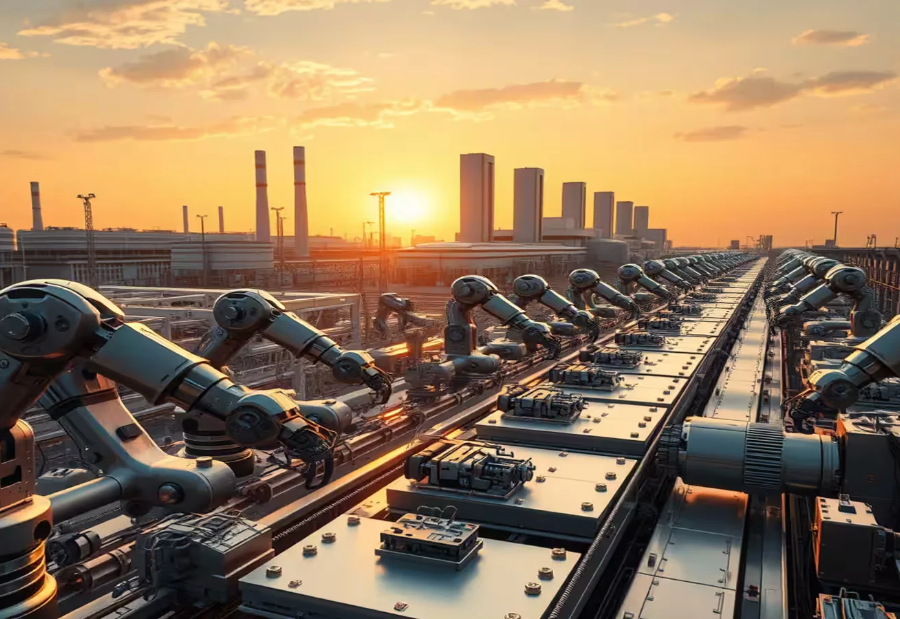
India could unlock major manufacturing opportunities as global investment in artificial intelligence infrastructure approaches $3 trillion. A report by Avendus Capital identifies 6 sectors that could help the country reduce import dependence, expand domestic production and strengthen its position in global supply chains.
The sectors are defence and aerospace, space technology, robotics and automation, semiconductors, energy transition and advanced materials. The report identifies 2027–28 as a key period, when projects are expected to move from policy support and approvals towards commercial production.
Koushik Bhattacharyya, Managing Director and Head of Industrials Investment Banking at Avendus Capital, said, “India’s new-age manufacturing opportunity is substantial, but its right-to-win manifests in select segments. With more than 80% of the USD 3 tn AI-infrastructure investment yet to be deployed globally, the India opportunity is driven by a trifecta of factors: a large sovereign and domestic demand base, deep engineering talent and robust policy framework.” “We have identified six sectors driving this wave, and 2027-28 will put to test India’s hard-tech ambitions as these sectors move towards commercialization,” Bhattacharyya added.
India’s semiconductor consumption is projected to rise from $49.5 billion in 2025 to $106.5 billion by 2030. This could create opportunities in chip design, packaging, testing and specialised materials. The space economy is expected to grow from around $13 billion in 2025 to $44 billion by 2033, while domestic defence production could reach $31.6 billion by 2030. The robotics market is projected to expand 4-fold to $4.6 billion by 2030, supported by domestic adoption and import substitution.
In clean energy, India aims to expand manufacturing across the supply chain over the next 5 years. By 2030, it could become one of the few countries outside China with an integrated solar manufacturing chain, from ingots to modules. Plans also include multiple battery cell plants with gigawatt-hour capacities, indigenous electrolyser stack production and rare-earth-free motor technology.
Advanced materials could follow a growth path similar to India’s electronics manufacturing sector a decade ago, driven by domestic demand and high import dependence. Recycling is expected to expand first, followed by battery materials. Rare-earth magnet production and specialised materials could also gain momentum, supported by targeted government policies and demand from defence and aerospace.
The report says the coming years will be crucial in turning India’s demand, engineering talent and policy support into globally competitive manufacturing businesses.
Also read: Viksit Workforce for a Viksit Bharat
Do Follow: The Mainstream LinkedIn | The Mainstream Facebook | The Mainstream Youtube | The Mainstream Twitter
About us:
The Mainstream is a premier platform delivering the latest updates and informed perspectives across the technology business and cyber landscape. Built on research-driven, thought leadership and original intellectual property, The Mainstream also curates summits & conferences that convene decision makers to explore how technology reshapes industries and leadership. With a growing presence in India and globally across the Middle East, Africa, ASEAN, the USA, the UK and Australia, The Mainstream carries a vision to bring the latest happenings and insights to 8.2 billion people and to place technology at the centre of conversation for leaders navigating the future.