


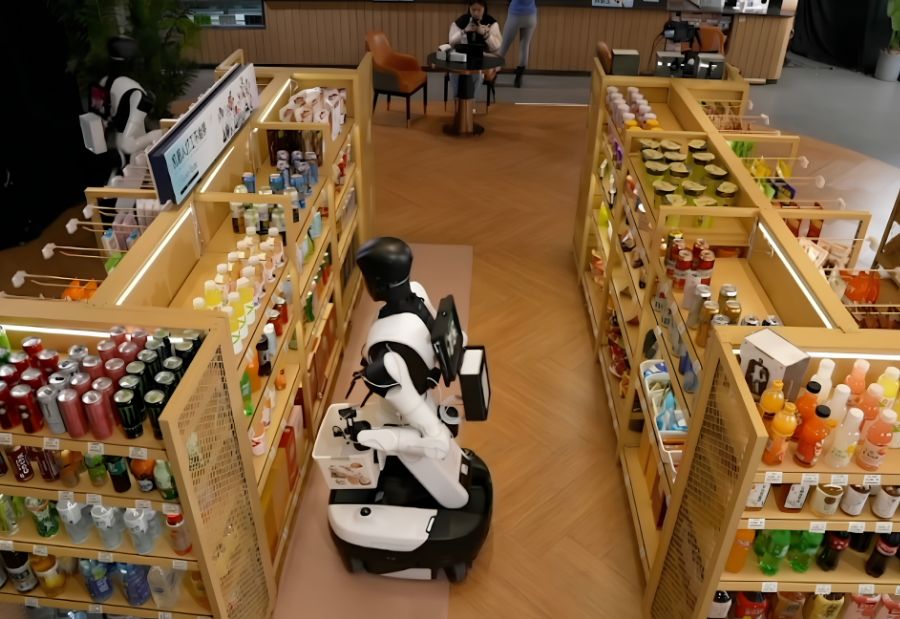
A real-world retail experiment in Shanghai has revealed the limitations of humanoid robots in handling everyday workplace responsibilities. Chinese robotics manufacturer Agibot recently put 6 humanoid robots through a 24-hour convenience store shift to test their ability to manage routine retail operations. While the machines collectively completed 1,730 tasks, 2 robots failed to meet their assigned responsibilities.
The livestreamed challenge, titled “Robots Never Clock Out”, took place at a convenience store in Shanghai’s Xuhui district. It aimed to evaluate how effectively humanoid robots could perform across different working conditions throughout the day and night.
During the challenge, the 6 robots completed 683 customer greetings, 369 item retrievals and deliveries, and 147 coffee orders. They also handled 126 hot-food orders, 277 shelf inspection and restocking tasks, and 128 table-cleaning activities.
The experiment covered 4 different periods: the lunchtime rush, evening crowd, overnight operations and morning breakfast rush. This approach allowed the company to assess the robots’ performance over an extended period rather than relying on short, controlled tests.
Although 4 robots demonstrated adequate performance, the other 2 struggled with their assigned duties of cleaning and shelf management.
The cleaning robot encountered a full trash can while following its designated route. Instead of collecting the waste, it moved outside the store and failed to return to its assigned position. Meanwhile, the robot responsible for shelf inspections and replenishment showed limited initiative and could not match the store’s operational pace.
The experiment highlights the challenges humanoid robots continue to face when performing tasks in unpredictable environments.
A similar limitation was highlighted last month by US startup Dimensional, which advertised jobs for human handlers to walk its robot dogs through the streets of San Francisco.
Dimensional founder Stash Pomichter said the initiative was intended to improve the robots’ ability to navigate urban environments independently. He explained that AI agents still struggle to control physical hardware effectively.
“What we determined from our dog-walking experiment was that agents are still very bad at controlling hardware,” Pomichter stated.
The company has purchased 100 robot dogs and 50 humanoid robots from manufacturers across China, Germany and the US. The robot dogs, each priced at $2,000, seen on San Francisco’s streets were purchased from Chinese manufacturer Unitree.
Also read: Viksit Workforce for a Viksit Bharat
Do Follow: The Mainstream LinkedIn | The Mainstream Facebook | The Mainstream Youtube | The Mainstream Twitter
About us:
The Mainstream is a premier platform delivering the latest updates and informed perspectives across the technology business and cyber landscape. Built on research-driven, thought leadership and original intellectual property, The Mainstream also curates summits & conferences that convene decision makers to explore how technology reshapes industries and leadership. With a growing presence in India and globally across the Middle East, Africa, ASEAN, the USA, the UK and Australia, The Mainstream carries a vision to bring the latest happenings and insights to 8.2 billion people and to place technology at the centre of conversation for leaders navigating the future.