


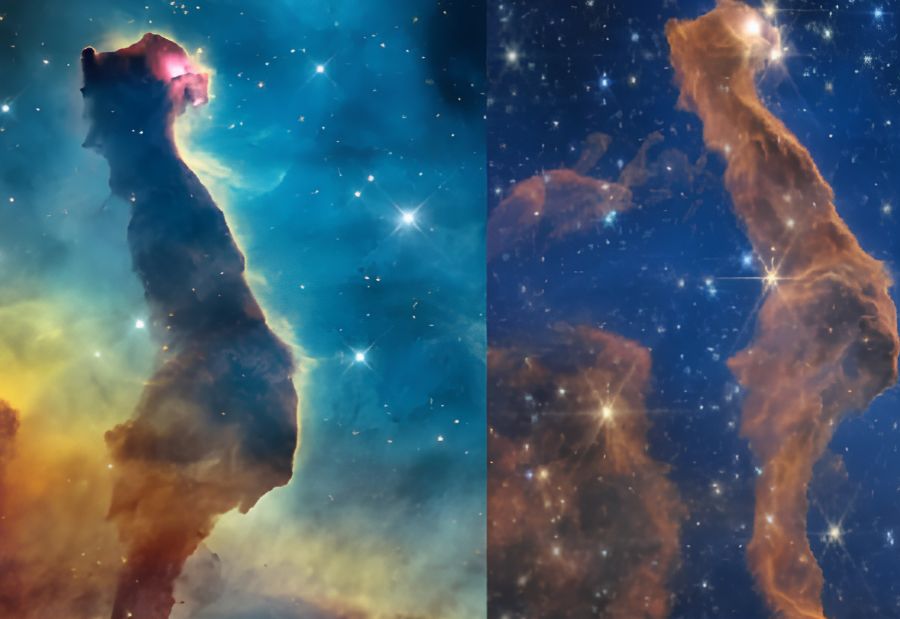
NASA’s Hubble Space Telescope and James Webb Space Telescope have captured striking views of a star-forming region that bears a resemblance to a cat’s head. Located within the Carina Nebula, approximately 7,500 light-years from Earth, the structure offers astronomers a closer look at the processes that shape stellar nurseries.
Known as the Cat’s Head Nebula, the region gets its name from its distinctive appearance, resembling a cat sitting with its back towards the viewer and its head turned to the right. The combined observations from Hubble and Webb reveal intricate clouds of gas and dust, glowing structures and stars at different stages of formation.
Astronomers believe the unusual shape developed over time under the influence of intense ultraviolet radiation and powerful winds from massive nearby stars. These forces gradually erode the surrounding gas and dust, while denser sections of the structure can withstand the effects for longer.
Although the formation will eventually disperse as stars develop, it provides valuable clues about how stellar systems take shape.
Hubble’s visible-light observations reveal a dark brown pillar of dust with a bright red feature resembling a cat’s eye. The glowing region could indicate a young star that remains partly hidden behind dust. A hazy yellow ridge along the structure’s right edge shows gas illuminated and altered by ultraviolet radiation from nearby massive stars.
The surrounding colours shift from blue and cyan in the upper region to yellow, orange and red towards the bottom. Hubble’s filters capture emissions from oxygen, hydrogen and sulfur, along with starlight scattered by dust, helping researchers identify different features within the nebula.
Webb’s infrared observations provide another perspective. Its near-infrared view reveals details hidden behind the dusty pillar, making its complex surface more visible. Faint clouds of gas and dust appear on the left, where they are exposed to radiation from nearby massive stars. The image also captures stars in blue and yellow, some still partially obscured by dust, along with distant background galaxies.
Webb’s mid-infrared observations highlight patterns in warm dust and carbon-based molecules influenced by nearby starlight. Small rounded structures and thin strands of material are particularly visible to the left of the pillar.
A bright yellow source surrounded by reddish material appears on the right side and is likely a young star enveloped in dust. Although a thin strand seems to cross the source, the image does not establish whether the two features are physically connected.
Together, the observations demonstrate how Hubble’s visible-light imaging and Webb’s infrared capabilities complement each other. Their combined views are helping astronomers investigate how massive stars influence their surroundings and how new stars emerge from clouds of gas and dust.
Also read: Viksit Workforce for a Viksit Bharat
Do Follow: The Mainstream LinkedIn | The Mainstream Facebook | The Mainstream Youtube | The Mainstream Twitter
About us:
The Mainstream is a premier platform delivering the latest updates and informed perspectives across the technology business and cyber landscape. Built on research-driven, thought leadership and original intellectual property, The Mainstream also curates summits & conferences that convene decision makers to explore how technology reshapes industries and leadership. With a growing presence in India and globally across the Middle East, Africa, ASEAN, the USA, the UK and Australia, The Mainstream carries a vision to bring the latest happenings and insights to 8.2 billion people and to place technology at the centre of conversation for leaders navigating the future.