


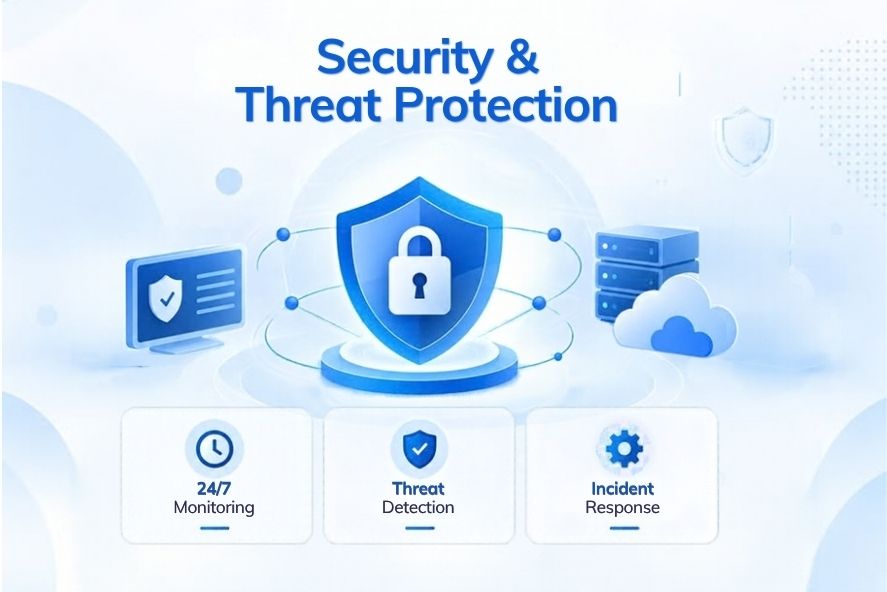
Businesses are moving applications, databases, and business services to cloud environments to improve flexibility and scalability. However, cloud adoption also creates new security challenges. Misconfigured resources, compromised accounts, suspicious API activity, and unauthorized access can expose sensitive information or disrupt operations.
Effective cloud threat detection helps security teams identify suspicious activity and investigate potential threats before they cause significant damage. To improve detection, businesses need clear visibility, reliable monitoring, and a coordinated response process.
Why is cloud threat detection challenging?
Cloud environments can include public cloud services, private infrastructure, containers, virtual machines, and software applications. Each component may generate different logs and security signals.
When these signals are spread across separate systems, security teams may struggle to identify the full picture. A suspicious login might appear harmless on its own but become more concerning when combined with unusual data access or unexpected changes to cloud resources.
Frequent changes in cloud infrastructure can add another challenge. New services, identities, and permissions may appear quickly, making continuous monitoring essential.
How can businesses improve cloud visibility?
Security teams need visibility into cloud assets, user activities, network traffic, configurations, and workload behaviour.
An up-to-date inventory can help identify which resources are active, who owns them, and what data they access. Centralizing relevant logs from cloud services can also make it easier to investigate activity across different environments.
Businesses should prioritize monitoring for critical systems and sensitive information. This helps teams focus their attention on resources where a security incident could have the greatest impact.
Why is identity monitoring important?
Compromised credentials are a common route into cloud environments. Attackers may use stolen passwords, session tokens, or access keys to operate with legitimate permissions.
Businesses should monitor unusual login locations, unexpected privilege changes, suspicious access patterns, and the use of inactive or rarely used accounts.
Multi-factor authentication, least-privilege access, and regular permission reviews can reduce exposure. Automated alerts can also help security teams investigate high-risk identity activity quickly.
How can automation improve detection?
Cloud environments generate large volumes of security events. Reviewing every alert manually can delay investigations and place pressure on security teams.
Automated detection rules can identify unusual activity, correlate related events, and prioritise alerts according to risk. Security information and event management (SIEM) platforms and cloud-native security tools can help teams bring relevant signals together.
Automation should be configured carefully. Poorly tuned alerts can create false positives, while overly broad rules may overlook important activity. Regular testing and adjustment can improve detection quality.
What role does cloud configuration security play?
Not every cloud threat begins with an active attack. Misconfigured storage, excessive permissions, exposed services, and weak security settings can create opportunities for unauthorized access.
Businesses should continuously assess cloud configurations against approved security standards. High-risk findings should be prioritised according to exposure, data sensitivity, and business impact.
Combining configuration monitoring with threat detection can help security teams understand both existing weaknesses and suspicious behavior that may indicate exploitation.
How should businesses respond to detected threats?
Detection is only useful when businesses can act on the findings. Security teams should define clear procedures for investigating alerts, containing affected resources, revoking compromised credentials, and recovering services.
Incident response plans should identify responsibilities across security, cloud operations, IT, and business teams. Regular exercises can help validate whether teams can respond effectively under pressure.
The Mainstream continues to cover the evolving cybersecurity challenges facing businesses as cloud environments become more connected and dynamic.
Final Thought
Strong cloud threat detection depends on visibility, identity monitoring, configuration management, automation, and an effective incident response process. No single tool can identify every threat across a complex cloud environment.
Businesses that combine monitoring with preventive controls and regular testing can improve their ability to identify suspicious activity and limit its impact. As cloud adoption expands, continuous detection will remain an important part of protecting digital operations.