


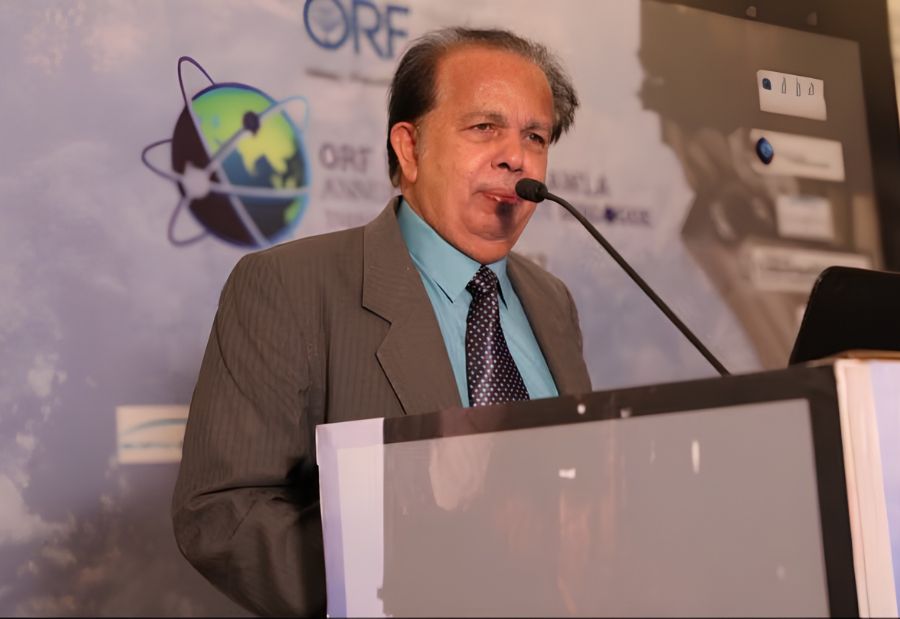
India’s space sector is entering a new phase, with private companies and startups taking on a growing role across the space value chain. Former ISRO Chairman G Madhavan Nair has argued that this growth should focus on building new capabilities rather than replicating technologies and activities already developed by ISRO.
The number of registered space startups in India has increased from 1 in 2014 to around 440 in 2026, according to government data. India’s space economy is estimated at around $9 billion in 2026, with projections of $40–45 billion over the next decade.
Nair said startups should focus their resources on specialised technologies, innovation, new business models, downstream applications and customer-facing services. ISRO, meanwhile, can continue concentrating on technology leadership, advanced R&D and national missions.
One major opportunity lies in satellite data. Applications such as crop-yield estimation, drought monitoring, flood prediction, transmission-line monitoring, forest-fire detection and climate-risk analysis could create significant economic value. Startups could combine satellite data with AI to turn raw information into insights that support business decisions.
Satellite communications also offer opportunities in areas such as maritime and aircraft connectivity. Rather than building large international constellations, companies could focus on markets where India has potential advantages, including South Asia and African countries.
Nair also suggested that startups look beyond building complete rockets and develop specialised subsystems and components for global manufacturers. A strong space-component industry, similar to India’s automotive-component ecosystem, could create opportunities to supply systems to customers worldwide.
He clarified that India still needs private launch companies, but argued that the focus should be on a smaller number of companies with high flight rates, technological differentiation and identifiable customers rather than many companies developing similar rockets.
For ISRO, Nair highlighted areas such as fundamental R&D, deep-space technology, human spaceflight, planetary exploration and national missions. The private sector could increasingly focus on manufacturing, commercial launches, components, subsystems, applications and exports.
Technology transfer could also play a larger role. As of August 2026, NSIL had signed 118 technology-transfer agreements covering 83 technologies developed by ISRO and the Department of Space, according to government data. Nair argued that this should expand and lead to greater mass production and exports.
He also proposed an annual Space Industry Performance Index covering metrics such as revenue, export revenue, operational satellites, technology-transfer agreements, patents and intellectual property.
The broader objective, according to Nair, should be to build 50–100 globally competitive companies supported by a wider supplier ecosystem, with greater emphasis on scale, sustainability and exports rather than simply increasing the number of registered startups.
Also read: Viksit Workforce for a Viksit Bharat
Do Follow: The Mainstream LinkedIn | The Mainstream Facebook | The Mainstream Youtube | The Mainstream Twitter
About us:
The Mainstream is a premier platform delivering the latest updates and informed perspectives across the technology business and cyber landscape. Built on research-driven, thought leadership and original intellectual property, The Mainstream also curates summits & conferences that convene decision makers to explore how technology reshapes industries and leadership. With a growing presence in India and globally across the Middle East, Africa, ASEAN, the USA, the UK and Australia, The Mainstream carries a vision to bring the latest happenings and insights to 8.2 billion people and to place technology at the centre of conversation for leaders navigating the future.