


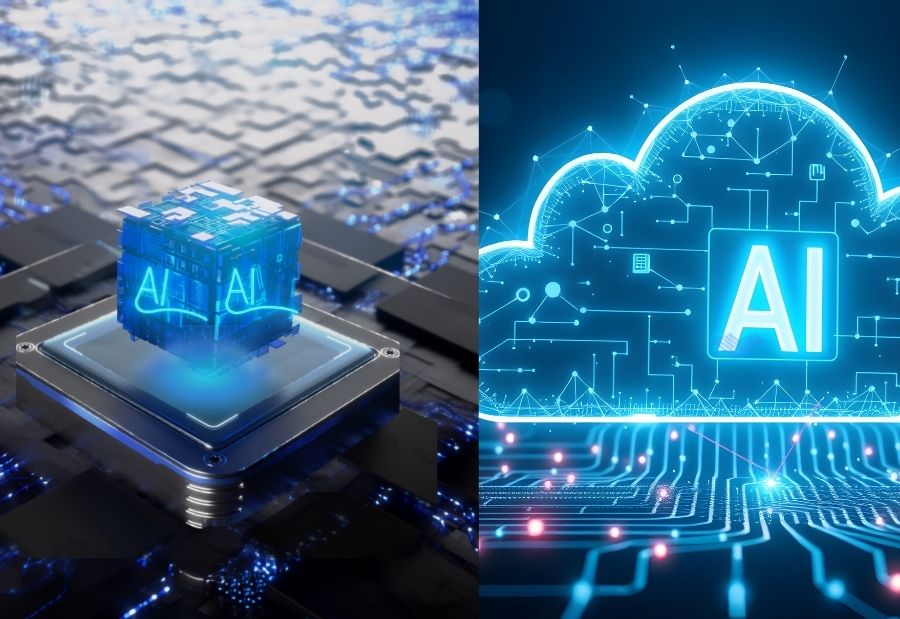
Artificial intelligence is becoming part of enterprise operations, but where AI processing happens can significantly affect performance, cost, security and scalability. This has made edge AI vs cloud AI an important technology decision for CIOs and enterprise architects.
Edge AI processes data closer to where it is generated, while cloud AI sends data to centralized cloud infrastructure for processing. Neither approach is universally better. The right choice depends on the workload, data sensitivity, connectivity, response time and business requirements.
Edge AI and Cloud AI: What is the difference?
The basic distinction is where AI computation takes place.
Edge AI runs AI models on or near devices such as cameras, industrial machines, sensors, vehicles, medical equipment, or local servers. This allows systems to analyze information without always sending it to a centralized cloud.
Cloud AI relies on centralized cloud infrastructure with access to scalable computing, storage, advanced AI services and large models.
In simple terms:
- Edge AI: Intelligence closer to the data source
- Cloud AI: Intelligence centralized in cloud infrastructure
- Edge AI: Lower dependence on continuous connectivity
- Cloud AI: Greater access to scalable computing resources
- Edge AI: Useful for real-time decisions
- Cloud AI: Useful for large-scale processing and complex models
Where Edge AI has an advantage
One of the biggest benefits of Edge AI is low latency.
Applications that need immediate responses may not have enough time to send data to a distant cloud environment and wait for processing.
Manufacturing systems, autonomous machines, security cameras, connected vehicles and industrial monitoring can benefit from local AI processing.
Edge AI can also reduce the amount of raw data transferred to the cloud. Instead of continuously sending large volumes of information, devices can process data locally and transmit only relevant insights.
This can help reduce network usage and may provide additional privacy benefits when sensitive information can remain closer to its source.
Where Cloud AI stands out
Cloud AI provides access to significantly larger and more flexible computing environments.
Enterprises can use cloud infrastructure for model training, large-scale analytics, generative AI applications and workloads that require substantial computing capacity.
Cloud platforms can also make it easier to scale resources when demand changes.
For businesses developing sophisticated AI applications, centralized infrastructure can simplify access to GPUs, storage, machine-learning platforms and AI development tools.
This makes cloud AI particularly useful for workloads that are too computationally demanding for edge devices.
Edge AI vs Cloud AI: Key trade-offs
| Factor | Edge AI | Cloud AI |
| Processing location | Near the data source | Centralized cloud |
| Latency | Generally lower | Depends on connectivity |
| Scalability | Limited by local hardware | Highly scalable |
| Connectivity | Less dependent | More dependent |
| Data transfer | Can be reduced | Often higher |
| Computing capacity | Limited | Broad and flexible |
| Best suited for | Real-time applications | Complex, large-scale workloads |
The edge AI vs cloud AI decision therefore requires organizations to look beyond technology specifications.
Security and data considerations
Security is another important factor.
Keeping certain data closer to the source can reduce unnecessary data movement, but edge devices can also create additional endpoints that need protection.
Cloud environments provide centralized security capabilities but require strong identity management, access controls, encryption, monitoring and configuration management.
Enterprises should assess where sensitive information is generated, processed, stored and transmitted before selecting an architecture.
Why a hybrid approach may work best
Many enterprises do not have to choose one model exclusively.
A hybrid architecture can combine edge and cloud capabilities. An edge device might analyze information locally and send selected results to the cloud for deeper analysis, centralized reporting, or model improvement.
For example, a manufacturing company could use Edge AI to detect equipment abnormalities in real time while using cloud infrastructure to analyze historical information across multiple facilities.
This approach can balance responsiveness with centralized intelligence.
The Mainstream covers enterprise technology, AI, cloud computing, cybersecurity and digital transformation, helping technology leaders understand emerging technology choices and their business implications.
Conclusion
The edge AI vs cloud AI debate is ultimately about choosing the right environment for the right workload. Edge AI can provide faster local processing and reduce dependence on connectivity, while cloud AI offers scalability and access to powerful computing resources.
For many enterprises, the most practical strategy may be a combination of both. By evaluating latency, data, security, cost, computing requirements and business objectives, CIOs can build an AI architecture that delivers performance without compromising scalability or control.