


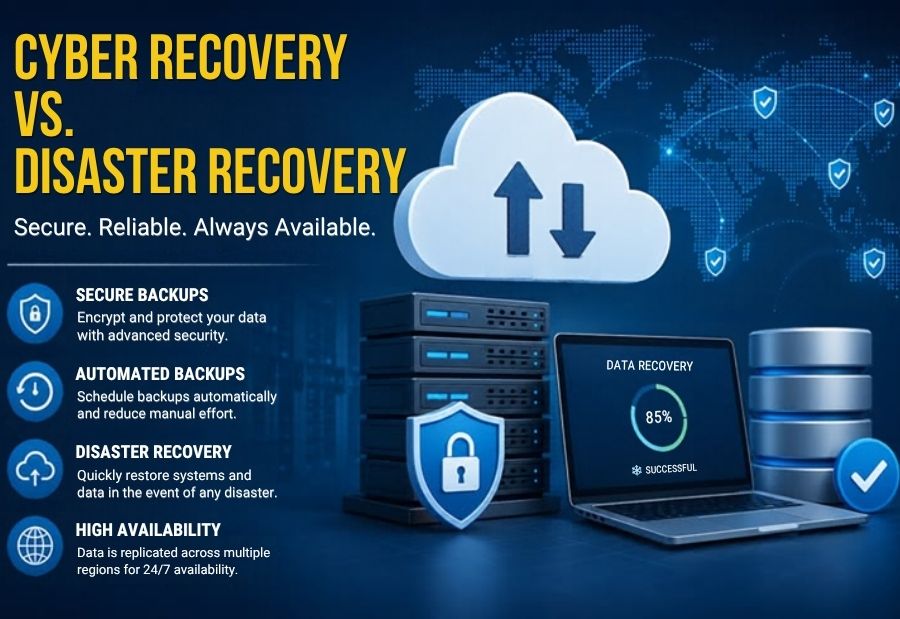
Organisations depend on digital systems to manage business operations, customer information and critical services. A ransomware attack, data breach, infrastructure failure or natural disaster can interrupt these systems and affect business continuity. Although organisations use recovery strategies to restore operations, not every disruption requires the same response.
This is where understanding cyber recovery vs. disaster recovery becomes important. Both approaches help organisations restore technology services after an incident, but they address different types of risks and recovery requirements.
Disaster recovery focuses on restoring IT systems and infrastructure after disruptive events. Cyber recovery specifically addresses the challenges of recovering data and systems following cyberattacks, including situations where backups or recovery environments may have been compromised.
What is Disaster Recovery?
Disaster recovery (DR) is a planned approach for restoring IT infrastructure, applications, data and services after a major disruption.
The disruption may result from hardware failure, power outages, natural disasters, accidental data deletion, software problems or cyber incidents.
A disaster recovery plan typically identifies critical systems, recovery priorities, backup arrangements and the procedures required to restore operations.
Common disaster recovery measures include:
- Maintaining backup copies of important data.
- Replicating workloads across separate locations.
- Establishing secondary data centres or cloud recovery environments.
- Documenting system restoration procedures.
- Testing recovery processes through planned exercises.
- Defining Recovery Time Objectives (RTOs) and Recovery Point Objectives (RPOs).
RTO represents the maximum targeted time an organisation can take to restore a service. RPO defines the acceptable amount of data loss measured in time.
For example, if a data centre becomes unavailable because of a power failure, an organisation may use its disaster recovery environment to restore critical applications.
What Is Cyber Recovery?
Cyber recovery focuses on restoring critical data and systems after a cyberattack or malicious activity. It is designed for situations where attackers may have accessed, encrypted, altered or deleted organisational data.
Ransomware is a common example. Attackers may encrypt production systems and attempt to delete or compromise backup copies to prevent recovery.
Cyber recovery therefore requires more than restoring infrastructure. Organisations must determine whether the data is clean, whether attackers still have access and whether the recovery environment is secure.
Key cyber recovery practices include:
- Maintaining isolated or immutable backup copies.
- Protecting backup systems with separate access controls.
- Scanning recovery data for malware and suspicious activity.
- Validating data integrity before restoring systems.
- Investigating the attack and identifying affected assets.
- Resetting compromised credentials and access permissions.
- Monitoring restored systems for signs of continued attacker activity.
The objective is to restore trustworthy systems without reintroducing malicious code, compromised configurations or unauthorised access.
Cyber Recovery vs. Disaster Recovery: Key Differences
Both approaches support organisational resilience, but their priorities differ.
- Type of Incident
Disaster recovery addresses a wide range of disruptive events, including infrastructure failure, environmental incidents, accidental deletion and technology outages.
Cyber recovery focuses specifically on malicious cyber incidents, such as ransomware, destructive malware, data manipulation and unauthorised access.
- Primary Recovery Objective
Disaster recovery aims to restore IT services and business operations within defined recovery targets.
Cyber recovery aims to restore clean, trustworthy data and systems while ensuring that attackers no longer have access to the environment.
- Backup Protection
Disaster recovery commonly uses backups and replication to restore data and services. However, replicated data can also reproduce corrupted or encrypted information if the issue is not detected.
Cyber recovery places additional emphasis on protecting backups from attackers. Immutable storage, offline copies, isolated recovery environments and strict administrative access controls help reduce the risk of backup compromise.
- Security Validation
In disaster recovery, teams generally verify that systems and applications are functioning correctly before returning them to normal operations.
In cyber recovery, security validation is essential. Teams must investigate the incident, check recovered data, remove malicious components, rotate compromised credentials and confirm that vulnerabilities have been addressed.
- Team Responsibilities
Disaster recovery typically involves IT infrastructure, operations, application and business continuity teams.
Cyber recovery requires closer coordination between cybersecurity, incident response, digital forensics, infrastructure, data protection and business teams.
Why Organisations Need Both Strategies
Disaster recovery and cyber recovery should work together as part of a wider resilience programme.
A traditional disaster recovery plan may not be sufficient when attackers deliberately target backup infrastructure. Similarly, a cyber recovery plan alone may not address physical infrastructure failures or natural disasters.
Organisations should maintain documented recovery procedures for different scenarios. They should identify critical systems, classify sensitive data, establish recovery priorities and define responsibilities for technical and business teams.
Regular testing is equally important. Recovery exercises should evaluate whether backups are accessible, systems can be restored within the required time and teams understand their responsibilities. Cyber recovery testing should also assess whether recovery environments remain isolated and whether restored data can be trusted.
Final Thought
Cyber recovery and disaster recovery address different but connected aspects of organisational resilience. Disaster recovery helps restore services after disruptive events, while cyber recovery ensures that systems and data can be safely restored after malicious activity.
For modern businesses, maintaining backups is only one part of recovery planning. Organisations must also protect those backups, validate recovered data and establish secure restoration procedures. Combining both approaches helps reduce operational disruption and strengthens preparedness against evolving risks.
The Mainstream covers cybersecurity, enterprise resilience and technology risk to help organisations understand the practices needed to protect critical digital operations.