


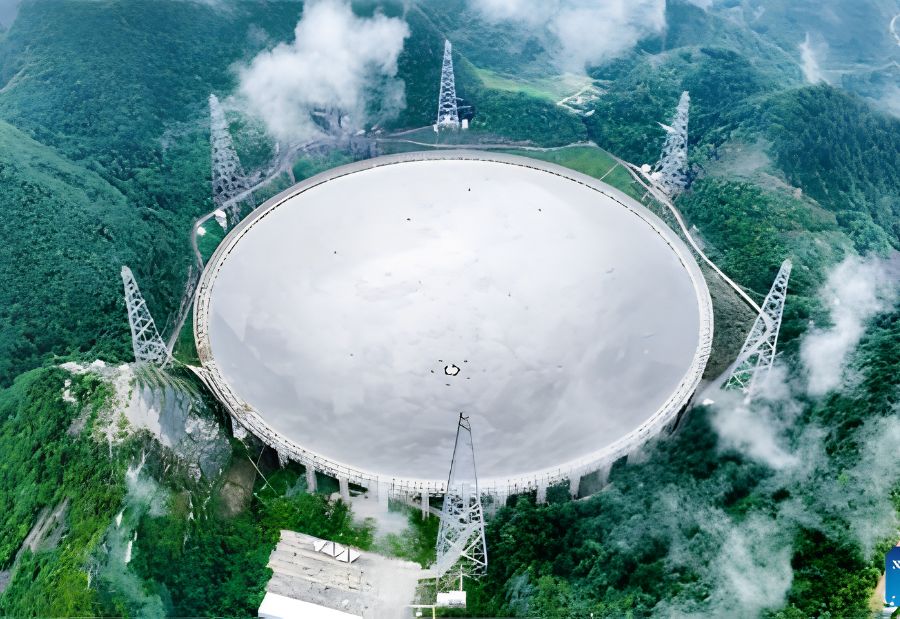
China’s Five-hundred-meter Aperture Spherical Radio Telescope (FAST), known as the country’s “Sky Eye”, is set to mark 10 years since its inauguration on September 25, highlighting a decade of major advances in radio astronomy.
In the next phase, the FAST team will move ahead with Phase II construction to strengthen the telescope’s capabilities and support further scientific discoveries.
Located in Pingtang County, Guizhou Province, FAST was inaugurated on September 25, 2016. As the world’s largest single-dish radio telescope, it has been used to study radio signals from deep space, the evolution of the universe, stars and the possibility of extraterrestrial life.
An academic conference marking the 10th anniversary is being held from Tuesday to Thursday in Guizhou, bringing together more than 200 experts and scholars from over 40 universities and research institutions across China.
Since beginning operations, FAST has reported advances across engineering, frontier science and practical applications. Developments in measurement and control systems, domestically produced steel cables and high-performance receivers have supported its stable operation.
The telescope has also contributed to research on pulsars, neutral hydrogen galaxies, fast radio bursts and gravitational waves. Its applications include cislunar space target detection, pulsar-based time standards and asteroid defence.
FAST has discovered 1,284 pulsars so far, including more than 170 millisecond pulsars and over 160 pulsar binary systems. These discoveries have made it an important facility for the study of rare celestial objects.
A major part of FAST’s progress has also involved replacing imported technologies with domestic alternatives. When the telescope was initially built, several key components depended on imports.
For example, laser total stations used for measurement were affected by Guizhou’s frequent rain and fog and failed during around one-third of observation periods. A domestically developed microwave ranging system, after 7 years of research, entered trial use in April 2026. It costs nearly half as much per set, works in all weather conditions and offers accuracy comparable in order of magnitude to laser systems.
As FAST enters its second decade, the team plans to advance Phase II construction while continuing to expand the telescope’s scientific capabilities and its contribution to global radio astronomy.
Also read: Viksit Workforce for a Viksit Bharat
Do Follow: The Mainstream LinkedIn | The Mainstream Facebook | The Mainstream Youtube | The Mainstream Twitter
About us:
The Mainstream is a premier platform delivering the latest updates and informed perspectives across the technology business and cyber landscape. Built on research-driven, thought leadership and original intellectual property, The Mainstream also curates summits & conferences that convene decision makers to explore how technology reshapes industries and leadership. With a growing presence in India and globally across the Middle East, Africa, ASEAN, the USA, the UK and Australia, The Mainstream carries a vision to bring the latest happenings and insights to 8.2 billion people and to place technology at the centre of conversation for leaders navigating the future.