


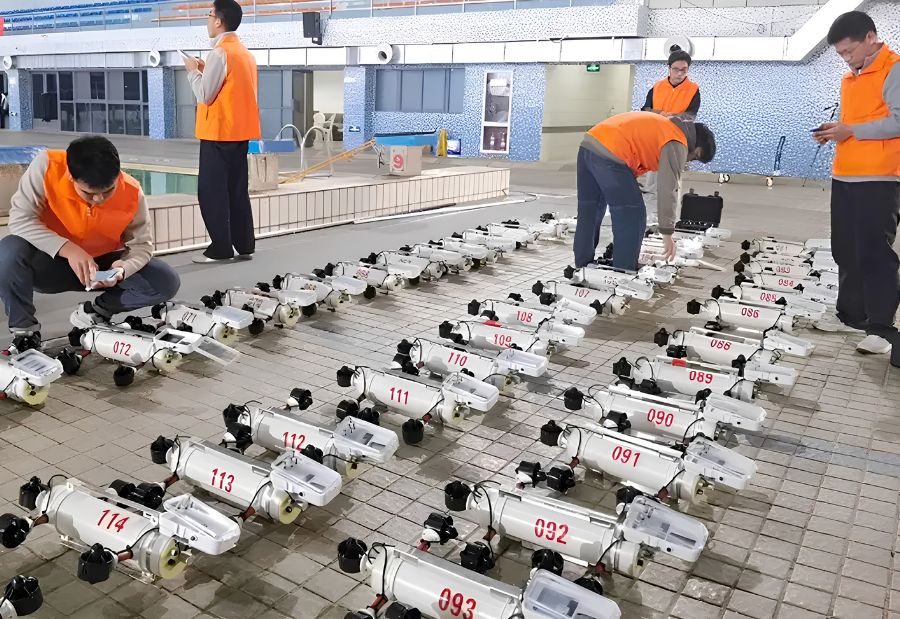
China has set a new world record for the largest number of autonomous underwater vehicles operating together without human control, after 116 small drones completed a coordinated navigation test.
The demonstration was conducted on August 29 by researchers from Northwestern Polytechnical University and Xi’an Tianhe Maritime Technologies. Guinness World Records certified the achievement after officials monitored the trial.
The TH-618 underwater drones navigated a preset route for 34 minutes, covering about 1,640 feet while maintaining coordinated movement. Operators initially deployed the vehicles before handing control to their onboard autonomous systems.
Each drone used real-time data to remain on its assigned route and could adjust its path when disturbances moved it away from the planned course.
Coordinating a large group of underwater vehicles presents additional technical challenges because radio signals do not travel through water in the same way they do through air. Maintaining communication and formation awareness is therefore more difficult as the number of vehicles increases.
Northwestern Polytechnical University has spent more than 2 decades developing technologies for underwater sensing, acoustic communication and visual perception. Researchers said the latest demonstration represents progress towards larger autonomous underwater systems.
The TH-618 measures about 24 inches in length and 7.8 inches in width and weighs around 11.3 pounds. The vehicle can reportedly travel up to 18.6 miles and operate for more than 8 hours.
A camera-based navigation system allows the drones to interpret their surroundings and adjust their movement. The vehicles can also respond to disturbances such as underwater currents that push them away from their planned paths.
Xian Tianhe Maritime Technologies said autonomous underwater vehicles could have civilian and industrial applications, including seabed surveys and inspections of oil and gas pipelines.
The record also comes as militaries and researchers explore coordinated uncrewed systems across air, land and water. Chinese researchers have examined potential military applications for underwater drone swarms, including their use for addressing gaps in maritime detection.
A study published in a Chinese-language command, control and simulation journal discussed coordinated underwater drones in this context.
Other countries have also tested groups of autonomous underwater robots. An EU-funded project previously demonstrated a swarm of 41 autonomous robots.
China’s latest formation more than doubles that figure, although the test was conducted in a controlled pool environment. Larger deployments would involve greater distances, stronger environmental disturbances and more difficult communication conditions.
The demonstration provides a test of how autonomous underwater navigation can be scaled from small groups to much larger coordinated formations.
Also read: Viksit Workforce for a Viksit Bharat
Do Follow: The Mainstream LinkedIn | The Mainstream Facebook | The Mainstream Youtube | The Mainstream Twitter
About us:
The Mainstream is a premier platform delivering the latest updates and informed perspectives across the technology business and cyber landscape. Built on research-driven, thought leadership and original intellectual property, The Mainstream also curates summits & conferences that convene decision makers to explore how technology reshapes industries and leadership. With a growing presence in India and globally across the Middle East, Africa, ASEAN, the USA, the UK and Australia, The Mainstream carries a vision to bring the latest happenings and insights to 8.2 billion people and to place technology at the centre of conversation for leaders navigating the future.