


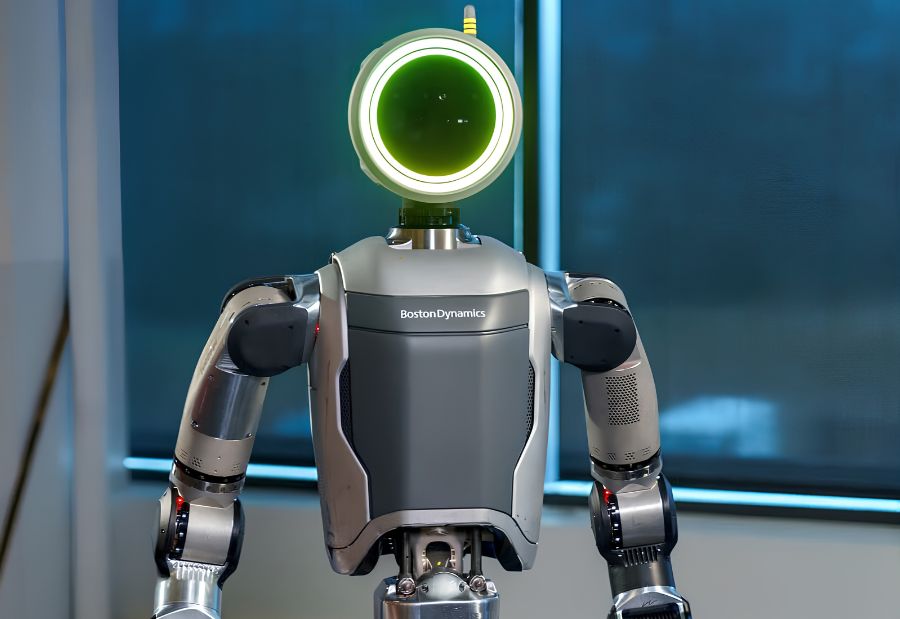
Humanoid robots are increasingly being designed for practical industrial work, and Boston Dynamics’ Atlas is taking another step in that direction. The production version of Atlas can autonomously return to a battery station, replace a depleted battery in under 3 minutes, and resume work without human assistance.
Atlas offers around 4 hours of battery life during typical use and about 2 hours during heavy lifting. A conventional recharge takes approximately 90 minutes, making autonomous battery replacement an important feature for reducing downtime and supporting longer operating shifts.
The robot stands about 6 feet 2 inches tall and weighs around 198 pounds. It can handle sustained loads of approximately 66 pounds and briefly lift up to 110 pounds. Atlas also features tactile sensing in its hands and a camera system providing a 360-degree view, supporting industrial tasks such as lifting, moving, and material handling.
Once known for demonstrations involving running, jumping, obstacle courses, and athletic movements, Atlas is now being developed for real-world industrial applications. The production version was unveiled at CES 2026, with initial deployments committed to Hyundai Motor Group’s Robot Metaplant Application Center and Google DeepMind.
Hyundai plans to begin using Atlas for validated manufacturing tasks at its Georgia Metaplant in 2028, starting with parts sequencing. More complex assembly tasks are targeted for 2030. Hyundai also plans to build capacity for up to 30,000 robots annually by 2028.
Boston Dynamics is also working with Google DeepMind to integrate Gemini Robotics foundation models with Atlas, aiming to expand its ability to perform industrial tasks. The company is also developing a system where skills learned by one Atlas can be shared across other robots in the fleet.
Beyond battery replacement, Atlas’ limbs can reportedly be replaced in the field in under 5 minutes, while onsite teams can be trained to maintain robot fleets.
The autonomous battery swap addresses one important challenge: downtime. However, widespread industrial adoption will ultimately depend on whether humanoid robots can perform tasks reliably, safely, repeatedly, and cost-effectively at scale.
Also read: Viksit Workforce for a Viksit Bharat
Do Follow: The Mainstream LinkedIn | The Mainstream Facebook | The Mainstream Youtube | The Mainstream Twitter
About us:
The Mainstream is a premier platform delivering the latest updates and informed perspectives across the technology business and cyber landscape. Built on research-driven, thought leadership and original intellectual property, The Mainstream also curates summits & conferences that convene decision makers to explore how technology reshapes industries and leadership. With a growing presence in India and globally across the Middle East, Africa, ASEAN, the USA, the UK and Australia, The Mainstream carries a vision to bring the latest happenings and insights to 8.2 billion people and to place technology at the centre of conversation for leaders navigating the future.