


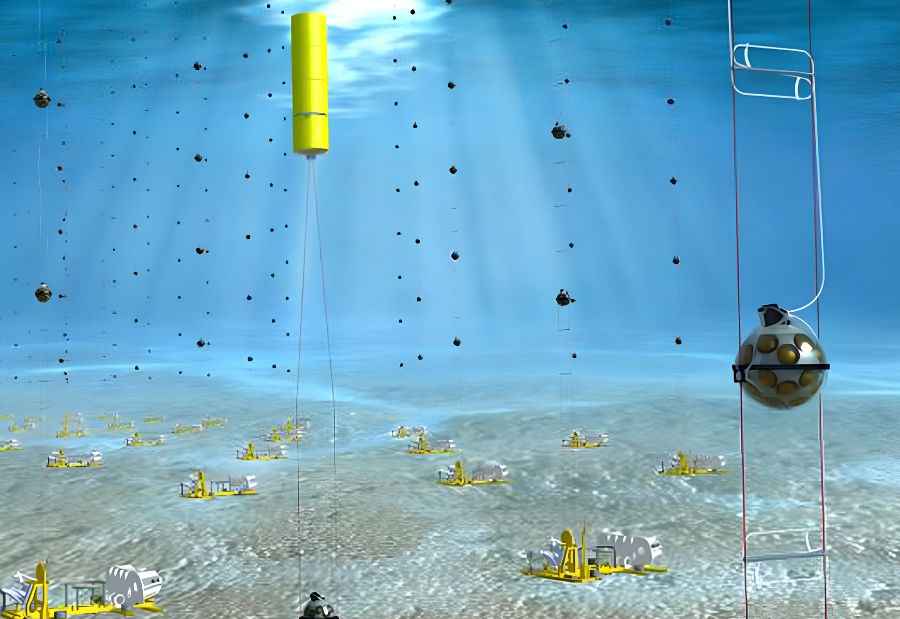
Researchers used a partially constructed neutrino telescope, positioned 1.5 miles (2.4 kilometres) below the sea surface off the coast of Toulon, France, to test a key principle of Albert Einstein’s theory of relativity. The experiment found no evidence of a violation. A scientific experiment beneath the Mediterranean Sea has offered another strong confirmation of one of the fundamental principles of modern physics.
The detector, known as Oscillation Research with Cosmics in the Abyss (ORCA), is designed to detect neutrinos, extremely elusive subatomic particles. It forms part of the KM3NeT neutrino telescope project. During its early construction phase, doctoral researcher Alba Domi participated in the deployment of some of the detector’s first units on the Mediterranean seabed.
Data collected from these initial units helped researchers examine Lorentz invariance, a fundamental principle stating that the laws of nature remain the same regardless of an observer’s direction or state of motion.
The findings showed no evidence of Lorentz invariance being violated. However, despite operating with only a small portion of its planned detection capacity, ORCA established limits that are competitive with those achieved by much larger experiments.
Modern physics is built around 2 major frameworks: Albert Einstein’s general theory of relativity, which explains the universe at a cosmic scale, and the Standard Model of particle physics, which describes the behaviour of subatomic particles.
“General relativity describes the universe well on a cosmic scale, and the Standard Model of particle physics describes the microscopic scale; really, the single particles, how they behave,” said study co-author Lukas Hennig, a doctoral student in advanced physics at Erlangen-Nürnberg.
Both frameworks rely on Lorentz invariance. However, they do not fully align under extreme conditions, such as those that existed during the earliest moments after the Big Bang. This has encouraged scientists to explore quantum gravity theories that could unite the 2 frameworks.
Some approaches, including certain versions of string theory and loop quantum gravity, suggest that space-time may have a hidden granular structure at extremely small scales. Such theories also raise the possibility that Lorentz invariance may not hold under all conditions.
Neutrinos offer a potential way to investigate this possibility. These nearly massless, electrically neutral particles pass through Earth in enormous numbers while interacting very rarely with matter. They exist in 3 types: electron, muon and tau neutrinos. As they travel, they can change from one type into another through a process known as neutrino oscillation.
If Lorentz invariance were violated, these oscillations could behave differently, with the effect becoming more noticeable over longer distances. Researchers therefore studied neutrinos produced when cosmic rays collide with Earth’s atmosphere. Some of these particles travelled through the entire planet before reaching the detector, covering distances of up to 7,900 miles (12,700 kilometres).
ORCA’s detection units are anchored to the seabed and contain 18 glass spheres, each equipped with 31 light sensors. When a neutrino interacts with a particle in the surrounding water, it produces a faint blue flash. These sensors capture the light and help researchers determine the particle’s direction.
Earth also acts as a natural filter. By selecting particles travelling upwards through the planet, researchers could eliminate much of the atmospheric particle background. As Hennig explained, “Only the neutrinos can get through.”
The researchers analysed 5,828 neutrinos recorded over approximately 17 months between 2020 and 2021. Their oscillation patterns were consistent with standard physics, indicating that any possible Lorentz invariance violation must remain below the limits established by the study.
The team also established the first direct limits on a possible violation that would affect muon and tau neutrinos differently.
The results are particularly significant because ORCA achieved competitive limits against Japan’s Super-Kamiokande, which used 12 years of observations, and IceCube in Antarctica, which analysed 2 years of data from its full detector array.
“I’m surprised that we have competitive results with only six detection units,” Hennig said.
ORCA currently has 44 detection units deployed in the water, with plans to increase the number to 108 by 2030.
Researchers believe that further investigations using high-energy neutrinos from distant cosmic sources could provide even stronger tests. The team plans to continue its research using ORCA’s sister detector, ARCA (Astroparticle Research with Cosmics in the Abyss), located off the coast of Sicily. ARCA is designed to detect high-energy neutrinos travelling across vast cosmic distances.
Also read: Viksit Workforce for a Viksit Bharat
Do Follow: The Mainstream LinkedIn | The Mainstream Facebook | The Mainstream Youtube | The Mainstream Twitter
About us:
The Mainstream is a premier platform delivering the latest updates and informed perspectives across the technology business and cyber landscape. Built on research-driven, thought leadership and original intellectual property, The Mainstream also curates summits & conferences that convene decision makers to explore how technology reshapes industries and leadership. With a growing presence in India and globally across the Middle East, Africa, ASEAN, the USA, the UK and Australia, The Mainstream carries a vision to bring the latest happenings and insights to 8.2 billion people and to place technology at the centre of conversation for leaders navigating the future.