


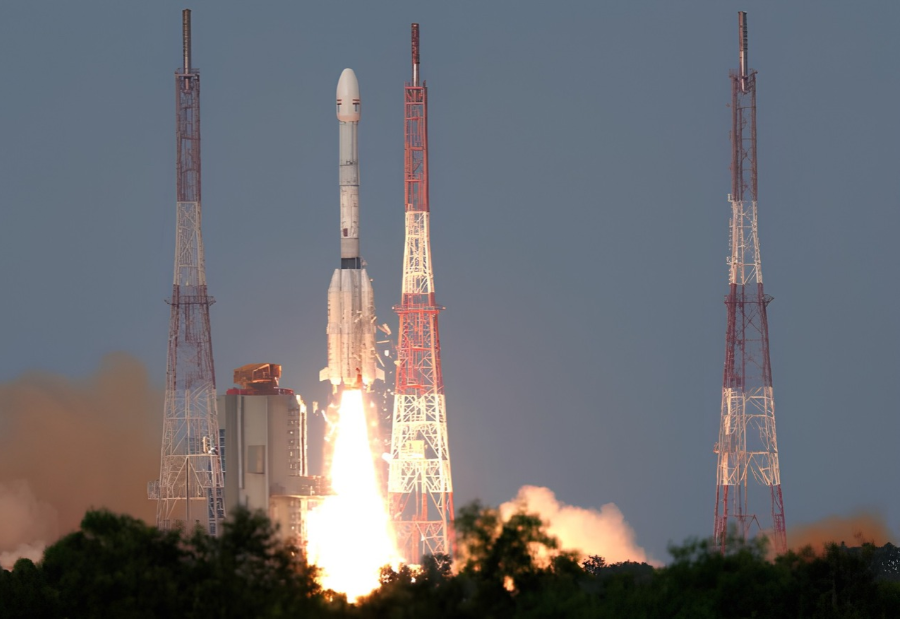
India’s space technology sector is expanding as government reforms, funding support and partnerships with the Indian Space Research Organisation (ISRO) create new opportunities for private companies. The country’s aerospace industry is projected to grow at twice the global market’s pace, strengthening India’s position in the global space economy.
Reforms open doors for private companies
India’s space startup count has grown from 1 in 2014 to more than 400 in 2026. The shift began in 2020, when the government opened the space sector to private businesses, followed by the Indian Space Policy 2023.
IN-SPACe now acts as a single-window agency for authorising private space activities and enabling access to ISRO facilities. Government-backed venture capital, technology adoption funding and seed schemes have supported growth. IN-SPACe facilitated $150 million in startup investments in 2025. Reforms in 2024 also allowed up to 74% foreign investment in satellite manufacturing and 49% in launch vehicles and spaceports.
India’s space technology sector is valued at $13 billion and could reach $40 billion by 2030, according to Arkam Ventures.
Investment and ISRO partnerships fuel innovation
Cumulative private investment has reached $600 million. Startups raised nearly $256 million in 2026, while $3.5 billion in venture capital and private equity investment is forecast over the next 5 years.
“Capital is making a beeline for India’s space startups because the country can build sophisticated aerospace systems at a fraction of the cost of the U.S. and Europe,” said Sanjay Kumar, cofounder of EON Space Labs. “Compared to other nations, India’s engineering talent is deep and manufacturing is cost-efficient.”
ISRO sources 80% of launch equipment from Indian companies and is sharing technology with private firms. Its commercial arm, NewSpace India Limited, has signed 83 technology transfer agreements. Startups are developing rockets, satellites, spacecraft systems and services such as satellite life extension and inspection.
Astrophel Aerospace is testing an indigenous cryogenic pump at ISRO facilities. Bellatrix Aerospace is developing green propulsion and space mobility solutions, while GalaxEye has launched its privately built OptoSAR Earth observation satellite.
ISRO’s support is also central to national plans for human spaceflight by 2027, a space station by 2035 and a crewed Moon mission by 2040.
Challenges remain despite growth
India recorded only 5 orbital launches in 2025, with limited launch sites, long booking waits and approvals that can take nearly 12 months. ISRO’s approximately $1.5 billion budget is much smaller than NASA’s $24.44 billion and the European Space Agency’s $25.63 billion. Around $539 million in cumulative investment has also gone to just 9 startups, according to Jefferies.
India currently accounts for about 2% of the global space market, valued at more than $620 billion. Its share could rise to 10% in 5–7 years, according to the US Department of Commerce.
By 2030, Indian firms could support 45 global launches annually, manufacture 1/3 of the world’s Earth observation satellites and expand exports of avionics, navigation, satellite communication and radio-frequency systems. India’s potential to become a $44 billion space economy by 2033 will depend on startups securing repeat global launches, contracts and reliable services.
Also read: Viksit Workforce for a Viksit Bharat
Do Follow: The Mainstream LinkedIn | The Mainstream Facebook | The Mainstream Youtube | The Mainstream Twitter
About us:
The Mainstream is a premier platform delivering the latest updates and informed perspectives across the technology business and cyber landscape. Built on research-driven, thought leadership and original intellectual property, The Mainstream also curates summits & conferences that convene decision makers to explore how technology reshapes industries and leadership. With a growing presence in India and globally across the Middle East, Africa, ASEAN, the USA, the UK and Australia, The Mainstream carries a vision to bring the latest happenings and insights to 8.2 billion people and to place technology at the centre of conversation for leaders navigating the future.