


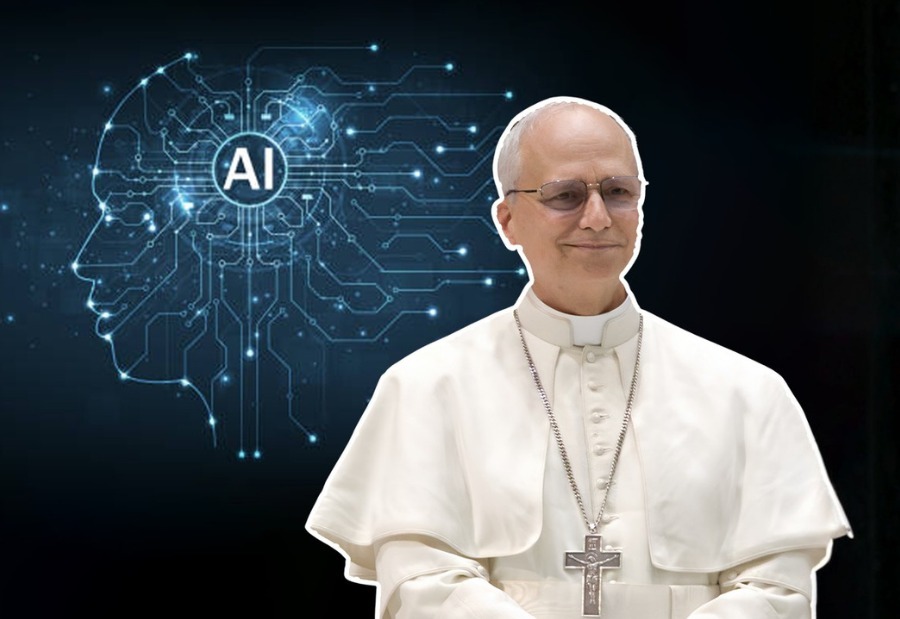
Artificial intelligence has become the defining technology story of our time. It dominates boardroom agendas, shapes national strategies, fuels trillion-dollar investments and increasingly influences how we work, learn and communicate. Yet amid the relentless focus on innovation and capability, Pope Leo XIV has posed a question that many technology leaders, policymakers and businesses have largely overlooked: What is artificial intelligence actually for?
It is a deceptively simple question.
For years, the global conversation around AI has revolved around a familiar set of themes. How powerful will the next model be? Which company is leading the race? Which country will dominate the AI economy? How many jobs will be automated? How quickly can organisations deploy AI at scale?
These are important questions. They are also incomplete.
Because beneath the excitement, investment and innovation lies a more fundamental challenge—one that no algorithm, no matter how sophisticated, can answer.
What is artificial intelligence ultimately meant to serve?
The question arrives at a pivotal moment.
Generative AI has moved from research laboratories to mainstream adoption at extraordinary speed. Organisations are embedding AI into products, operations and customer experiences. Governments are rushing to develop AI policies. Investors continue to place enormous bets on the technology’s future.
The momentum is undeniable.
So too is the assumption that often accompanies it: that faster technological progress is inherently desirable.
History offers a more nuanced perspective.
Every major technological revolution has promised transformation. The printing press democratised knowledge. Electricity reshaped economies. The internet redefined communication. Yet each breakthrough also introduced unintended consequences that societies spent years—sometimes decades—trying to understand and address.
Artificial intelligence is unlikely to be any different.
The challenge is not that AI is advancing too quickly. The challenge is that our discussions about AI frequently focus on capability while neglecting consequence.
We celebrate what machines can do before deciding what they should do.
We discuss efficiency before discussing accountability.
We optimise for scale before asking whether scale itself is the objective.
In many respects, today’s AI landscape resembles a global competition. Governments view artificial intelligence as a strategic asset. Businesses see a pathway to competitive advantage. Investors see unprecedented economic opportunity.
Everyone is focused on winning.
Far fewer are discussing direction.
That distinction matters because technology has never existed in a vacuum. Every innovation reflects human choices about whose problems are solved, whose interests are prioritised and who benefits from the outcome.
Artificial intelligence is no exception.
The technology is already influencing hiring decisions, shaping consumer behaviour, generating content, supporting healthcare systems and informing public services. As AI becomes more deeply embedded in everyday life, decisions once made solely by people are increasingly being influenced by algorithms.
This raises questions that extend far beyond engineering.
Who is accountable when automated systems make mistakes?
How do societies preserve trust in an era of synthetic media and AI-generated information?
What responsibilities do organisations have towards workers displaced by automation?
How should governments regulate technologies evolving faster than legislation can keep pace?
And where should human judgement remain non-negotiable?
These are not merely technology questions.
They are questions of governance, ethics and societal values.
Perhaps the most significant concern is not artificial intelligence itself, but the concentration of power surrounding it.
A relatively small number of organisations now control much of the infrastructure, computing power, data and foundational models driving the AI ecosystem. Their innovations have undoubtedly accelerated progress. Yet history consistently demonstrates that when transformative technologies become concentrated within a limited number of institutions, questions of accountability become unavoidable.
Power—whether economic, political or technological—rarely remains a purely technical issue.
Artificial intelligence amplifies this reality because it does not simply influence how people work. It increasingly shapes how they consume information, form opinions and make decisions.
This is precisely why conversations around AI governance, responsible AI and ethical AI development have become so important.
Regulation, however, is only part of the solution.
Rules can establish guardrails. They can reduce risk and create accountability. What they cannot do is provide purpose.
No regulatory framework can determine what kind of future society wishes to build.
That responsibility remains human.
And this is where Pope Leo XIV’s intervention becomes particularly relevant.
His argument is not fundamentally about opposing technology. Nor is it about slowing innovation. It is about ensuring that technological advancement remains anchored to human dignity, societal wellbeing and the common good.
In an era increasingly defined by automation and optimisation, that reminder feels surprisingly radical.
The technology sector excels at solving technical challenges. Yet the future of artificial intelligence will ultimately be shaped by questions that are philosophical rather than technological.
What does meaningful work look like in an age of automation?
How do we preserve human agency as machines become more capable?
What values should guide the development of intelligent systems?
How do we ensure innovation strengthens society rather than deepening inequality?
These questions cannot be answered through larger datasets, faster processors or more advanced models.
They require collective judgement.
The future of AI will not be determined solely by engineers, governments or technology companies. It will also be shaped by educators, ethicists, business leaders, regulators and citizens who collectively decide how these systems should serve society.
That may prove to be the defining challenge of the AI era.
Because despite all the discussion about machine intelligence, the most important issue has never been whether machines will become smarter.
It is whether humanity will remain wise enough to guide them.
Artificial intelligence may become the most transformative technology of the twenty-first century. It has the potential to unlock extraordinary economic value, accelerate scientific discovery and improve lives on a global scale.
But progress without purpose has never been a sustainable strategy.
Before asking how quickly AI can move forward, society must first decide where it wants to go.
And that is a question no machine can answer on our behalf.
Also read: Viksit Workforce for a Viksit Bharat
Do Follow: The Mainstream LinkedIn | The Mainstream Facebook | The Mainstream Youtube | The Mainstream Twitter
About us:
The Mainstream is a premier platform delivering the latest updates and informed perspectives across the technology business and cyber landscape. Built on research-driven, thought leadership and original intellectual property, The Mainstream also curates summits & conferences that convene decision makers to explore how technology reshapes industries and leadership. With a growing presence in India and globally across the Middle East, Africa, ASEAN, the USA, the UK and Australia, The Mainstream carries a vision to bring the latest happenings and insights to 8.2 billion people and to place technology at the centre of conversation for leaders navigating the future.