


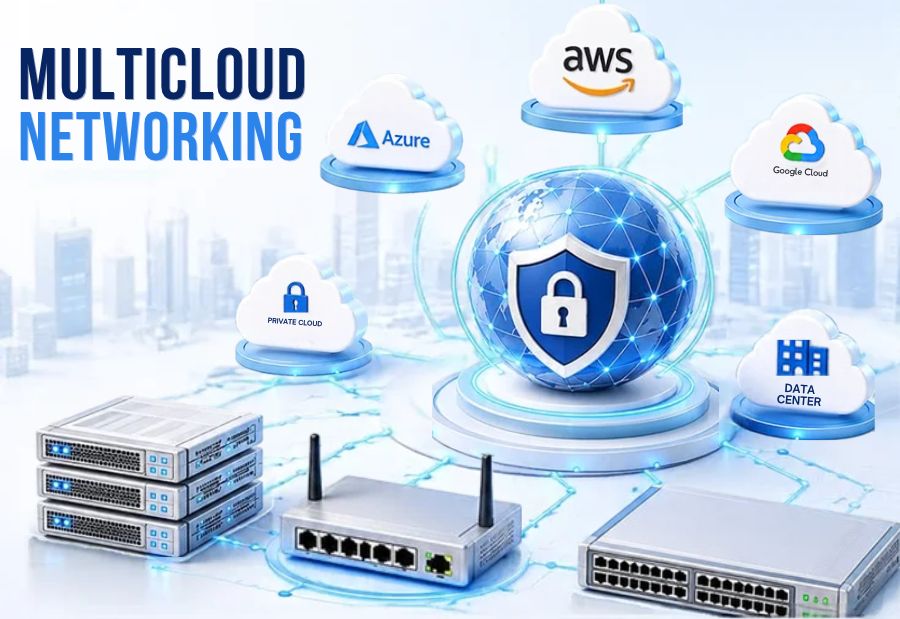
Businesses increasingly use services from multiple cloud providers to support applications, store data and run critical workloads. While this approach offers flexibility, connecting systems across different cloud environments can introduce challenges involving connectivity, security, performance and cost. Multi-cloud networking helps organisations connect these environments so that applications, users and services can communicate reliably.
As cloud strategies become more distributed, technology teams need to understand how multi-cloud networks work and what they must manage to keep business operations running smoothly.
What is Multi-Cloud Networking?
Multi-cloud networking refers to the infrastructure, technologies and policies used to connect workloads across two or more cloud providers. It may involve virtual networks, private connections, VPNs, routing policies, firewalls, DNS services and network monitoring tools.
For example, a business might host its customer-facing applications on one cloud platform while running analytics workloads on another. These systems need secure and dependable connections to exchange data and support business processes.
A well-designed network helps organisations manage connectivity across environments without treating each cloud as an isolated system.
Key Challenges of Multi-Cloud Networking
1. Managing Different Network Architectures
Cloud providers offer different networking services, configuration models and security controls. A network design that works in one environment may require adjustments in another.
These differences can make network administration more complex, particularly when teams manage routing, access rules and connectivity across several platforms. Organisations should document network designs and establish consistent policies wherever possible.
2. Maintaining Security Across Environments
Each cloud environment may have its own identity controls, firewall rules and network security tools. Inconsistent configurations can create gaps that attackers may exploit.
Businesses should apply least-privilege access, segment workloads and review connectivity between environments. Centralised visibility can help security teams understand which systems communicate and identify unexpected traffic.
3. Controlling Network Latency
Applications that exchange data across cloud providers may experience additional latency because traffic travels through different networks and geographic locations.
High latency can affect database queries, distributed applications and real-time analytics. Teams should measure response times between critical services and place connected workloads strategically to reduce unnecessary network travel.
4. Understanding Connectivity Costs
Moving data between cloud providers or across regions can create transfer charges. Frequent replication, large analytics transfers and unnecessary cross-cloud communication may increase operating costs.
Technology teams should identify high-volume traffic paths, review transfer pricing and determine whether certain workloads should be located closer together. Network cost optimization should consider performance, resilience and data governance requirements rather than cost alone.
5. Monitoring Network Performance
Each cloud provider may supply different monitoring dashboards, metrics and alerting mechanisms. This can make it difficult to investigate incidents that involve multiple environments.
A shared monitoring approach should track latency, packet loss, throughput, connection failures and important network events. Consistent logging and alerting help teams identify whether a problem originates in an application, a cloud network or the connection between providers.
Best Practices for Building a Reliable Multi-Cloud Network
Organisations should begin by mapping applications, dependencies and data flows across cloud environments. This provides a clearer understanding of which systems need connectivity and which traffic paths require additional protection.
They should also standardise naming conventions, network documentation, access policies and monitoring practices. Infrastructure as Code can help teams manage configurations consistently and review changes before deployment.
For critical workloads, redundant connections and tested recovery procedures can reduce disruption. However, redundancy should be designed carefully to avoid creating routing conflicts or unnecessary complexity.
Final Thought
Multi-cloud networking can help businesses connect services across different cloud platforms, but it requires careful planning. Consistent security policies, performance monitoring, cost visibility and clear network ownership are essential for reliable operations. The Mainstream continues to cover cloud infrastructure and technology strategies that help organisations build resilient digital environments.