


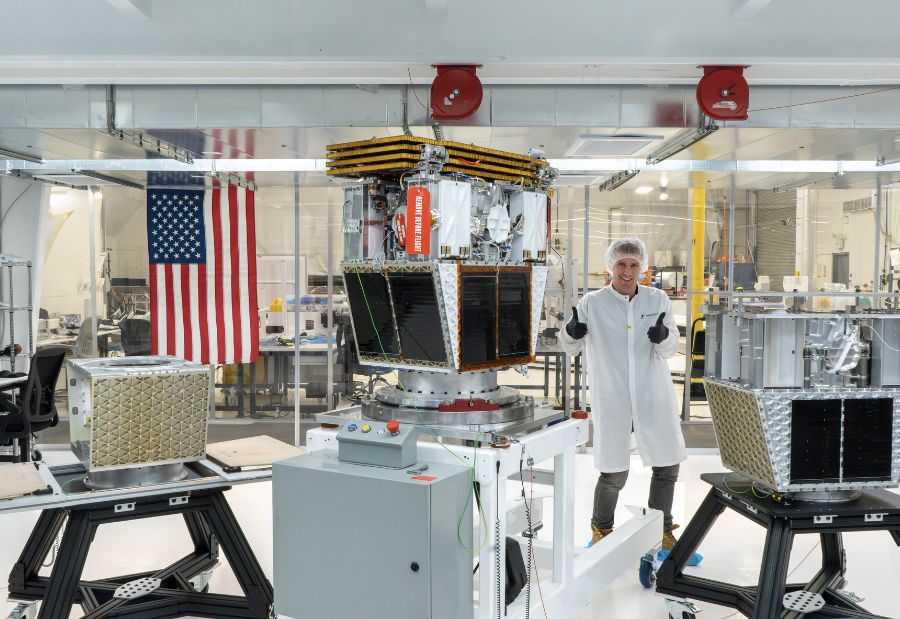
The United States has approved an experimental space mission that aims to reflect sunlight onto Earth after sunset. The Federal Communications Commission (FCC) has authorised California-based startup Reflect Orbital to launch its Eärendil-1 satellite, marking a significant step toward testing orbital mirror technology for practical applications.
Scheduled to launch later this year, Eärendil-1 will be placed in low Earth orbit at an altitude of approximately 640 km. The satellite, about the size of a dormitory refrigerator, will deploy a square mirror measuring nearly 18 metres across. According to the company, the mirror is designed to redirect sunlight onto a circular area of around 5 km on Earth’s surface after dark.
Reflect Orbital says the technology could extend daylight for solar farms, provide temporary lighting during natural disasters and emergency rescue operations, support overnight construction projects, and illuminate roads and urban areas during nighttime.
The company has outlined plans to launch around 1,000 larger satellites by 2028 and expand the network to as many as 50,000 satellites by 2035. Future satellites could carry mirrors measuring nearly 55 metres across, producing illumination comparable to the brightness of around 100 full moons.
Despite its potential benefits, the project has raised concerns within the scientific community. The American Astronomical Society urged the FCC to reject the proposal, arguing that large orbital mirrors could interfere with astronomical observations by increasing artificial light in the night sky.
Samantha Lawler, an astronomer at the University of Regina, has also warned that additional artificial light could negatively affect astronomical research. Environmental researchers have raised concerns that increased nighttime illumination may disrupt circadian rhythms in humans, animals, and plants, while bright reflections from repositioning mirrors could distract aircraft pilots and motorists.
The FCC said its approval is limited to satellite communications and radio frequency regulations and does not cover environmental impacts in outer space. The agency added that current U.S. regulations do not require environmental reviews for activities conducted beyond Earth’s atmosphere.
Although the concept has gained renewed attention, it is not entirely new. In 1993, Russia tested an 80-foot orbital mirror that briefly reflected sunlight onto parts of Siberia before the programme was discontinued following a failed follow-up mission.
The outcome of Reflect Orbital’s Eärendil-1 mission is expected to determine whether orbital mirror technology can become a practical solution for extending daylight or remain an experimental concept in space exploration.
Also read: Viksit Workforce for a Viksit Bharat
Do Follow: The Mainstream LinkedIn | The Mainstream Facebook | The Mainstream Youtube | The Mainstream Twitter
About us:
The Mainstream is a premier platform delivering the latest updates and informed perspectives across the technology business and cyber landscape. Built on research-driven, thought leadership and original intellectual property, The Mainstream also curates summits & conferences that convene decision makers to explore how technology reshapes industries and leadership. With a growing presence in India and globally across the Middle East, Africa, ASEAN, the USA, the UK and Australia, The Mainstream carries a vision to bring the latest happenings and insights to 8.2 billion people and to place technology at the centre of conversation for leaders navigating the future.