


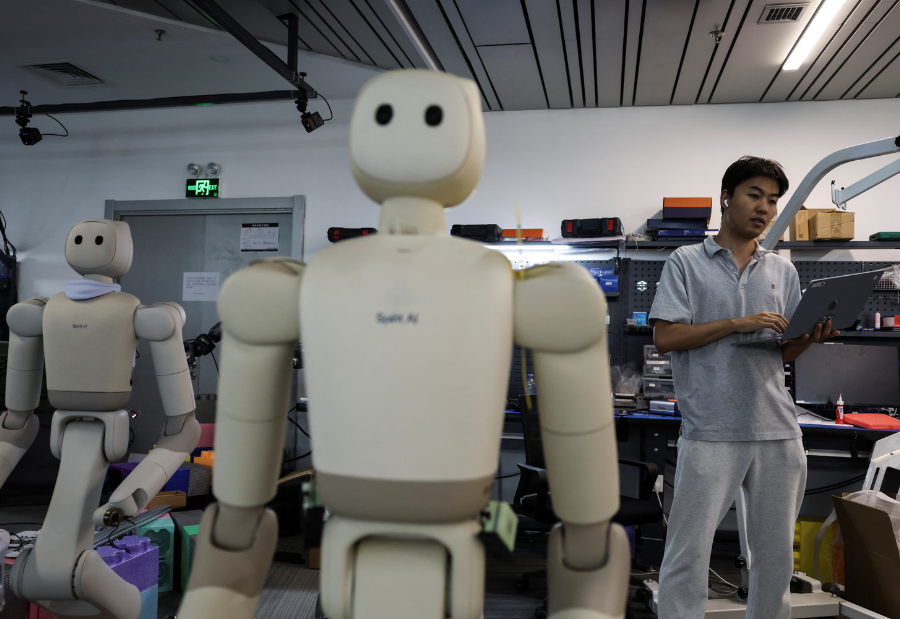
China’s humanoid robotics industry is shifting greater attention towards the software that powers robot intelligence, with Spirit AI predicting a major breakthrough in robot “brains” by mid-2027. However, the company expects household use of such robots to remain at least 8 years away because of challenges in collecting enough training data.
Chinese humanoid robots have made rapid hardware progress, with machines now capable of running, dancing and performing backflips. The industry is increasingly focused on improving the intelligence and real-world productivity of these systems.
“The brain is indeed the weakest link in the complete robotics stack,” Gao Yang, co-founder and chief scientist of Spirit AI, said at the company’s Beijing office on Thursday.
Gao expects an industry breakthrough comparable to OpenAI’s GPT-3.0, which powered ChatGPT, around mid-2027. Spirit AI’s robots have achieved a 90% success rate on simple tasks in structured living-room environments.
“The next one to two years mark the initial window for industrial applications. Two years from now, we’ll see robots deployed in commercial service settings doing simpler tasks. Entering homes is far harder than both,” said Gao, who is also an assistant professor of robotics at Tsinghua University.
Spirit AI focuses on robot intelligence
Spirit AI has tens of its Moz1 wheeled humanoid robots working on production lines at battery maker CATL and retailer JD.com, which is also an investor.
The 300-person startup has raised more than $670 million since its founding in 2024. It is currently valued at 20 billion yuan ($2.9 billion). Gao declined to comment on a possible initial public offering.
“Progress is extremely fast. When Spirit AI was founded, a robot could perform only one isolated task well, like pouring water or folding a piece of clothing,” said Gao.
“Today, robots operate across large spatial areas and execute continuous complex workflows.”
The company still faces challenges with fine-motor tasks such as unscrewing bottle caps and handling unfamiliar situations. Spirit AI mainly uses real-world data instead of virtual simulations for training.
“Simulators handle rigid bodies well, but flexible objects like deformable electric cables remain a problem,” said Gao.
Human-collected data drives training
Spirit AI employs around 1,000 contractors across China who collect data in homes and production facilities using wearable equipment.
At its Beijing training centre, dozens of people were seen wearing sensors and repeatedly performing actions such as opening refrigerators, unlocking safes and cutting vegetables with knives.
At some other training centres, operators may repeat a movement more than 50 times to produce 1 “clean” movement with the required precision.
Spirit AI found that using “dirty data” containing a wider variety of movements helped its models improve faster, Gao said.
Also read: Viksit Workforce for a Viksit Bharat
Do Follow: The Mainstream LinkedIn | The Mainstream Facebook | The Mainstream Youtube | The Mainstream Twitter
About us:
The Mainstream is a premier platform delivering the latest updates and informed perspectives across the technology business and cyber landscape. Built on research-driven, thought leadership and original intellectual property, The Mainstream also curates summits & conferences that convene decision makers to explore how technology reshapes industries and leadership. With a growing presence in India and globally across the Middle East, Africa, ASEAN, the USA, the UK and Australia, The Mainstream carries a vision to bring the latest happenings and insights to 8.2 billion people and to place technology at the centre of conversation for leaders navigating the future.