


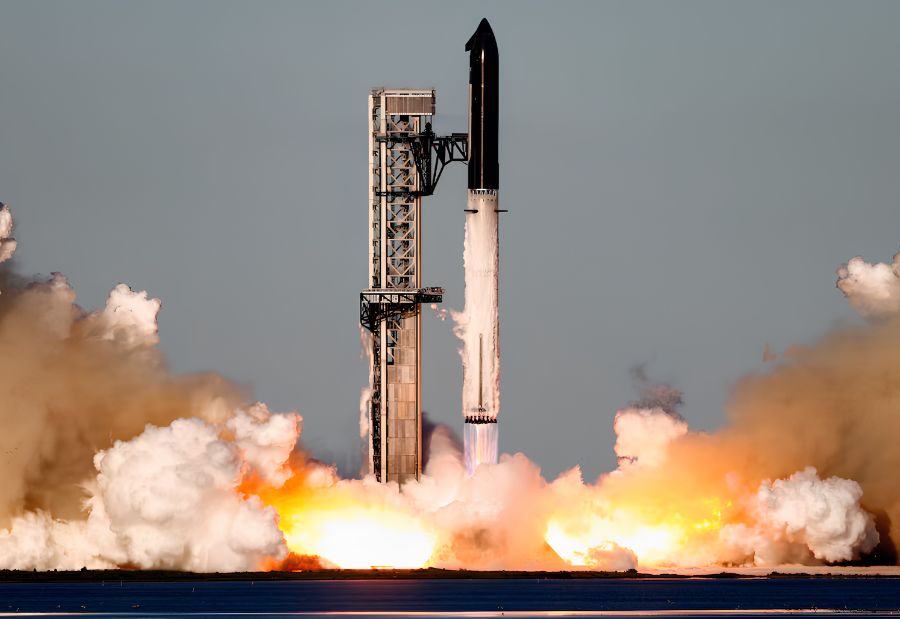
SpaceX has taken another major step towards developing a fully reusable rocket system with the launch of its 15th Starship test flight from Texas on Friday. The mission aims to achieve the first complete orbital journey in which the spacecraft returns to the same launch site, marking an important milestone in Elon Musk’s plans to reduce the cost of space travel.
The mission is designed to test the return of Starship’s uncrewed upper stage after approximately 22 hours in orbit. The spacecraft is expected to re-enter Earth’s atmosphere and return to its Texas launch tower on Saturday. Its final descent will be controlled by its engines, while 2 giant mechanical arms, known as the “chopsticks”, are designed to catch the vehicle above the launch platform.
SpaceX had also planned to recover the lower-stage Super Heavy booster using the same catching mechanism shortly after separation. However, the booster was diverted from its planned return route towards the Gulf of Mexico for reasons that remain unclear. It briefly hovered above the sea before exploding near the water’s surface.
Despite the setback, the upper stage successfully reached orbit approximately 27 minutes after launch, according to SpaceX. Mission controllers are now focused on bringing it back safely. A successful return to the original launch platform would represent a major achievement in the company’s efforts to make its rockets completely reusable.
The combined Starship vehicle, consisting of the main spacecraft mounted on the Super Heavy booster, stands approximately 40 storeys tall. It lifted off from SpaceX’s Starbase facility in South Texas, near Brownsville along the Gulf Coast.
This was Starship’s 15th test flight since 2023 and its second mission to carry operational Starlink satellites into orbit. SpaceX confirmed that all 26 satellites were successfully deployed within the first 2 hours of the flight. The mission therefore supports the company’s satellite connectivity business while also testing a rocket system that remains under development.
Starship is expected to play a major role in expanding SpaceX’s Starlink network and supporting its future plans for orbital AI data-processing centres, known as Starmind. These ambitions are part of the company’s broader strategy to become a major provider of advanced technology infrastructure.
During its previous flight in September, Starship reached orbit for the first time despite engine malfunctions during the mission. The planned 10-hour flight ended after approximately 3 hours, with the upper stage landing intact in the Pacific Ocean before catching fire.
For the latest mission, the upper stage is expected to complete 14 orbits around Earth before attempting its first catch landing on Saturday afternoon. If successful, it would become the first vertically launched spacecraft to complete an orbital round trip and return to its precise launch location.
SpaceX already regularly recovers the booster stages of its Falcon 9 rockets using dedicated landing pads and floating platforms at sea. The Super Heavy booster has also been successfully caught by the launch tower on 3 previous test flights, with the latest successful recovery taking place in March 2025. The reason behind Friday’s failed fourth catch attempt has not yet been established.
Musk has stated that SpaceX aims to achieve weekly Starship launches by the first half of 2027.
NASA has supported Starship’s development with approximately $3.2 billion since selecting it in 2021 as a lunar lander for its astronauts under the Artemis programme. SpaceX has separately invested at least $15 billion in the rocket’s development.
NASA and SpaceX are targeting 2028 for the first human lunar landing using Starship. However, several major technical milestones remain, including demonstrating fuel transfers between Starship tanker spacecraft in orbit. This process is essential for enabling the vehicle to travel beyond Earth’s orbit and reach the Moon.
Meanwhile, Jeff Bezos’ Blue Origin is also developing a lunar lander for NASA’s Artemis programme. Its Blue Moon lander is expected to join Starship and NASA’s Orion capsule in Earth’s orbit next year for Artemis III, a docking demonstration mission ahead of the planned lunar landings under Artemis IV.
Also read: Viksit Workforce for a Viksit Bharat
Do Follow: The Mainstream LinkedIn | The Mainstream Facebook | The Mainstream Youtube | The Mainstream Twitter
About us:
The Mainstream is a premier platform delivering the latest updates and informed perspectives across the technology business and cyber landscape. Built on research-driven, thought leadership and original intellectual property, The Mainstream also curates summits & conferences that convene decision makers to explore how technology reshapes industries and leadership. With a growing presence in India and globally across the Middle East, Africa, ASEAN, the USA, the UK and Australia, The Mainstream carries a vision to bring the latest happenings and insights to 8.2 billion people and to place technology at the centre of conversation for leaders navigating the future.