


Advanced research in cartilage bioprinting and lead-free soldering took priority aboard the International Space Station on Tuesday, as the Expedition 75 crew continued work on technologies that could support future space missions and benefit applications on Earth.
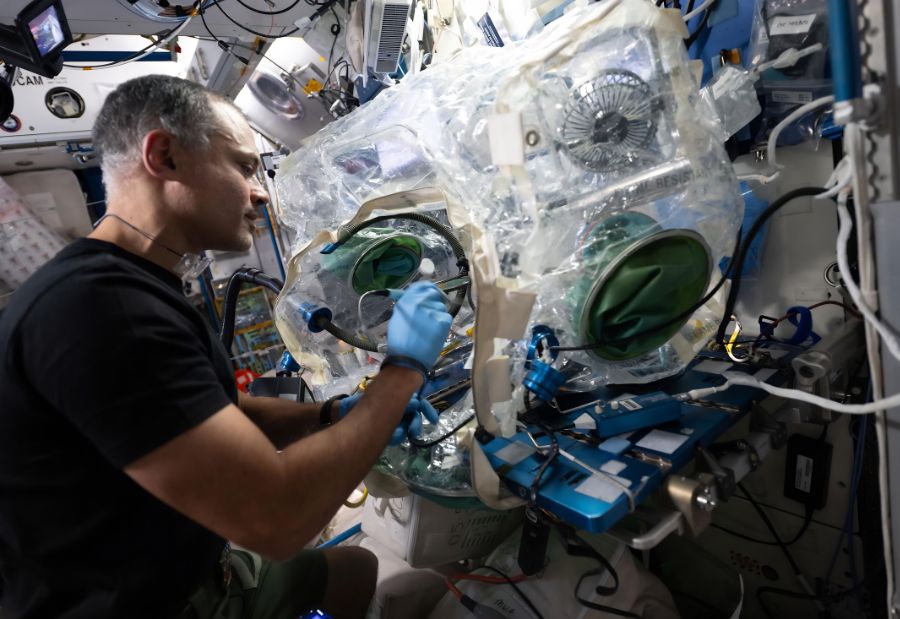
NASA astronauts Jessica Meir and Sophie Adenot of the European Space Agency worked on cartilage bioprinting by processing cartilage cell samples stored in the MERLIN research incubator and loading them into the Auxilium bioprinter. The sessions take place inside the Kibo laboratory module’s Life Science Glovebox and can be operated remotely.
Bioprinting cartilage tissue in microgravity can produce higher-quality tissue than processes carried out on Earth. The research could support advanced treatments for cartilage injuries and potentially enable personalised implants made using a patient’s own cells.
Meir also worked on the RelaxPro investigation, exploring mindfulness and meditation techniques aimed at reducing stress and improving sleep quality for astronauts. Adenot inspected hatch seals across the U.S. segment of the station.
NASA flight engineer Anil Menon continued research into lead-free soldering inside the Harmony module. He soldered components onto a circuit board to demonstrate the ability to manufacture and repair electronics in microgravity. He photographed the samples for analysis, with the space-soldered components set to return to Earth for comparison with identical ground-produced samples.
The results could help reduce dependence on costly resupply missions. Menon also cleaned a water filter cartridge in the Unity module’s oxygen generation system and tested a spacesuit emergency jet pack inside the Quest airlock.
NASA flight engineer Jack Hathaway worked on Quest’s atmospheric control system and installed a new oxygen tank. He also inspected lithium-ion batteries that power spacesuits and metal oxide canisters that remove carbon dioxide during spacewalks.
In the Roscosmos segment, flight engineers Pyotr Dubrov and Anna Kikina checked research hardware in the Nauka science module designed to heat and remove air pressure from material samples. They also inspected air ducts and hatch seals.
Roscosmos flight engineer Andrey Fedyaev measured his blood pressure using cuffs on his arm, wrist and fingers to study how microgravity affects the microcirculatory system. He later worked on ventilation system maintenance inside Nauka.
Also read: Viksit Workforce for a Viksit Bharat
Do Follow: The Mainstream LinkedIn | The Mainstream Facebook | The Mainstream Youtube | The Mainstream Twitter
About us:
The Mainstream is a premier platform delivering the latest updates and informed perspectives across the technology business and cyber landscape. Built on research-driven, thought leadership and original intellectual property, The Mainstream also curates summits & conferences that convene decision makers to explore how technology reshapes industries and leadership. With a growing presence in India and globally across the Middle East, Africa, ASEAN, the USA, the UK and Australia, The Mainstream carries a vision to bring the latest happenings and insights to 8.2 billion people and to place technology at the centre of conversation for leaders navigating the future.