


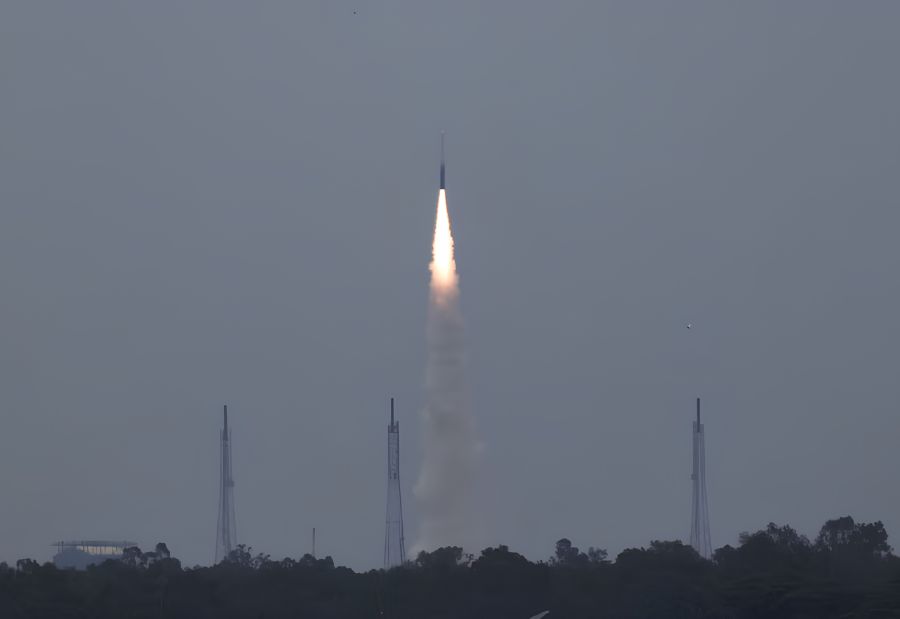
India marked a major milestone in its private space journey as space startup Skyroot Aerospace successfully launched Vikram-1, the country’s first privately developed orbital rocket.
The mission is a significant step towards strengthening India’s position in the global commercial launch market.
The Vikram-1 rocket lifted off from the Satish Dhawan Space Centre in Sriharikota at 06:35 GMT, carrying multiple customer payloads and in-orbit experiments on its maiden orbital mission, Mission Aagaman. Around 15 minutes after launch, the rocket successfully placed its payload into a 450 km orbit, making India the 3rd country to achieve orbital launch capability through private enterprise.
The launch was originally scheduled for 06:00 GMT but was briefly put on hold before being rescheduled.
The mission was designed to validate the rocket’s propulsion, avionics, telemetry, guidance, navigation and control systems while collecting valuable flight data for future commercial launches.
“Mission Aagaman is a grand success. This is a test flight. We will be doing a few of these before we move into routine commercial flights,” the company said in a statement.
Founded in 2018, Skyroot is part of India’s growing private space ecosystem, which has attracted significant global investment following the liberalisation of the country’s space sector. Earlier this year, the company became India’s first space-sector startup to achieve a $1 billion valuation.
The launch comes as competition in the global small satellite launch market continues to grow, with startups challenging established players led by Elon Musk’s SpaceX. Governments across Europe and Asia are also increasing support for domestic launch companies to strengthen independent access to space.
Standing 22 metres (72 feet) tall, Vikram-1 can carry payloads of up to 350 kg into low-Earth orbit. The launch vehicle uses 3 solid-fuel stages and a liquid-fuel orbital adjustment module powered by a 3D-printed engine, marking another first for India. It also carried multiple technology demonstration satellites and in-orbit experiments from Indian and international organisations.
The mission builds on Skyroot’s Vikram-S suborbital launch in 2022, the first privately developed rocket to reach space from Indian soil. India opened its space sector to private investment in 2020 and aims to expand its share of the global space economy from $8 billion to $44 billion by 2033.
Also read: Viksit Workforce for a Viksit Bharat
Do Follow: The Mainstream LinkedIn | The Mainstream Facebook | The Mainstream Youtube | The Mainstream Twitter
About us:
The Mainstream is a premier platform delivering the latest updates and informed perspectives across the technology business and cyber landscape. Built on research-driven, thought leadership and original intellectual property, The Mainstream also curates summits & conferences that convene decision makers to explore how technology reshapes industries and leadership. With a growing presence in India and globally across the Middle East, Africa, ASEAN, the USA, the UK and Australia, The Mainstream carries a vision to bring the latest happenings and insights to 8.2 billion people and to place technology at the centre of conversation for leaders navigating the future.