


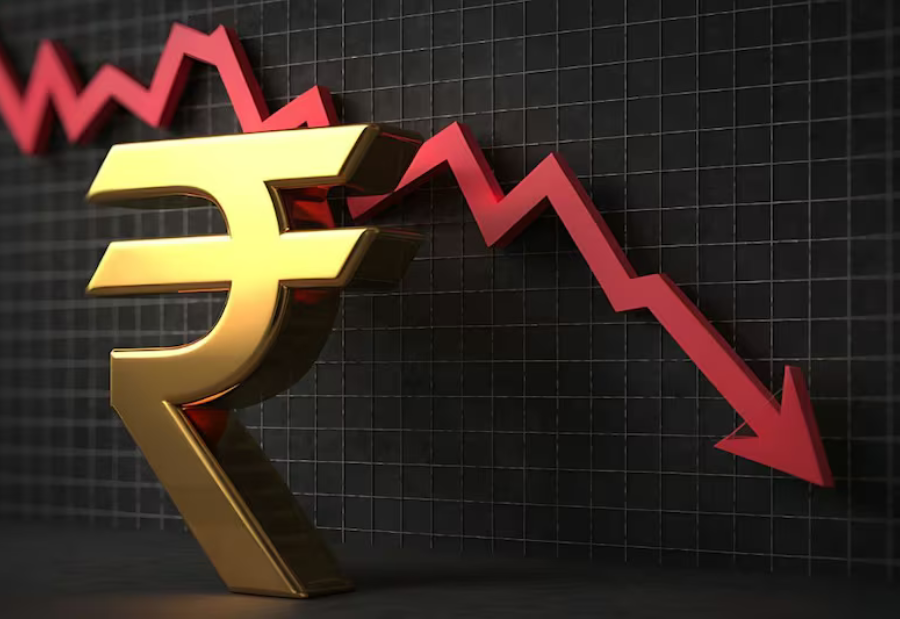
The Indian rupee gave up most of its previous session’s gains and weakened by 43 paise to close at 95.61 against the US dollar on Monday, as rising crude oil prices and a stronger US dollar weighed on market sentiment.
According to forex market participants, escalating geopolitical tensions in the Middle East, higher crude prices, and increased demand for safe-haven assets put pressure on the domestic currency.
At the interbank foreign exchange market, the rupee opened at 95.35 against the US dollar and traded between an intraday high of 95.15 and a low of 95.75 before settling at 95.61. The decline follows Friday’s sharp appreciation of 56 paise, which was driven by the Reserve Bank of India’s measures aimed at boosting foreign capital inflows and strengthening forex liquidity.
Meanwhile, the dollar index, which tracks the performance of the US currency against a basket of six major currencies, was trading 0.09% higher at 100.16.
Crude oil prices witnessed a significant jump after Iran launched multiple rounds of missiles towards Israel. Brent crude rose 3.94% to $96.76 per barrel in futures trade, increasing concerns over inflationary pressures and higher import costs for oil-dependent economies such as India.
Anuj Choudhary, Research Analyst at Mirae Asset ShareKhan, said the rupee is expected to remain under pressure due to escalating tensions involving the US, Israel, and Iran, along with rising crude prices. He noted that a stronger dollar and higher US Treasury yields could further weigh on the currency, although any intervention by the Reserve Bank of India may provide support. He expects the USD-INR spot rate to trade between 95.40 and 96.10.
Dilip Parmar, Senior Research Analyst at HDFC Securities, said the rupee erased most of its previous gains as geopolitical tensions boosted crude prices and increased demand for safe-haven assets. He added that strong US employment data has renewed expectations of potential interest rate hikes by the US Federal Reserve, supporting the dollar and reducing investor appetite for riskier assets. Parmar expects USD-INR to remain within the 94.50 to 96.50 range in the near term.
On the domestic equity front, the Sensex declined 719.08 points to close at 73,524.26, while the Nifty fell 243.70 points to 23,123. Foreign institutional investors sold equities worth ₹5,555.67 crore on a net basis during the session.
Separately, Reserve Bank of India data showed that India recorded a current account surplus of $7.1 billion, or 0.7% of GDP, during the January–March quarter of FY26, supported by stronger services exports and remittance inflows. For the full financial year, the current account deficit stood at $25.2 billion, equivalent to 0.6% of GDP, compared with $22.9 billion, or 0.6% of GDP, in FY25.
Meanwhile, media reports indicated that US President Donald Trump urged Israeli Prime Minister Benjamin Netanyahu not to retaliate against Iran’s latest missile attacks, cautioning that such action could affect ongoing efforts to end the conflict that has continued for nearly 3 months.
Also read: Viksit Workforce for a Viksit Bharat
Do Follow: The Mainstream LinkedIn | The Mainstream Facebook | The Mainstream Youtube | The Mainstream Twitter
About us:
The Mainstream is a premier platform delivering the latest updates and informed perspectives across the technology business and cyber landscape. Built on research-driven, thought leadership and original intellectual property, The Mainstream also curates summits & conferences that convene decision makers to explore how technology reshapes industries and leadership. With a growing presence in India and globally across the Middle East, Africa, ASEAN, the USA, the UK and Australia, The Mainstream carries a vision to bring the latest happenings and insights to 8.2 billion people and to place technology at the centre of conversation for leaders navigating the future.