


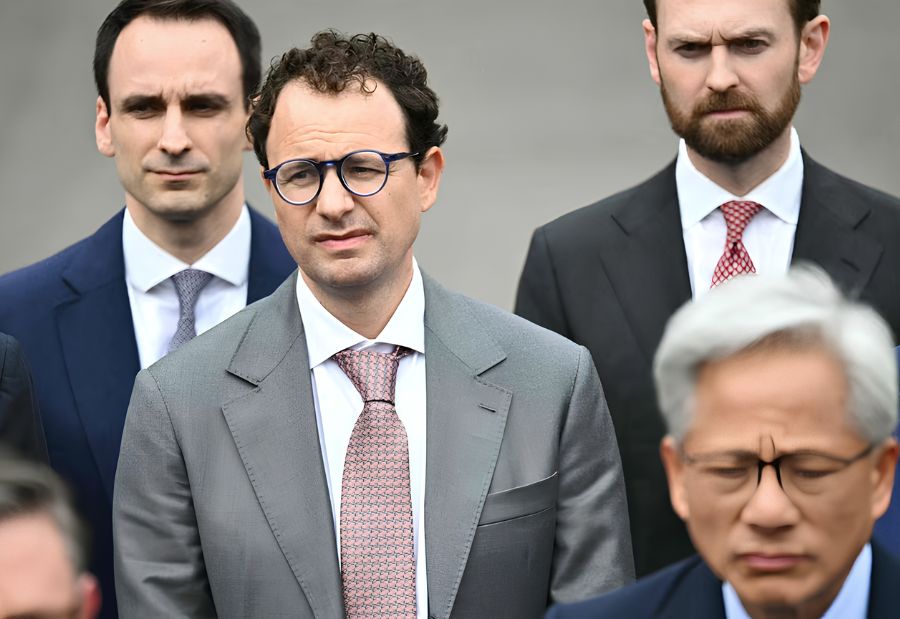
Nvidia’s proposed investment in Anthropic is facing fresh scrutiny following reports of a leadership change at the chipmaker, just days before the AI company’s highly anticipated stock market debut. The development has also brought renewed attention to how major chipmakers are supporting the AI industry’s growing borrowing needs through financial guarantees.
According to Bloomberg Intelligence analyst Mandeep Singh, a leadership transition could lead Nvidia’s board to reassess the size, timing or strategic rationale of its $10 billion commitment to Anthropic. Singh noted that any delay or reduction could weaken an important signal of support for the company’s proposed IPO valuation of around $1.4 trillion. However, commitments from Google and other strategic investors could help limit the impact.
Anthropic, the company behind the Claude chatbot, has offered 825 million shares at $70 to $78 each, potentially raising up to $64.4 billion. The company is expected to list on Nasdaq under the symbol ANT on November 19, according to Bloomberg.
Alongside the public offering, 7 technology companies have agreed to purchase $26 billion worth of shares at the IPO price through a private placement. Nvidia and Google are each expected to invest around $10 billion, followed by AMD with $2.5 billion. Broadcom, Micron and Microsoft are set to contribute approximately $1 billion each, while TSMC has committed around $500 million.
Together, the public offering and private placement could raise as much as $90.4 billion, potentially surpassing SpaceX’s $75 billion listing in June. The IPO has reportedly attracted around 6 times more orders than the shares available.
Anthropic’s filing shows revenue of $17 billion for the 3 months ended September 30. Its revenue run rate reached $81 billion by October 31, compared with $65 billion at the end of July.
The private placement remains subject to the IPO proceeding and the fulfilment of certain conditions. While Anthropic declined to comment, Nvidia did not immediately respond to requests for comment. Matt Maley, chief market strategist at Miller Tabak, said the deal appeared likely to proceed and that the developments surrounding Nvidia did not seem to be having a significant impact on Anthropic.
How chipmakers are supporting AI financing
Under Jensen Huang’s leadership, Nvidia was often described as the “central bank of AI” because of its investments and financial backing across the industry.
One important part of this support involves chip leasing, a financing model that has expanded as AI companies compete to secure expensive processors. In a typical arrangement, a specially created company borrows money to purchase chips and leases them to an AI company. If lease payments stop, the chips can be leased to another customer or sold to recover the debt.
Chipmakers provide an additional layer of financial protection through guarantees known as residual value support. These guarantees cover any remaining shortfall, helping attract lenders, secure better credit ratings and reduce borrowing costs.
Nvidia has indicated that it would cover up to 25% of a financing deal. Broadcom, however, has offered significantly larger guarantees. In May, it backed $30 billion of a $35 billion debt arrangement through which Anthropic leases tensor processing units (TPUs) developed by Broadcom and Google. It is also supporting approximately $43 billion of a separate $63 billion financing deal.
Nvidia faces a financing challenge
The difference in guarantee levels had already complicated Nvidia’s efforts to expand its AI financing business before the reported leadership change.
In August, Huang joined executives from Apollo, BlackRock, Blackstone, Brookfield, Goldman Sachs and KKR to announce a platform aimed at financing $500 billion in AI computing deals. However, no deals had emerged in the following months. Some customers and financial partners had also reportedly pushed Nvidia to increase its 25% guarantee.
The earliest Nvidia could announce a deal is likely January, although the leadership transition could affect the initiative.
Increasing its guarantee would expose Nvidia to greater financial risk. However, maintaining the current 25% limit could make its chips more difficult for customers to afford and its financing arrangements less attractive to lenders.
The developments highlight the growing role of chipmakers in financing AI infrastructure, as investment commitments, lending guarantees and access to advanced processors become increasingly connected.
Also read: Viksit Workforce for a Viksit Bharat
Do Follow: The Mainstream LinkedIn | The Mainstream Facebook | The Mainstream Youtube | The Mainstream Twitter
About us:
The Mainstream is a premier platform delivering the latest updates and informed perspectives across the technology business and cyber landscape. Built on research-driven, thought leadership and original intellectual property, The Mainstream also curates summits & conferences that convene decision makers to explore how technology reshapes industries and leadership. With a growing presence in India and globally across the Middle East, Africa, ASEAN, the USA, the UK and Australia, The Mainstream carries a vision to bring the latest happenings and insights to 8.2 billion people and to place technology at the centre of conversation for leaders navigating the future.