


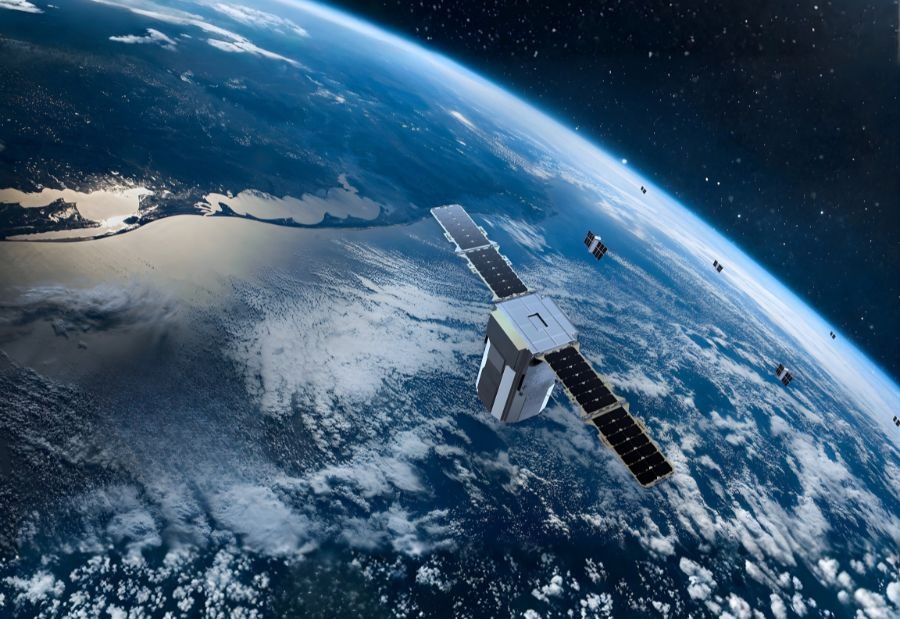
A new breakthrough in space technology is set to redefine how spacecraft operate, bringing real-time intelligence directly onboard and reducing reliance on ground-based control.
Developed by Aurora Engineering under the Small Business Innovation Research/Small Business Tech Transfer (SBIR/STTR) program of NASA’s Space Technology Mission Directorate, the Module for Event Driven Operations on Spacecraft (MEDOS) introduces event-driven autonomous operations.
Unlike traditional mission planning, which depends on schedules created days or weeks in advance, MEDOS enables spacecraft to detect events as they happen and respond instantly without human intervention. This capability is expected to support advanced missions, including exploring subterranean caves on Mars, studying solar wind turbulence, and investigating subsurface oceans on Europa.
MEDOS works by combining raw telemetry data from multiple onboard instruments and converting it into meaningful physical parameters. These are then compared against known event signatures to determine what is happening, along with a clear confidence level. Based on this assessment, the system decides the most appropriate response in real time.
The system does not rely on large volumes of labeled training data. Instead, it encodes years of expert knowledge into a mathematical framework that accounts for uncertainty. By weighing multiple parameters together, MEDOS can identify complex events such as space weather changes. For instance, simultaneous increases in particle energy, density, and magnetic activity may signal a significant event, prompting the system to prioritize data for transmission.
MEDOS also evaluates multiple possible explanations for observed signals and assigns likelihood scores. This allows it to distinguish between genuine environmental events and potential hardware issues, enabling more accurate decision-making onboard.
The technology has already been flight-tested on Magnetospheric Multiscale Mission, which consists of 4 spacecraft studying magnetic reconnection between the Sun and Earth. During operations, MEDOS successfully identified a radiation event—an unexpected passage through the Van Allen radiation belts—and triggered protective actions that ground-based predictions had missed.
This real-time detection helped prevent potential instrument damage by adjusting spacecraft operations instantly, demonstrating the limitations of pre-planned commands in dynamic space environments.
As missions grow more complex, technologies like MEDOS are expected to play a critical role in enabling autonomous exploration. By embedding human expertise into onboard systems, MEDOS offers a transparent, reliable, and efficient approach to spacecraft operations for future missions to the Moon, Mars, and beyond.
Also read: Viksit Workforce for a Viksit Bharat
Do Follow: The Mainstream LinkedIn | The Mainstream Facebook | The Mainstream Youtube | The Mainstream Twitter
About us:
The Mainstream is a premier platform delivering the latest updates and informed perspectives across the technology business and cyber landscape. Built on research-driven, thought leadership and original intellectual property, The Mainstream also curates summits & conferences that convene decision makers to explore how technology reshapes industries and leadership. With a growing presence in India and globally across the Middle East, Africa, ASEAN, the USA, the UK and Australia, The Mainstream carries a vision to bring the latest happenings and insights to 8.2 billion people and to place technology at the centre of conversation for leaders navigating the future.