


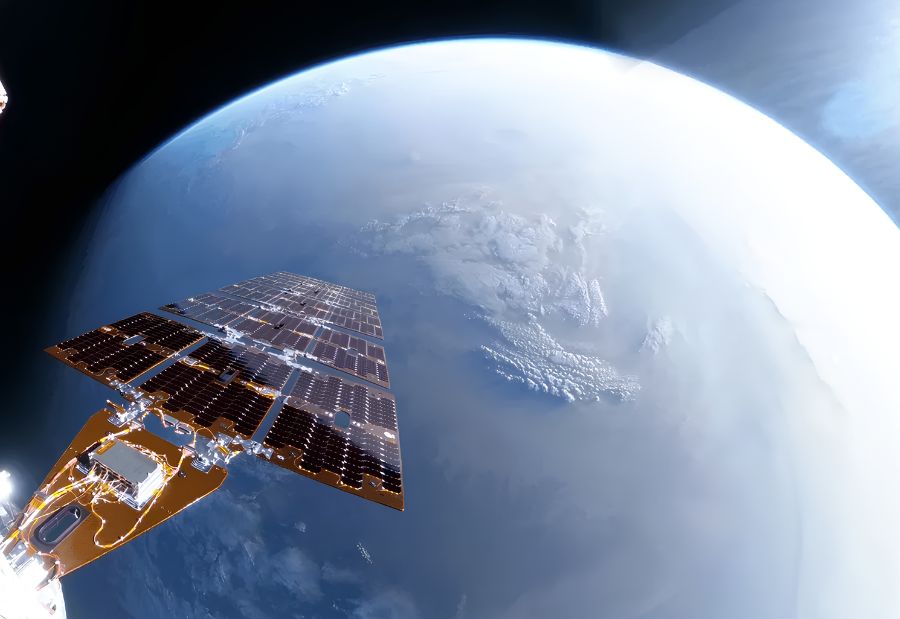
After more than 22 years of scientific observations, NASA’s Swift space telescope has completed its final journey, re-entering Earth’s atmosphere on November 4. The observatory’s return comes just 3 months after a private spacecraft failed to carry out a planned orbital boost that could have extended its operational life.
Weighing approximately 3,200 pounds (1,450 kg), Swift re-entered the atmosphere at 7:39 a.m. EST (12:39 GMT) over northern Sumatra, according to satellite tracker Jonathan McDowell, citing US Space Force data.
NASA had predicted that most of the observatory would burn up during re-entry. The agency had estimated the probability of any surviving debris causing harm to someone on Earth at just 1 in 2,100.
Officially known as the Swift Gamma-Ray Burst Explorer, the telescope was launched into Earth’s orbit in November 2004 for a planned 2-year mission to study gamma-ray bursts (GRBs), some of the most powerful explosions in the universe. Its name referred to its ability to quickly detect and observe cosmic events rather than being an acronym.
Swift was designed to identify gamma-ray bursts, communicate their locations to other observatories and rapidly redirect its telescopes towards them before their afterglows disappeared. This process typically took around 1 minute.
Beyond gamma-ray bursts, the observatory also studied distant supernova explosions, feeding black holes, asteroids and comets within our solar system.
Despite being designed for a relatively short mission, Swift continued its scientific operations for more than 20 years beyond its original 2-year plan. In 2018, it was renamed the Neil Gehrels Swift Observatory in honour of its first principal investigator, who passed away in 2017.
“Swift delivered an incredible, lasting return on investment for the nation, designed for a two-year primary mission but productive for more than 10 times as long,” said Shawn Domagal-Goldman, director of NASA’s Astrophysics Division, in an October 23 statement.
He added, “In that time, Swift played a major role in advancing our understanding of the changing universe and was part of a revolution in astrophysics that showed how critical rapid-response observations are to the entire community.”
During its scientific operations, Swift observed more than 2,000 gamma-ray bursts and 1,400 supernovas. Its final scientific observation took place on October 20, 2026.
However, NASA had made an attempt to extend the telescope’s lifespan. In September 2025, the agency awarded Arizona-based Katalyst Space a $30 million contract to develop, launch and operate a robotic spacecraft that would capture Swift and move it into a higher orbit.
The telescope had been gradually losing altitude because it lacked onboard thrusters to counter atmospheric drag. As it moved closer to Earth, the rate of orbital decay increased, making the rescue mission time-sensitive.
Katalyst Space launched its refrigerator-sized LINK servicing spacecraft on July 3, 2026, with plans to reach Swift in August. However, problems with its propulsion system and reaction wheels, which help maintain spacecraft orientation, prevented the planned rendezvous.
LINK itself re-entered Earth’s atmosphere on September 25, 2026.
“From the beginning, this was a high-risk, high-reward mission,” Domagal-Goldman said, acknowledging the challenges of the rescue effort. He also highlighted its value in advancing US spacecraft servicing technology, testing rapid mission timelines and developing methods to extend satellite operations in low Earth orbit.
Swift’s re-entry is part of a broader pattern of space debris returning to Earth. A 2025 report estimated that at least 3 large objects, including defunct satellites and spent rocket bodies, fall back to Earth every day on average. This number is expected to increase as more satellite megaconstellations are deployed in Earth’s orbit.
Also read: Viksit Workforce for a Viksit Bharat
Do Follow: The Mainstream LinkedIn | The Mainstream Facebook | The Mainstream Youtube | The Mainstream Twitter
About us:
The Mainstream is a premier platform delivering the latest updates and informed perspectives across the technology business and cyber landscape. Built on research-driven, thought leadership and original intellectual property, The Mainstream also curates summits & conferences that convene decision makers to explore how technology reshapes industries and leadership. With a growing presence in India and globally across the Middle East, Africa, ASEAN, the USA, the UK and Australia, The Mainstream carries a vision to bring the latest happenings and insights to 8.2 billion people and to place technology at the centre of conversation for leaders navigating the future.