


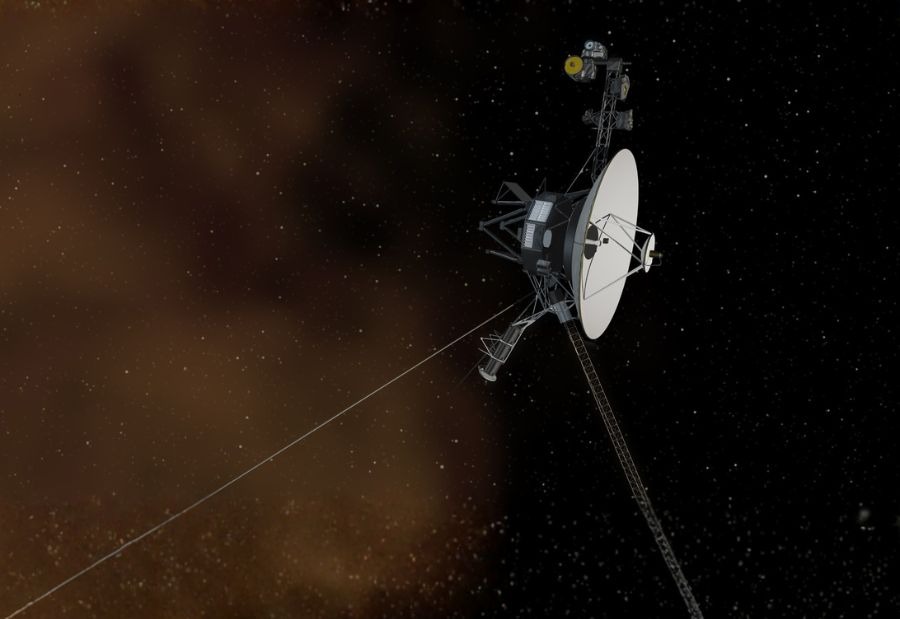
Nearly 50 years after their launch, NASA’s iconic Voyager 1 and Voyager 2 spacecraft are running critically low on power, but engineers are preparing a new strategy that could help extend their scientific missions deeper into interstellar space.
The twin spacecraft, launched in 1977, were originally designed to study the giant planets of the solar system. Today, both probes continue transmitting valuable data long after exceeding their expected operational lifespans. Voyager 1 entered interstellar space in 2012, followed by Voyager 2 in 2018.
Over the years, NASA has gradually shut down several onboard instruments as the probes continue losing around 4 watts of power annually. Each spacecraft initially generated about 470 watts of energy after launch, but current available power levels have dropped significantly.
NASA’s Jet Propulsion Laboratory (JPL) is now preparing an engineering operation called the “Big Bang” to help conserve energy. According to NASA, engineers plan to switch off 3 devices currently keeping the thruster fuel lines from freezing and replace them with 3 alternative devices that perform the same task while consuming nearly 10 watts less power.
If successful, the move could delay the shutdown of at least 1 science instrument on each spacecraft by another year. The test will first be carried out on Voyager 2 during May and June 2026, followed by Voyager 1 later in the summer.
Currently, Voyager 1 operates with 2 active instruments, including a magnetometer and plasma wave subsystem instrument. Voyager 2 still has 3 active instruments running.
Despite aging systems, freezing thruster lines, radiation damage, and declining power supplies, scientists remain optimistic. Suzanne Dodd, Voyager project manager at JPL, earlier stated that the spacecraft could potentially continue operating into the 2030s if conditions remain favorable.
At present, Voyager 1 is nearly 169.8 astronomical units (AU) from Earth, while Voyager 2 is around 143.1 AU away. NASA hopes the probes could eventually reach 200 AU by around 2035.
As the spacecraft approach their 50th anniversary in 2027, the Voyagers continue to represent one of humanity’s longest-running and most remarkable space exploration missions.
Also read: Viksit Workforce for a Viksit Bharat
Do Follow: The Mainstream LinkedIn | The Mainstream Facebook | The Mainstream Youtube | The Mainstream Twitter
About us:
The Mainstream is a premier platform delivering the latest updates and informed perspectives across the technology business and cyber landscape. Built on research-driven, thought leadership and original intellectual property, The Mainstream also curates summits & conferences that convene decision makers to explore how technology reshapes industries and leadership. With a growing presence in India and globally across the Middle East, Africa, ASEAN, the USA, the UK and Australia, The Mainstream carries a vision to bring the latest happenings and insights to 8.2 billion people and to place technology at the centre of conversation for leaders navigating the future.