


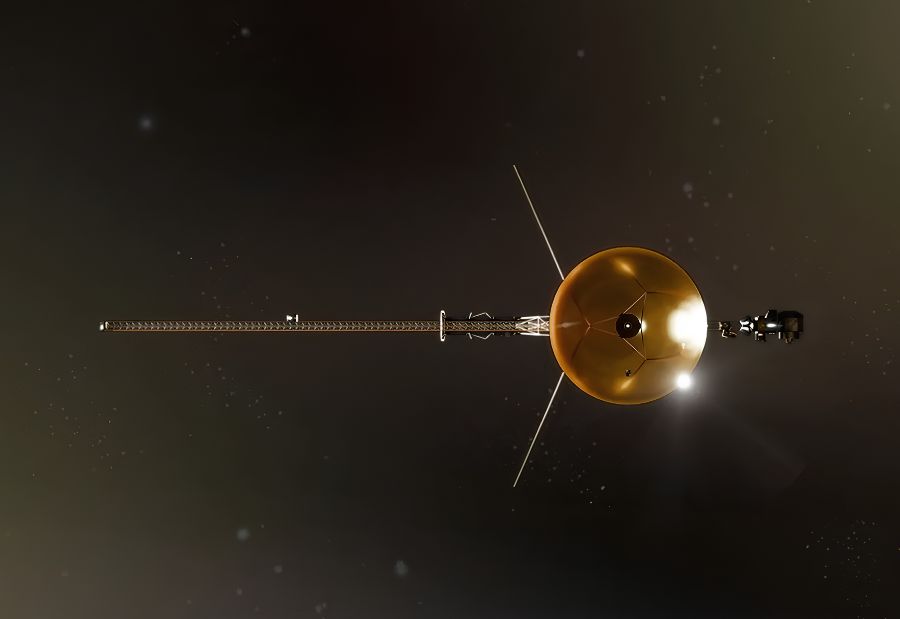
Nearly 50 years after its launch in 1977, NASA’s Voyager 1 is set to reach a major milestone on November 18, 2026, when it will be 1 light-day away from Earth. The spacecraft, recognised as the most distant human-made object, will have travelled more than 16 billion miles (25.9 billion kilometres), meaning light from Earth will take 24 hours to reach it.
To mark the occasion, NASA has announced 2 events inviting the public and media to celebrate the spacecraft’s journey.
On November 17, NASA will organise “Shine Bright for Voyager’s Light-Day”, encouraging people worldwide to create a symbolic wave of golden light after sunset. A dedicated website allows smartphones and tablets to flash “VGR”, Voyager’s call sign, in Morse code. Participants can share photos and videos on social media by tagging @NASA.
More information is available at https://go.nasa.gov/shinebright.
On November 19 at 12 p.m. EST (9 a.m. PST), NASA’s Jet Propulsion Laboratory (JPL) in Southern California will host a moderated discussion featuring mission experts and NASA leadership.
The discussion will cover the operational status of Voyager 1 and Voyager 2, their ongoing scientific observations in interstellar space and the technical challenges of maintaining spacecraft across such vast distances. A question-and-answer session with media representatives and other attendees will follow.
NASA will also preview its upcoming Voyager documentary on NASA+, scheduled for release in 2027 to celebrate the mission’s 50th anniversary.
The event will take place at JPL’s von Kármán Auditorium, which previously hosted mission briefings during the spacecraft’s exploration of the outer planets.
Participants will include Nicky Fox, Associate Administrator of NASA’s Science Mission Directorate; Jonathan Lunine, JPL Chief Scientist and Caltech Professor of Planetary Science; Suzanne Dodd, Voyager Project Manager; Kareem Badaruddin, Voyager Mission Manager; and Jamie Rankin, Voyager Deputy Project Scientist at Princeton University.
The discussion will also be available online through https://www.nasa.gov/live.
US media planning to attend in person must register with Josh Smooha at [email protected] by November 16. Foreign national media seeking onsite credentials must register by November 12, while virtual participants must RSVP at least 2 hours before the event. NASA’s media accreditation policy is available online.
Launched in 1977, Voyager 1 and Voyager 2 were developed to explore the outer planets using a rare planetary alignment that occurs every 176 years.
Voyager 1 entered interstellar space in 2012, followed by Voyager 2 in 2018 along a different trajectory. Both spacecraft continue to collect scientific data beyond the heliosphere, the protective region created by the Sun.
NASA JPL, managed by Caltech in Pasadena, California, built and operates the spacecraft. Its Deep Space Network supports communication with the distant probes, while NASA’s Heliophysics Division funds the mission.
More information: https://science.nasa.gov/mission/voyager/
Also read: Viksit Workforce for a Viksit Bharat
Do Follow: The Mainstream LinkedIn | The Mainstream Facebook | The Mainstream Youtube | The Mainstream Twitter
About us:
The Mainstream is a premier platform delivering the latest updates and informed perspectives across the technology business and cyber landscape. Built on research-driven, thought leadership and original intellectual property, The Mainstream also curates summits & conferences that convene decision makers to explore how technology reshapes industries and leadership. With a growing presence in India and globally across the Middle East, Africa, ASEAN, the USA, the UK and Australia, The Mainstream carries a vision to bring the latest happenings and insights to 8.2 billion people and to place technology at the centre of conversation for leaders navigating the future.