


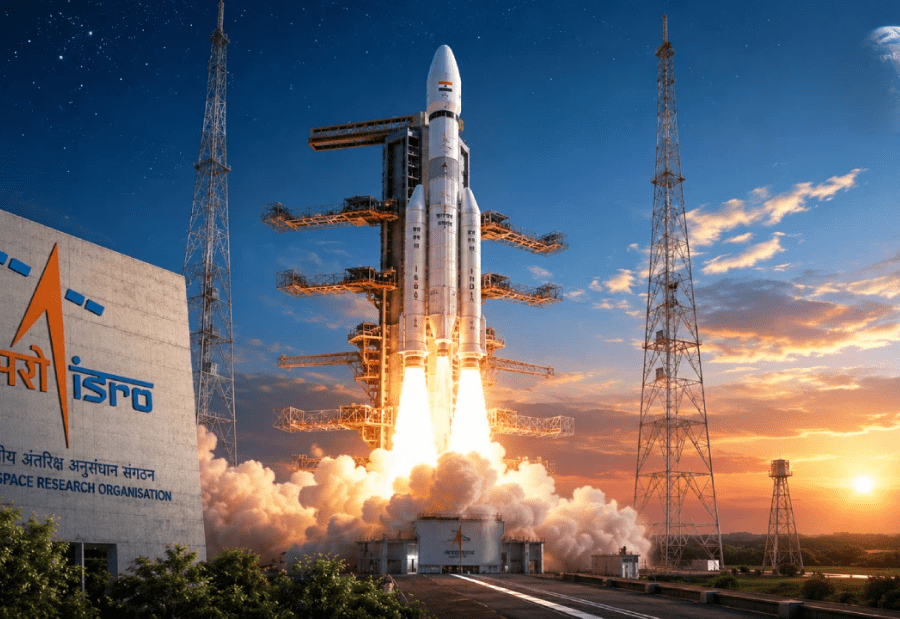
India’s space ambitions are entering a new phase as the Indian Space Research Organisation (ISRO) accelerates work on two major deep-space missions—Chandrayaan-4 and the Venus Orbiter Mission (VOM). Both projects are central to the country’s Space Vision 2047 roadmap, which aims to establish the Bharatiya Antariksha Station (BAS) by 2035 and achieve an indigenous crewed lunar landing by 2040.
Unlike earlier missions focused on single spacecraft operations, these upcoming programs will rely on advanced orbital maneuvers, autonomous docking, modular spacecraft architecture and complex deep-space logistics. The technologies being developed are also expected to serve as critical building blocks for future human spaceflight missions.
ISRO’s exploration strategy is based on comparative planetology, using the Moon and Venus to better understand the evolution of the solar system. While the Moon remains a near-vacuum environment with extreme temperature variations, Venus presents one of the most hostile planetary environments, with surface temperatures of around 457°C and atmospheric pressure nearly 92 times that of Earth.
Scheduled for launch in March 2028 aboard the LVM-3 launch vehicle, the Venus Orbiter Mission has an estimated budget of Rs 1,236 crore. The spacecraft will initially enter a highly elliptical orbit around Venus before gradually lowering its orbit through a 6-to-8-month aerobraking campaign. This technique will use the planet’s upper atmosphere to reduce speed while conserving fuel.
The mission will carry multiple scientific instruments designed to study Venus’ surface, atmosphere, ionosphere and geological activity. These payloads will support investigations into volcanic activity, atmospheric composition, thermal dynamics, solar wind interactions and subsurface structures. Data collected during the mission will be transmitted through the Indian Deep Space Network and processed at the Indian Space Science Data Centre.
Meanwhile, Chandrayaan-4 represents one of ISRO’s most ambitious lunar projects to date. The mission aims to return 2 to 3 kilograms of lunar samples from the Moon’s South Polar Region, an area of significant scientific interest due to the presence of permanently shadowed regions and potentially preserved ancient materials.
To overcome payload limitations, Chandrayaan-4 will be launched in 2 separate LVM-3 missions. The spacecraft components will assemble and dock autonomously in Earth orbit before beginning their journey to the Moon. After landing near the lunar South Pole, robotic systems will collect surface and subsurface samples for return to Earth.
A key objective of the mission is to validate technologies required for future human lunar missions, including autonomous lunar liftoff, orbital rendezvous and docking, precision navigation and high-speed Earth re-entry. These capabilities are considered essential for safely transporting astronauts to and from the lunar surface.
The mission will also support the development of advanced sample curation facilities in India, enabling scientists to analyze lunar materials in ultra-clean laboratory environments. In parallel, ISRO plans to expand access to mission data through research programs, workshops and academic collaborations aimed at strengthening India’s scientific ecosystem.
Together, Chandrayaan-4 and the Venus Orbiter Mission represent major steps toward India’s long-term goal of building indigenous capabilities across deep-space exploration, planetary science and human spaceflight.
Also read: Viksit Workforce for a Viksit Bharat
Do Follow: The Mainstream LinkedIn | The Mainstream Facebook | The Mainstream Youtube | The Mainstream Twitter
About us:
The Mainstream is a premier platform delivering the latest updates and informed perspectives across the technology business and cyber landscape. Built on research-driven, thought leadership and original intellectual property, The Mainstream also curates summits & conferences that convene decision makers to explore how technology reshapes industries and leadership. With a growing presence in India and globally across the Middle East, Africa, ASEAN, the USA, the UK and Australia, The Mainstream carries a vision to bring the latest happenings and insights to 8.2 billion people and to place technology at the centre of conversation for leaders navigating the future.