


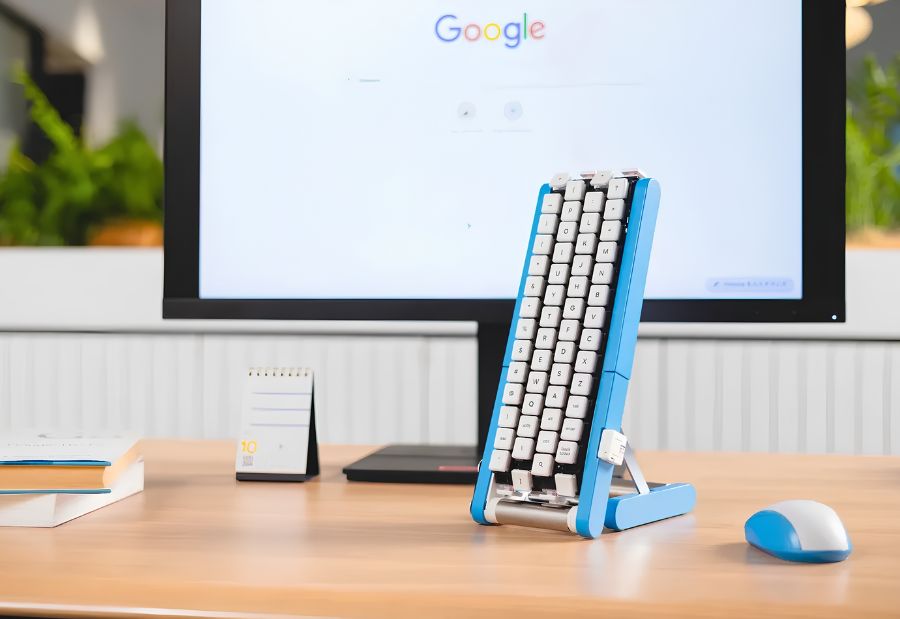
In an unconventional take on everyday typing, Google Japan has developed a working keyboard that brings keys to users instead of making them move their fingers across a fixed layout. The experimental device uses conveyor belts to move keys into position, allowing people to type with just 1 hand or even a single finger.
The invention was unveiled on October 1 as part of Google’s annual Keyboard Day tradition. However, it will not be available for commercial purchase. One YouTube commenter described it as an April Fools video uploaded 6 months late, reflecting the team’s tradition of turning unusual ideas into fully functional devices.
The keyboard has 4 vertically arranged conveyor belts, with 29 keys on each belt, bringing the total to 116 moving keys. Users must wait for the required key to reach the right position and tap it at the correct moment. Uppercase and lowercase letters are available directly. This design also leaves the other hand free to drink coffee, use a mouse, or operate a second conveyor-belt keyboard.
Google Japan has also suggested several possible improvements. These include a high-speed mode to test hand-eye coordination, a voice guide that announces keys as they pass, longer and shorter versions, and cardboard keycaps for users who want to file their nails while typing. However, correcting mistakes may take patience, as users must wait for the Backspace key to come around again.
Although the device will not be sold commercially, Google Japan has released its design as open source on GitHub. This allows interested users to build their own version.
The choice of October 1 is part of the concept. The date, written as “10/1”, represents the standard 101-key keyboard layout. Every year, the team celebrates Keyboard Day by creating working solutions to problems that do not really exist.
The conveyor-belt keyboard is the latest addition to a long line of experimental designs. In 2025, Google Japan introduced a rotary dial Gboard inspired by old telephone hardware, requiring users to turn concentric dials to select letters. In 2024, the Double-Sided Gboard featured 208 keys across 26 connected modules arranged in a Möbius-strip-inspired loop. It could be used from different angles or by multiple people at once.
Earlier experiments included the head-mounted CAPS keyboard in 2023, the extra-long Bar version in 2022, and the Teacup keyboard in 2021. Other projects explored spoon-bending and physical handwriting. The series began in 2012 with a single-key Morse-code keyboard.
The 2026 conveyor-belt design is officially the 15th installment in the series. While Google Japan continues to experiment with new keyboard concepts, its latest creation suggests that making typing more complicated can sometimes be the main attraction.
Also read: Viksit Workforce for a Viksit Bharat
Do Follow: The Mainstream LinkedIn | The Mainstream Facebook | The Mainstream Youtube | The Mainstream Twitter
About us:
The Mainstream is a premier platform delivering the latest updates and informed perspectives across the technology business and cyber landscape. Built on research-driven, thought leadership and original intellectual property, The Mainstream also curates summits & conferences that convene decision makers to explore how technology reshapes industries and leadership. With a growing presence in India and globally across the Middle East, Africa, ASEAN, the USA, the UK and Australia, The Mainstream carries a vision to bring the latest happenings and insights to 8.2 billion people and to place technology at the centre of conversation for leaders navigating the future.