


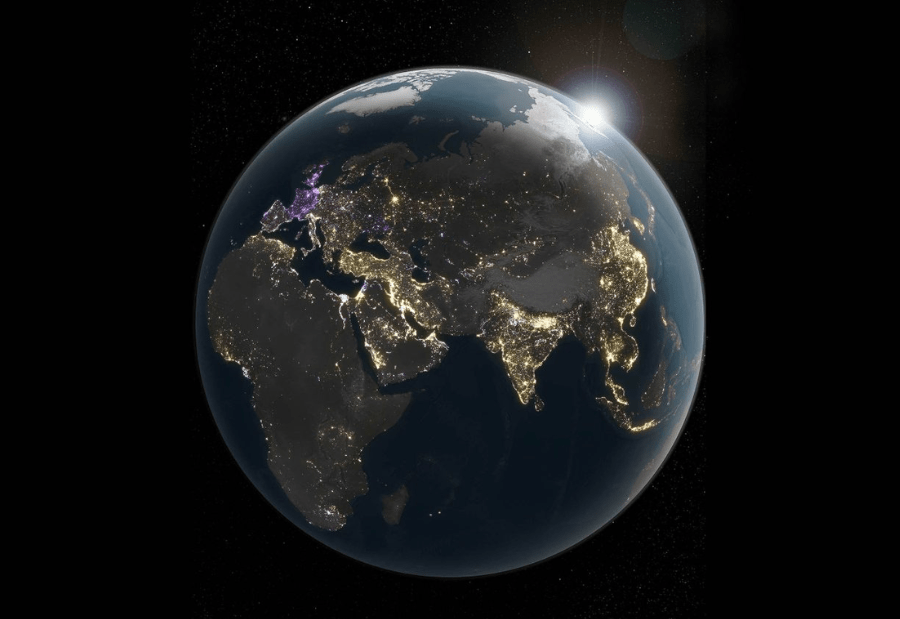
A new global analysis using daily satellite imagery shows that Earth’s night-time lights are far more dynamic than previously understood, reflecting rapid changes in human activity, infrastructure, and policy.
Using data from NASA’s Black Marble project, researchers analysed over a million nightly satellite images captured between 2014 and 2022. The findings reveal that illuminated regions frequently brightened and dimmed over short periods, rather than following a steady upward or downward trend.
Led by Christopher Kyba of Ruhr University Bochum, the study shows how local fluctuations combine into a global pattern of constant change. Over time, gains in some regions were often offset by declines in others, making global averages less meaningful.
To improve accuracy, researchers used daily observations instead of traditional monthly or yearly averages, while correcting for viewing angles. This helped capture short-term shifts that were previously overlooked.
In regions such as eastern China, India, and parts of Africa, night-time brightness increased due to urban expansion and improved access to electricity. Southern India showed sustained growth, while northern regions brightened earlier through rural electrification and street-lighting initiatives.
In contrast, Europe recorded an overall 4% decline in night light levels. France saw a sharp 33% drop, largely due to reduced street lighting for energy savings. Germany remained relatively stable, as increases and decreases balanced out.
The dataset also captured major global events. During the COVID-19 pandemic in 2020, industrial zones dimmed sharply. Later, Ukraine experienced significant darkening following the Russian invasion, while Europe’s 2022 energy crisis caused further declines.
The study highlights how night-time light can act as a real-time indicator of economic activity, infrastructure stress, and societal disruption. However, dimming does not always signal positive outcomes. Countries like Venezuela saw declines due to economic collapse and unreliable power, while South Africa experienced repeated dimming from rolling blackouts.
Each satellite pixel in the dataset represents about 0.5 sq km, capturing detailed activity across cities, ports, and highways. The sensors measure radiance while filtering out natural light sources such as fires and auroras.
Beyond infrastructure insights, the study also points to environmental concerns. Artificial light at night can disrupt ecosystems, affecting animal behaviour, plant growth, and biodiversity.
Looking ahead, initiatives like European Space Agency’s Night Watch project aim to improve monitoring with higher sensitivity and resolution, helping better distinguish between causes of change.
The findings suggest that night-time light is a powerful but complex indicator of global change—one that reflects growth, disruption, and adaptation in equal measure.
Also read: Viksit Workforce for a Viksit Bharat
Do Follow: The Mainstream LinkedIn | The Mainstream Facebook | The Mainstream Youtube | The Mainstream Twitter
About us:
The Mainstream is a premier platform delivering the latest updates and informed perspectives across the technology business and cyber landscape. Built on research-driven, thought leadership and original intellectual property, The Mainstream also curates summits & conferences that convene decision makers to explore how technology reshapes industries and leadership. With a growing presence in India and globally across the Middle East, Africa, ASEAN, the USA, the UK and Australia, The Mainstream carries a vision to bring the latest happenings and insights to 8.2 billion people and to place technology at the centre of conversation for leaders navigating the future.