


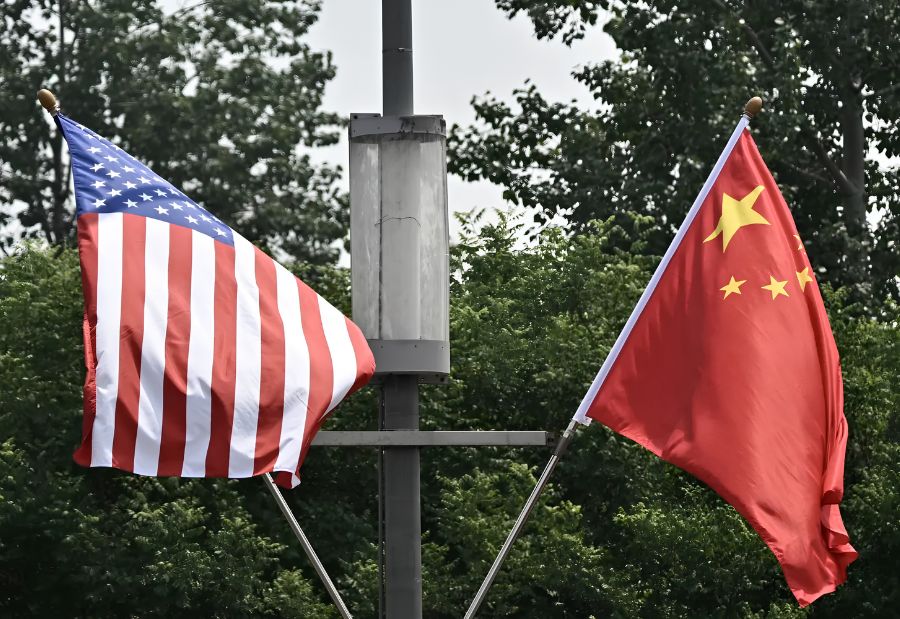
Despite growing efforts by Washington to limit China’s technological influence, Chinese companies are becoming increasingly important technology partners for major global businesses. Their role is expanding across artificial intelligence, electric vehicles, batteries and other technology sectors.
Apple has partnered with Alibaba and Baidu for AI services in China, while Ford is working with CATL on battery technology. Volkswagen has joined forces with Xpeng on smart electric vehicles in China, and Stellantis is expanding its partnership with Leapmotor for EV production and joint purchasing.
Analysts say the relationship between global companies and Chinese technology firms is shifting from manufacturing dependence to technology and innovation partnerships.
“Five years ago, China was primarily where global companies went to sell. Today, in certain sectors, it is where they go to source capability,” said Kitty Fok, managing director at IDC China.
The trend is developing despite tighter US restrictions on Chinese technology. Since 2019, Washington has imposed restrictions on advanced chips and chipmaking equipment, limited certain US investments in Chinese semiconductors, quantum technology and AI, and placed companies such as Semiconductor Manufacturing International Corporation (SMIC) under restrictions.
China has built strong positions across several technology industries. Automakers including BYD, Changan and Chery accounted for nearly 63% of the global electric vehicle market in 2025, while battery manufacturers including CATL, BYD, CALB and Gotion held close to 70%, according to Counterpoint Research analyst Soumen Mandal.
Mandal said cost, scale, manufacturing capabilities, supply-chain integration and rapid innovation are encouraging global companies to continue working with Chinese firms.
“China’s technological rise is shifting from low-cost manufacturing to scale, supply-chain depth, and speed of innovation,” he said.
The shift is especially visible in EV batteries. Ford is working with CATL to use its lithium-iron phosphate battery technology at a $3.5 billion battery plant in Michigan.
“In EV batteries, the structural shift is already complete,” Fok said. “Switching suppliers is not a procurement decision you make in a quarter. It takes years of engineering, testing, and recertification.”
For companies operating in China, partnerships with local technology providers are sometimes driven by market access. Fok said multinational companies requiring AI services or cloud infrastructure in China have to work with local providers because of restrictions on foreign services.
“Inside China, a lot of this isn’t a choice,” she said, referring to Apple’s partnerships with Alibaba and Baidu.
Lian Jye Su, chief analyst at Omdia, said access to the Chinese market remains a major reason for such partnerships, particularly among automakers seeking software, AI and other technologies for vehicles sold in China.
However, Su also sees a “slow yet persistent structural shift” in global supply chains and innovation across batteries, EVs, energy storage and applied AI.
Chinese AI models are also gaining attention. An IDC survey of European companies found that security and compliance requirements and stronger performance were the top reasons for extensive adoption of Chinese AI models, rather than lower costs.
“So the popular narrative that Western companies are rushing to Chinese AI because it’s cheap gets this backwards,” Fok said. “The decision is performance-led and compliance-gated.”
Chinese companies including Alibaba and DeepSeek have also focused on open-source AI models, increasing access for developers globally.
US technology restrictions have limited China’s access to advanced semiconductors, but analysts say they have also encouraged domestic innovation.
“The key impact of the U.S. restriction is that it has become a catalyst for Chinese domestic innovation and efficiency,” Su said.
However, geopolitical concerns continue to influence adoption. Resistance is expected to remain stronger in areas linked to advanced semiconductors, cybersecurity, defence and national security.
Analysts expect Chinese technology adoption to expand across EVs, batteries, consumer electronics, robotics, drones and selected AI and semiconductor applications. Mandal described the outcome as “a more fragmented but pragmatic global technology ecosystem.”
Fok said the shift is already structural in batteries and electronics manufacturing, while AI remains in transition and automotive software is still at an early stage.
Also read: Viksit Workforce for a Viksit Bharat
Do Follow: The Mainstream LinkedIn | The Mainstream Facebook | The Mainstream Youtube | The Mainstream Twitter
About us:
The Mainstream is a premier platform delivering the latest updates and informed perspectives across the technology business and cyber landscape. Built on research-driven, thought leadership and original intellectual property, The Mainstream also curates summits & conferences that convene decision makers to explore how technology reshapes industries and leadership. With a growing presence in India and globally across the Middle East, Africa, ASEAN, the USA, the UK and Australia, The Mainstream carries a vision to bring the latest happenings and insights to 8.2 billion people and to place technology at the centre of conversation for leaders navigating the future.