


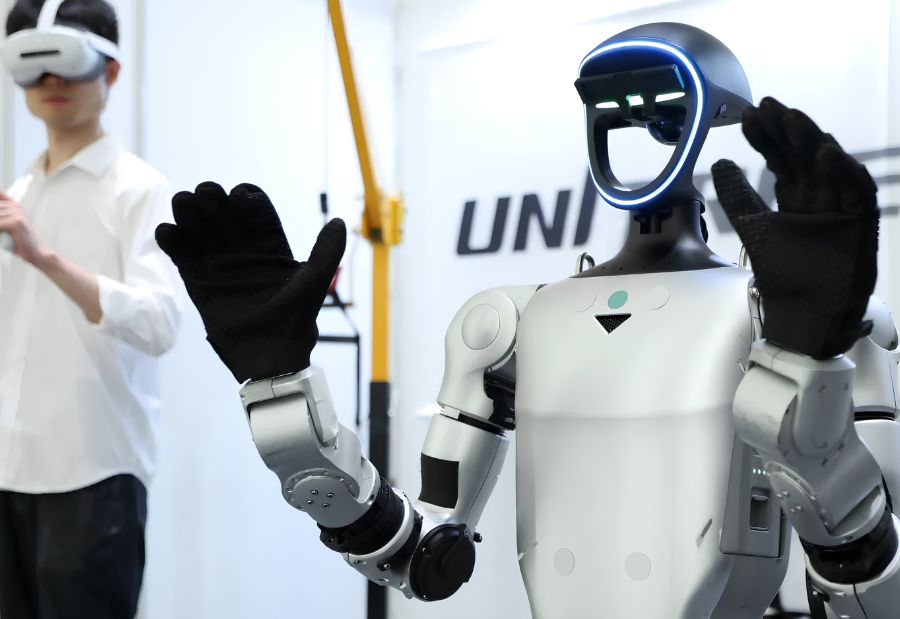
China’s humanoid robotics sector is attracting strong investor interest, but questions remain over whether these machines can move beyond impressive demonstrations and deliver commercially useful work at scale. Unitree Robotics is at the centre of that debate as it prepares for its mainland listing.
The Hangzhou-based startup priced its IPO at 150.8 yuan ($22.4) per share, raising $900 million and valuing the company at 61 billion yuan, or around $9 billion.
Investors are expecting a strong debut when Unitree begins trading on Shanghai’s STAR market later this month. It will become the first humanoid robotics company to list on the mainland.
The IPO generated record retail demand, with the online offering oversubscribed more than 5,000 times and a lot-winning rate of just 0.018%. Strategic investors, including AI startup DeepSeek, also participated.
A Unitree-linked pre-IPO perpetual contract on Hyperliquid was trading at around 4 times the IPO price on Friday, reflecting strong speculative interest before the stock begins trading.
Unitree has gained attention for robots capable of kung fu kicks, dancing and recovering from falls. However, analysts question whether the technology is ready for widespread commercial use.
“For these humanoid robots, to be honest, they’re fascinating. They can dance and all that – but never seen them doing any real housework,” said Hao Hong, managing partner of Lotus Asset Management.
Unitree warned in its prospectus that large-scale commercial adoption could take longer than expected because robotic hands are not yet sufficiently precise or durable for sustainable use.
Dominik Pross, equity analyst at VP Bank, said advanced humanoid robots can typically perform only a limited number of tasks and operate for a few hours before requiring a recharge. Most models can run for up to 4 hours while sitting idle.
“Robots have to be specifically trained for each and every task entrusted to them, even the simplest,” he said.
More robotics companies are also preparing to list. Unitree rivals AgiBot and Leju Robotics are seeking listings in Hong Kong and Shenzhen, respectively. LimX Dynamics founder Will Zhang previously said, “listing is a must.”
China’s manufacturing scale has helped it gain a strong position in robotics. Wood Mackenzie expects the global humanoid robot fleet to grow by more than 90% annually through 2035, exceeding 10 million units. Annual shipments could surpass 4 million by then.
China already accounts for more than 70% of global industrial robot installations and nearly 90% of humanoids deployed in 2025, according to Wood Mackenzie.
Average humanoid robot prices fell 93% between 2020 and 2025 to $58,000. Unitree’s $16,000 G1 model is estimated to cost about $82 a year in electricity when operated for 8 hours daily.
SemiAnalysis estimates Unitree has reduced the pre-tax price of its G1 EDU research model by more than 45% since last year to $27,300, while maintaining a 67% gross margin.
Lower prices and Chinese government support are driving interest in the sector. However, analysts say proving the return on investment will take time.
Unitree’s revenue more than quadrupled last year, but its 1st-quarter adjusted profit fell more than 52% as research and development and marketing spending increased.
A large share of current demand remains linked to research and demonstrations. Nearly 3/4 of Unitree’s humanoid revenue came from research and education during the 1st 9 months of 2025, while corporate tours accounted for more than half of its still-small industrial business.
“Unlike many early-stage robotics companies, the Unitree story is backed by real revenue growth,” said Jeff Ko, chief analyst at CoinEx. However, he noted that the company’s $9 billion valuation, more than 200 times last year’s earnings, reflects a speculative element.
The IPO interest has continued despite the US moving last month to ban imports of foreign-made humanoid and 4-legged robots. Unitree could be particularly exposed, with 13% of its revenue coming from the US last year, according to Smart Analytics Global.
Unitree robots are widely used in research at US universities, while some small-batch imports for testing and development remain exempt from the restrictions. Its 4-legged robots have also been used in US state correctional systems and military settings, according to the House Select Committee on China.
Another risk is potential restrictions on access to Nvidia hardware and software. Chinese robotics companies remain dependent on Western components, while China’s dominance in rare earths used in robotic motors and actuators provides a strategic advantage.
Despite the challenges, the potential market has attracted major players. Tesla CEO Elon Musk is also expanding its robotics ambitions, with production of Optimus humanoid robots expected to begin later this year.
Researchers also point out that Unitree’s opportunity extends beyond humanoids. Its quadruped robots remain a significant part of the business and can be cheaper and more reliable for repetitive industrial tasks, while humanoids may be better suited to unpredictable and less structured environments.
Also read: Viksit Workforce for a Viksit Bharat
Do Follow: The Mainstream LinkedIn | The Mainstream Facebook | The Mainstream Youtube | The Mainstream Twitter
About us:
The Mainstream is a premier platform delivering the latest updates and informed perspectives across the technology business and cyber landscape. Built on research-driven, thought leadership and original intellectual property, The Mainstream also curates summits & conferences that convene decision makers to explore how technology reshapes industries and leadership. With a growing presence in India and globally across the Middle East, Africa, ASEAN, the USA, the UK and Australia, The Mainstream carries a vision to bring the latest happenings and insights to 8.2 billion people and to place technology at the centre of conversation for leaders navigating the future.