


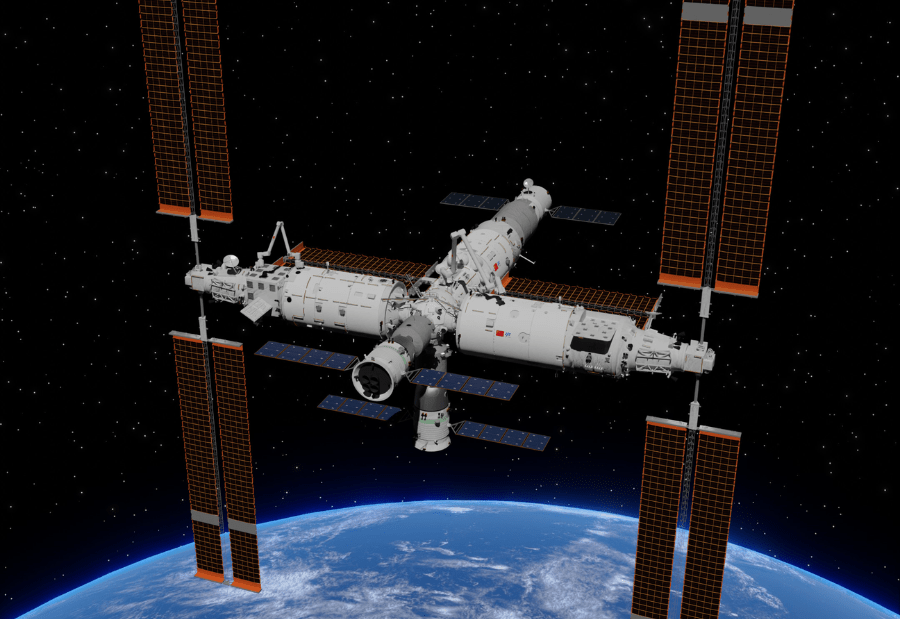
As the global space landscape prepares for a major transition, China is moving ahead with plans to expand its Tiangong space station, positioning itself strongly in low Earth orbit ahead of the International Space Station’s retirement in 2030.
China’s orbital laboratory is already nearing capacity due to rising international payloads and a more diverse crew lineup. Future missions are expected to include participants from Pakistan, Hong Kong and Macau, reflecting a broader global engagement strategy.
While the US is yet to finalize a replacement for the ISS, China has steadily advanced its presence in orbit. The current T-shaped Tiangong structure is set to evolve into a cross-shaped configuration, eventually expanding into a 6-module system. This includes the addition of a new multifunctional module, larger than the existing core.
The expansion will begin with an extension to the Tianhe core, designed as a central hub. This module will feature multiple docking ports, a dedicated airlock for spacewalks and act as the base for 2 additional laboratory modules. Once completed, the station’s total mass is expected to reach around 180 tonnes (198 tons), significantly increasing its research and habitation capacity.
To support this expansion, China is upgrading its launch and assembly capabilities. A more powerful version of the Long March 5B rocket with a larger payload fairing is expected to play a key role. Engineers are also enhancing robotic arms to handle more complex assembly and maintenance operations.
Since becoming operational in 2022, Tiangong has hosted over 24 astronauts and supported more than 260 experiments. It also set a new spacewalk record of 9 hours, 6 minutes, surpassing a previous record of 8 hours and 56 minutes that stood for 22 years.
China is also expanding access to its station. While international collaboration with China remains restricted for NASA, Beijing is positioning Tiangong as a “global laboratory” open to wider participation.
Designed to operate for 15 years, Tiangong could become the only active space station in low Earth orbit after the ISS is deorbited by SpaceX in 2030.
Also read: Viksit Workforce for a Viksit Bharat
Do Follow: The Mainstream LinkedIn | The Mainstream Facebook | The Mainstream Youtube | The Mainstream Twitter
About us:
The Mainstream is a premier platform delivering the latest updates and informed perspectives across the technology business and cyber landscape. Built on research-driven, thought leadership and original intellectual property, The Mainstream also curates summits & conferences that convene decision makers to explore how technology reshapes industries and leadership. With a growing presence in India and globally across the Middle East, Africa, ASEAN, the USA, the UK and Australia, The Mainstream carries a vision to bring the latest happenings and insights to 8.2 billion people and to place technology at the centre of conversation for leaders navigating the future.